Officials, researchers and providers press for sustained funding, rate reform in state preschool expansion
Loading...
Summary
Researchers and agency officials told lawmakers California has expanded preschool access but faces gaps for 2‑ and 3‑year‑olds, one‑time funding that will sunset and a workforce paid far less than K‑12 peers; community providers urged making 2‑year‑old flexibility permanent and switching to enrollment‑based reimbursement to stabilize programs.
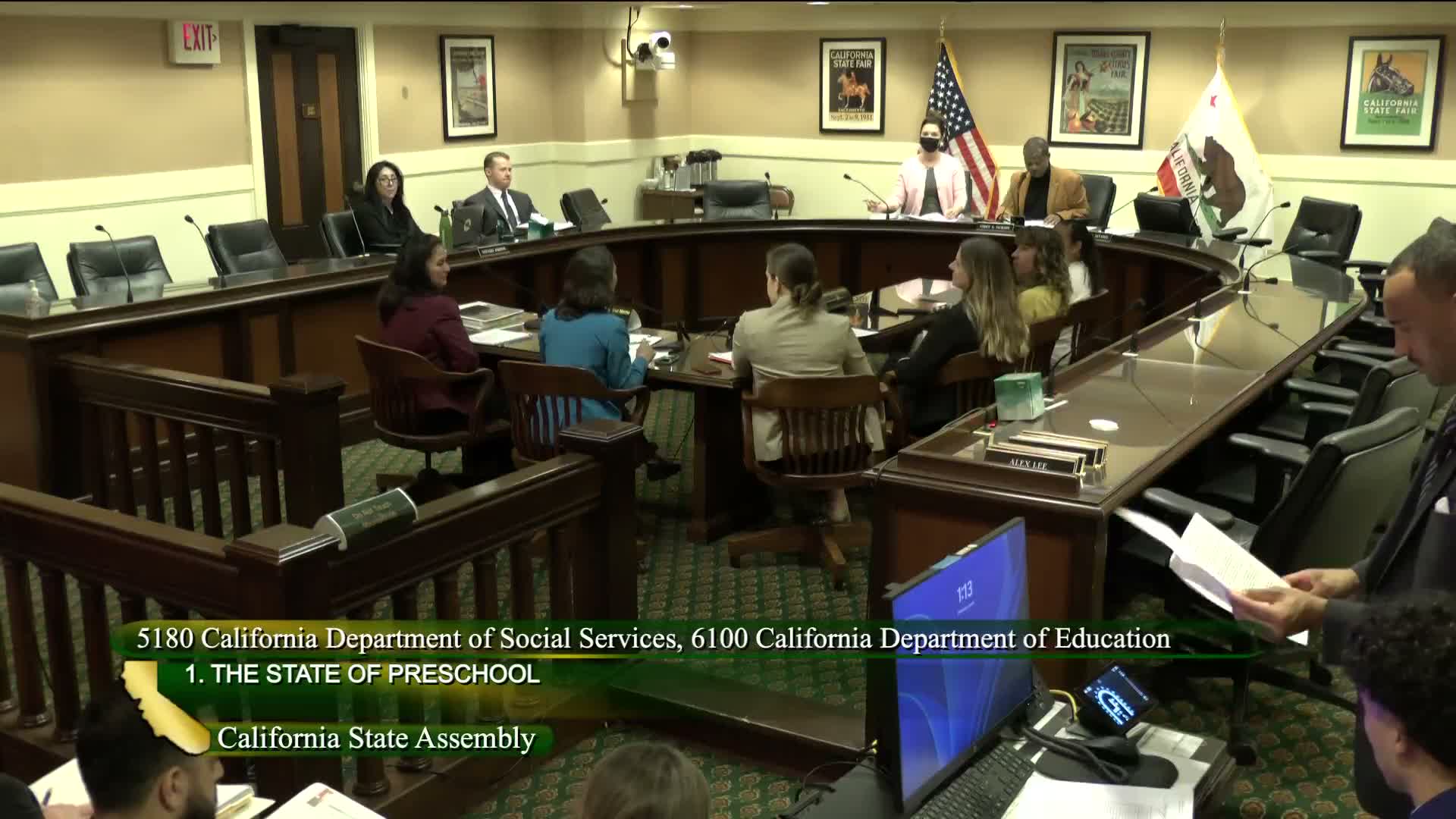
Chair opened the joint Assembly hearing on early childhood funding by summarizing the governor’s January budget, noting a $3 billion proposed investment for state preschool with $2 billion in Proposition 98 for LEA programs and $1 billion for non‑LEA programs.
Hannah Melnick of the Learning Policy Institute said California has substantially expanded access to public preschool: “we went from serving just 42% of our 4 year olds in 2019 to 62% last year across our public programs.” She told the committees that increasing access for 3‑year‑olds, improving application and enrollment systems, funding facility conversions and closing a preschool‑teacher pay gap must be priorities to reach the master‑plan goals.
State Department of Social Services deputy director Lupe Jaime Milam described CDSS’s role in mixed‑delivery implementation and cited recent growth in funded slots and spending. “We have nearly doubled the funding in regards to the Child Care and Development Program going from $3,300,000,000 … to 6,600,000,000,” she said, and pointed to large percentage increases in enrollment for 2‑ and 3‑year‑olds under the multi‑year slot expansion.
Kimberly Rosenberger, speaking for the State Superintendent of Public Instruction, said CDE currently serves roughly 300,000 preschool‑age children across TK, state preschool and community settings and flagged that some temporary allowances — notably the provision allowing state preschool contractors to serve 2‑year‑olds — expire on June 30, 2027. She told the panel that expanding 2‑year‑old access and supporting full‑day, full‑year seats will be costly and that some community‑based organizations will need non‑Proposition 98 funds to operate those programs.
Community providers described operational challenges during rapid expansion. Melanie Dotson, CEO of 4Cs Sonoma County, said her agency’s budget and staff scaled dramatically from 2020 to 2025 and that many sites remain fragile: “We now serve more than 3,500 children annually… Yet still today, we also maintain an eligibility list of more than 1,900 children.” Andrea Fernandez Mendoza of California Children’s Academy urged the Legislature to protect CCTR investments, to make the CSPP 2‑year‑old flexibility permanent and to adopt enrollment‑based reimbursement with a flex factor so programs can plan and cover fixed costs.
Parents and provider advocates urged the Legislature to preserve one‑time investments that supported outreach, planning and teacher development and to convert successful short‑term programs into ongoing funding streams. Multiple witnesses warned that rolling back temporary funds or allowing key provisions to sunset would destabilize centers and the mixed‑delivery system just as enrollment has expanded.
The panel concluded with members asking agencies for more granular data — including what percentage of slots meet full‑day, full‑year needs and how many of the 300,000 served have placements that support parental employment — before the May revision of the budget.