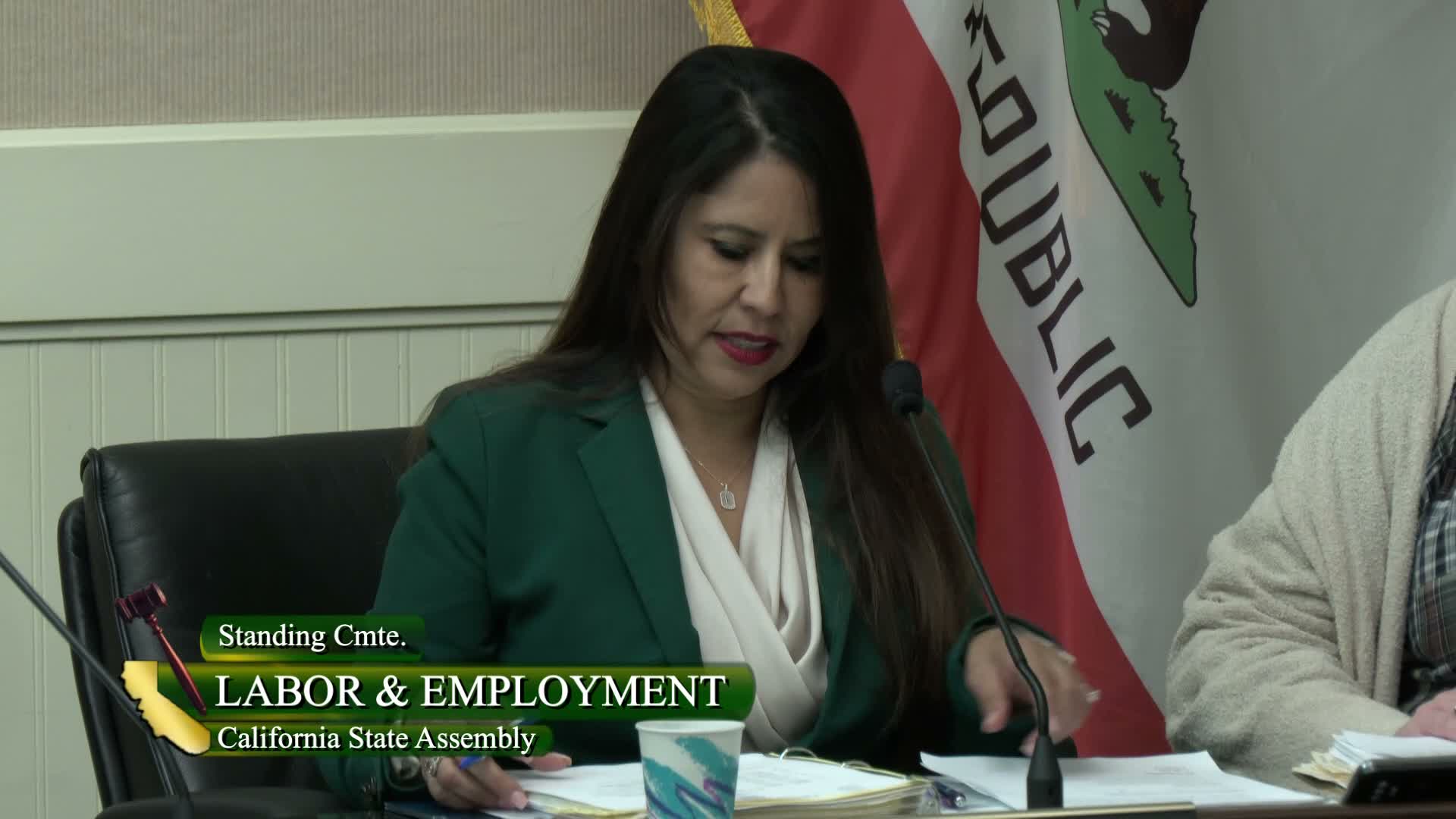
Assembly Labor Committee advances package of worker‑protection, CalOSHA and AI bills
Loading...
Summary
The California Assembly Labor and Employment Committee advanced a series of bills addressing employer coercion of immigrant workers, behavioral‑health pay data, support for displaced refinery workers, Cal/OSHA staffing and multiple AI and worker‑data protections; supporters urged stronger enforcement while business groups raised concerns about scope and administrative burdens.
The Assembly Labor and Employment Committee advanced a broad slate of labor bills at a subcommittee hearing that included detailed testimony from unions, advocates, workers and industry representatives.
The committee voted to move measures that would expand protections against immigration‑related employer coercion (AB 24 95), fund studies into behavioral‑health pay disparities (AB 25 11), make a displaced oil‑and‑gas worker pilot permanent (AB 21 57), study Cal/OSHA inspector vacancies and recruitment (AB 24 88), and create or refine multiple rules tied to artificial intelligence and worker data (AB 25 45, AB 20 27, AB 25 75 and AB 26 53). Several bills passed the subcommittee and were referred to policy and appropriations committees for further consideration.
Why it matters: Committee members and witnesses framed the package as an attempt to protect workers at a time of technological change and industry consolidation. Supporters argued the bills close enforcement gaps, protect vulnerable workers from coercion and promote transparency where private sector practices may harm labor standards. Opponents, largely from employer groups and some public‑sector associations, said several proposals are too broad, raise data‑security or procurement implementation challenges, or would impose heavy reporting burdens.
Advocates, enforcement gaps and employer coercion "In this political climate, undocumented workers must take real and significant risks when they step forward to assert their workplace rights," a Legal Aid at Work representative told the committee in support of AB 24 95, which the author said would make immigration‑related threats unlawful at any point during employment. June Trujillo, identified in the record as CHIRLA's director of workers' rights and labor legal services, described repeated patterns of coercion at poultry plants and other worksites and urged codifying a distinct coercion subsection so those workers receive protection.
Behavioral‑health pay study and industry pushback Supporters of AB 25 11 said a study by the Department of Industrial Relations would show whether behavioral‑health providers are paid significantly less than medical‑surgical clinicians and how that gap affects network participation and access. "When forced out of network, families face average balance bills of $861 per episode," Ben Eichert, public policy director for the National Union of Healthcare Workers, said in testimony urging passage. Hospital and provider groups cautioned that the bill could layer on new reporting requirements and expose proprietary payment data, and asked for further negotiation.
Cal/OSHA staffing and enforcement Lawmakers discussed long‑standing staffing shortfalls at Cal/OSHA and enforcement practices flagged in an auditor's report. AB 24 88 would require a data‑driven study of inspector vacancies and new workforce pathways; lawmakers and union witnesses argued the bill is needed to rebuild inspection capacity and protect high‑risk workers.
AI and worker protections Multiple measures on the agenda would address AI's impact on jobs and worker data. AB 25 45 would create an EDD assessment of AI's labor impacts; AB 20 27 would limit employers' collection and use of worker data and bar using it to train AI intended to automate jobs; and AB 25 75 would require AI tools in health care to carry clear disclosure labels and protect clinicians who override AI recommendations. "When an AI tool goes awry because of the developers or an employer's failure to develop safeguards, someone can try to hold them liable," Diane McClure, a registered nurse testifying for the California Nurses Association, said in support of AB 25 75.
Votes at a glance (subcommittee actions) - AB 24 95 — Expanded prohibition on immigration‑related coercion: advanced by the subcommittee; referred to committee on judiciary. - AB 25 11 — Study of behavioral‑health pay disparities: filed and referred to committee on health. - AB 21 57 — Permanence for the displaced oil & gas worker pilot (DOGWOoF): passed and referred to appropriations. - AB 25 30 — 60‑day notice for certain public‑employer layoffs (state WARN alignment): passed as amended and referred to judiciary. - AB 24 88 — Workplace Safety Inspector Study (Cal/OSHA): passed and referred to appropriations. - AB 25 45 — AI worker impact data assessment (EDD study): passed and referred to privacy & consumer protection. - AB 20 27 — Worker data protections and limits on using worker data to train AI: passed and referred to privacy & consumer protection. - AB 20 95 — Fair Chance Act amendments (ban‑the‑box clarification): passed and referred to judiciary. - AB 26 53 — Sweatshop‑free AI procurement provisions: passed and re‑referred to privacy & consumer protection. - AB 23 21 — Cal/OSHA enforcement: authorizes public prosecutors in serious cases (upon appropriation): passed and referred to appropriations. - AB 25 75 — Healthcare AI safeguards (nutrition label, anti‑retaliation, liability rules): passed and referred to privacy & consumer protection.
What was contested: Employer groups and several public agency associations repeatedly raised concerns about broad or vague definitions (particularly for "worker data" and "AI products") and potential administrative or competitive harms from new disclosure and procurement rules. Supporters countered that targeted definitions and technical fixes can be negotiated as bills move through subsequent committees.
Next steps: All advanced bills will move to their next assigned committee (Appropriations, Health, Judiciary, Privacy & Consumer Protection) for further review, fiscal analysis and potential amendments. The subcommittee left several votes 'open' for absentee members in keeping with standard committee practice.
The hearing record includes detailed testimony from union and advocacy witnesses, affected workers and industry stakeholders; many speakers urged lawmakers to refine definitions but to retain the core protections for workers.