California lawmakers hear pleas to stabilize gender-affirming care as hospitals withdraw services
Loading...
Summary
At a joint Senate–Assembly budget hearing, state officials, clinicians and families described hospital program closures and provider shortages tied to federal actions and urged lawmakers to approve a $26 million one‑time request to stabilize access for youth and families in California.
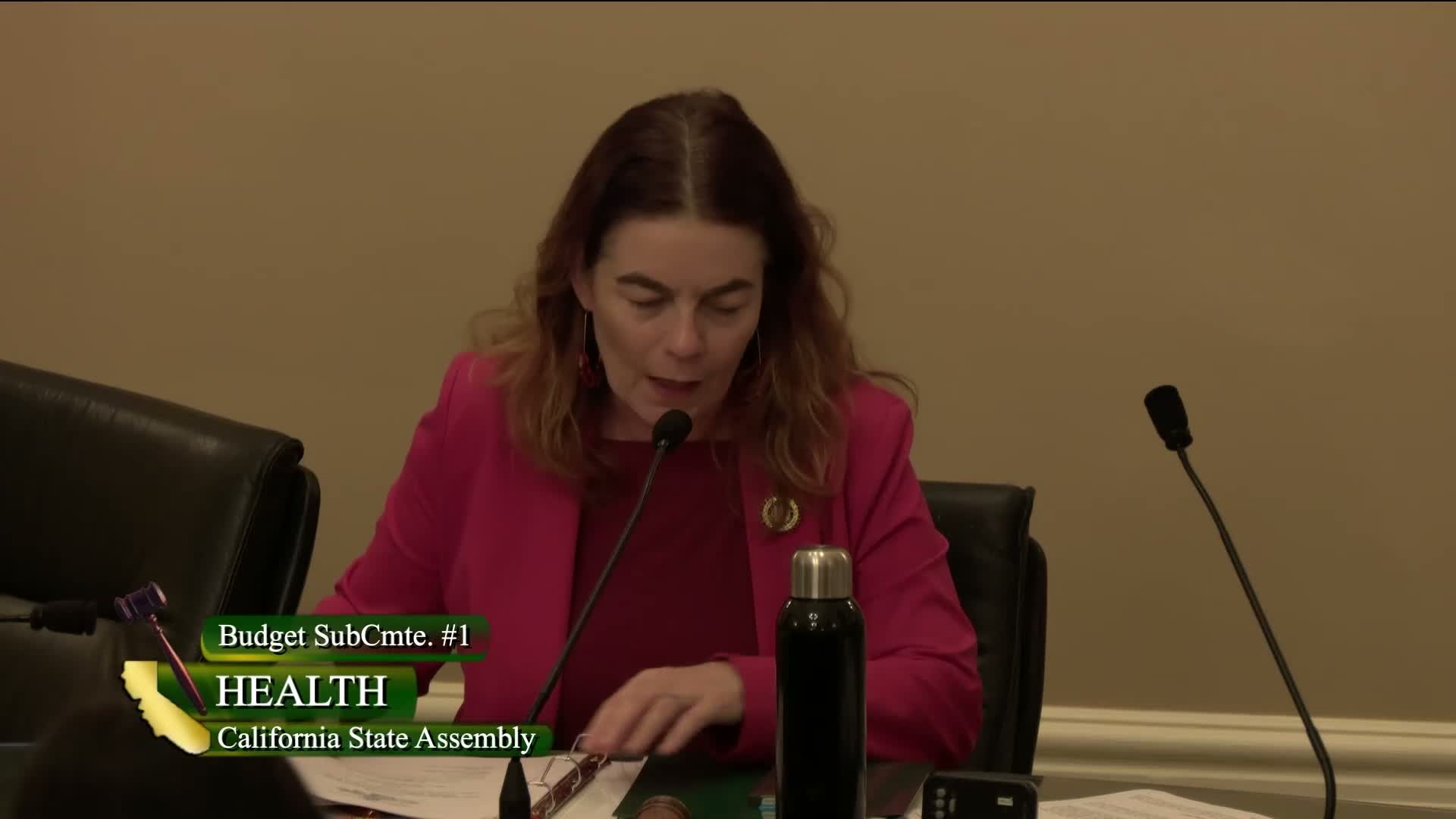
A joint Senate Budget Subcommittee No. 3 and Assembly Subcommittee No. 1 hearing on access to gender‑affirming care on April 1 focused on legal fights with the federal government, shrinking provider networks and a coalition request for a $26 million one‑time state investment to preserve services.
Deputy Attorney General Crystal Adams told lawmakers the Department of Justice is litigating multiple fronts against federal actions that, in DOJ’s view, threaten care: a multistate challenge to an executive order cited as the denial‑of‑care order (executive order 14187), a challenge to a declaration by the U.S. Department of Health and Human Services’ secretary, and a suit to block Rady Children’s Hospital San Diego from terminating gender‑affirming services after the hospital agreed to conditions tied to a merger. "We are taking action to make sure hospitals are following their obligations," Adams said.
State agencies described how those federal proposals could affect the local health system. Tyler Sadrith, state Medicaid director at the Department of Health Care Services, said Medi‑Cal continues to cover medically necessary gender‑affirming services and the agency is preparing contingency plans if federal rules are finalized. Mary Watanabe, director of the Department of Managed Health Care, explained that her agency requires licensed commercial plans to cover medically necessary care and relies on clinical criteria such as WPATH when reviewing medical necessity, but said DMHC does not track gender‑affirming services as a discrete specialty and thus cannot count utilization for that specific category.
Lawmakers pressed the panel on why some major hospital systems and clinics — including Rady, Stanford, Kaiser and UCSF surgical services — have paused or curtailed certain gender‑affirming procedures. Adams said DOJ’s primary litigation is aimed at the federal government, which providers have told the state is "intimidating" them into withdrawing services; in the case of Rady, she said merger conditions created an additional legal basis for state action. "Providers have been telling us that they are intimidated into changing their policies," Adams testified.
Clinicians and community providers described the on‑the‑ground consequences. Dr. Johanna Olsen Kennedy, the former medical director of the Center for Trans Youth Health and Development at Children’s Hospital Los Angeles, recounted the program’s abrupt termination and the scramble to serve nearly 3,000 displaced youth. "Programs are scarce, and those that accept medical care are even more so," she said, describing patients who now travel long distances and clinics that struggle to contract with insurers.
JM Jaffe, executive director of Lyon Martin Community Health Services in San Francisco, said community clinics have seen surges in demand and rising uncompensated costs. Lyon Martin asked lawmakers for $26,000,000 to scale capacity and stabilize providers statewide, including support for clinics that might need to separate state‑only services from federally funded streams.
Parents and young people gave emotional testimony about interruptions to care. Raysha Hanscomb described nine months of back‑and‑forth with Kaiser before receiving an initial surgical consult and urged legislators to "protect and stabilize access to care for transgender kids and their families." A parent testifying as Jane Doe said her family faces a roughly $217,000 hospital bill after a clinic closure and that prescriptions were not refilled once the clinic ceased operations.
The hearing also addressed a prior, smaller state allocation: a committee member asked about $15 million previously earmarked through Covered California; the Department of Finance said implementation was ongoing and deferred specifics to Covered California.
A coalition representative, Laura Sheckler of the California Primary Care Association advocacy affiliate, outlined the $26 million proposal: $1 million for DHCS administrative setup of a state‑only Medi‑Cal pathway (to reimburse services if federal funds become unavailable) and $25 million for a provider stabilization fund to help clinics hire staff, expand infrastructure, purchase malpractice coverage if needed, and cover legal or uncompensated care costs for families who lose federal coverage such as TRICARE.
Public comment filled much of the record, with dozens of speakers either urging the Legislature to approve the stabilization funds or opposing state investment and expressing concern about care for minors. Supporters included federally qualified health centers, county health officials, veteran parents and medical associations that cited evidence associating gender‑affirming care with reduced depression and self‑harm. Opponents and some public commenters pressed for stronger parental involvement and raised concerns about the medicalization of minors.
The hearing produced no formal vote; lawmakers said the agency panels and community testimony would inform budget deliberations. Chairing members asked agencies for additional detail on implementation guardrails and utilization tracking if the Legislature directs funding to a stabilization program.
What happens next: lawmakers signaled interest in developing administrative language and reporting metrics if they move forward with funding. Agencies said they would coordinate on potential state‑only reimbursement options and continued to monitor litigation challenging federal actions.