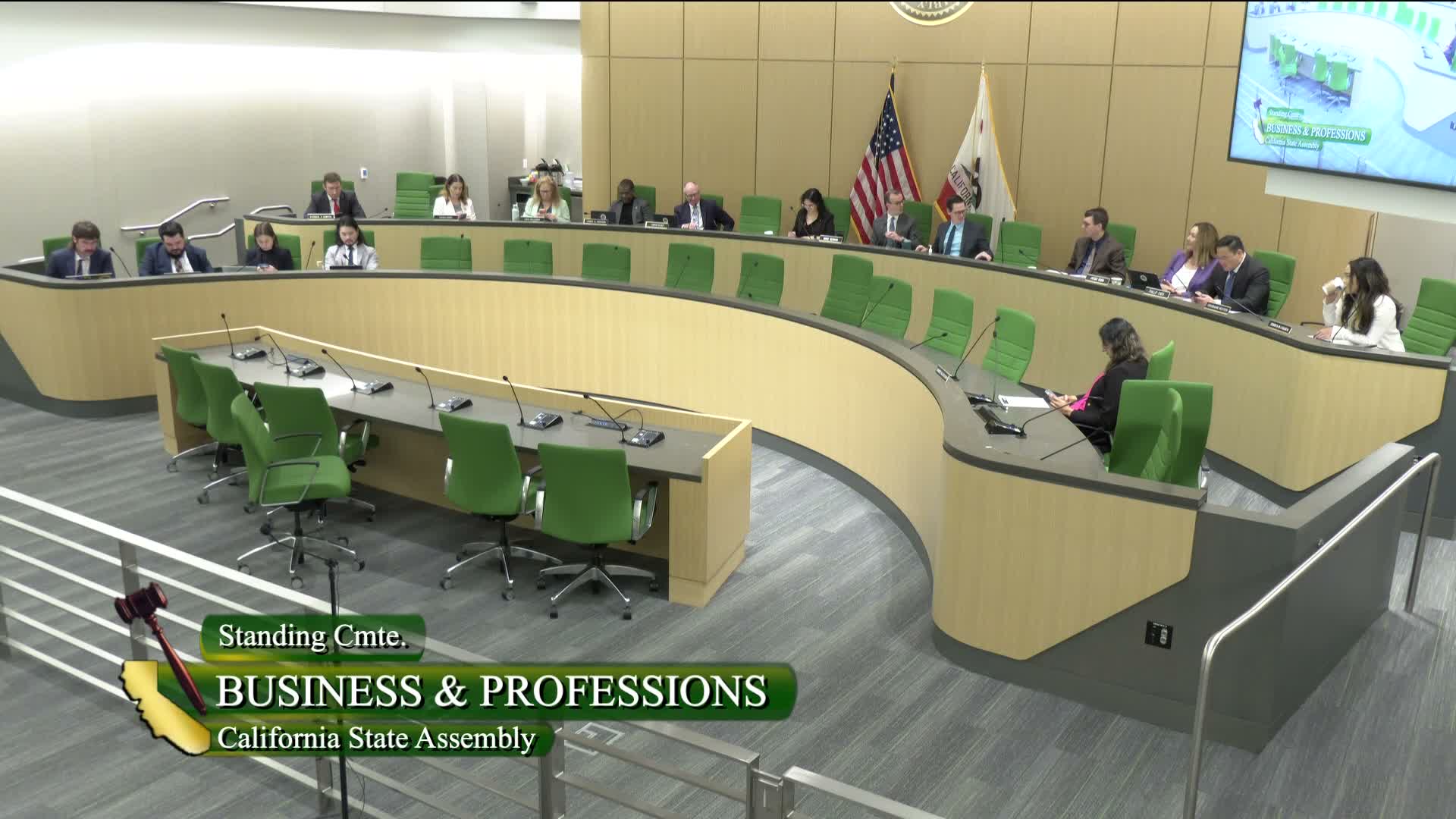
Business and Professions Committee advances 18 bills; consent calendar and roll-call votes recorded
Loading...
Summary
After establishing a quorum the committee moved the consent calendar and recorded roll-call votes advancing multiple bills to appropriations and other committees; several bills were left open for absent members before final confirmations.
The Assembly Business and Professions Committee established a quorum and advanced a set of measures, including a consent calendar of bills and several individual items that were moved to policy and appropriations committees.
The clerk read the consent calendar and the committee recorded roll-call votes approving those items. The chair then called for motions and roll-call votes on individual agenda items; multiple bills were passed as amended and sent to committees including Appropriations, Judiciary, Health, Revenue & Taxation, and Environmental Safety & Toxic Materials. Several votes were left "open for absent colleagues" before final affirmation; the hearing concluded with the committee adjourning after the final roll calls.
Votes at a glance (as recorded in committee): - Consent calendar (listed items including AB 15 87, AB 17 60, AB 17 67, AB 17 78, AB 17 85, AB 19 39, AB 19 65, AB 22 50, AB 22 56) — passed and referred to relevant committees (approvals read aloud by the clerk). - AB 16 37 (Colosa) — passed as amended to appropriations (roll call recorded). - AB 17 58 (Wynne) — motion passed to appropriations (held open for absent members in some calls). - AB 21 41 (Patterson) — passed as amended to judiciary. - AB 24 77 (Chen) — passed as amended to Environmental Safety & Toxic Materials. - AB 25 06 (Hart) — passed as amended to appropriations. - AB 26 33 (Gibson) — passed to appropriations. - AB 19 73 (Pellerin) — passed as amended to health.
Why it matters: The committee’s actions move multiple bills further along the legislative process and set the schedule for subsequent hearings and fiscal review. Several measures that drew testimony now face additional committee review or appropriations scrutiny.
What’s next: Each advanced bill will be scheduled in its receiving committee for further analysis or fiscal consideration; some items were held open for members not present at initial votes and were finalized by subsequent roll-call confirmations during the hearing.