Get Full Government Meeting Transcripts, Videos, & Alerts Forever!
Get email alerts on the Data Centers topic
No spam. Unsubscribe anytime.
Yuma residents press council on proposed data centers’ water and power impacts
Summary
Residents, tribal members and public-health professionals urged the City Council to pause or scrutinize proposed data-center development, citing concerns about water use, power supply, public-health impacts and transparency. GYEDC said no permits are yet filed and a seminar for officials is planned.
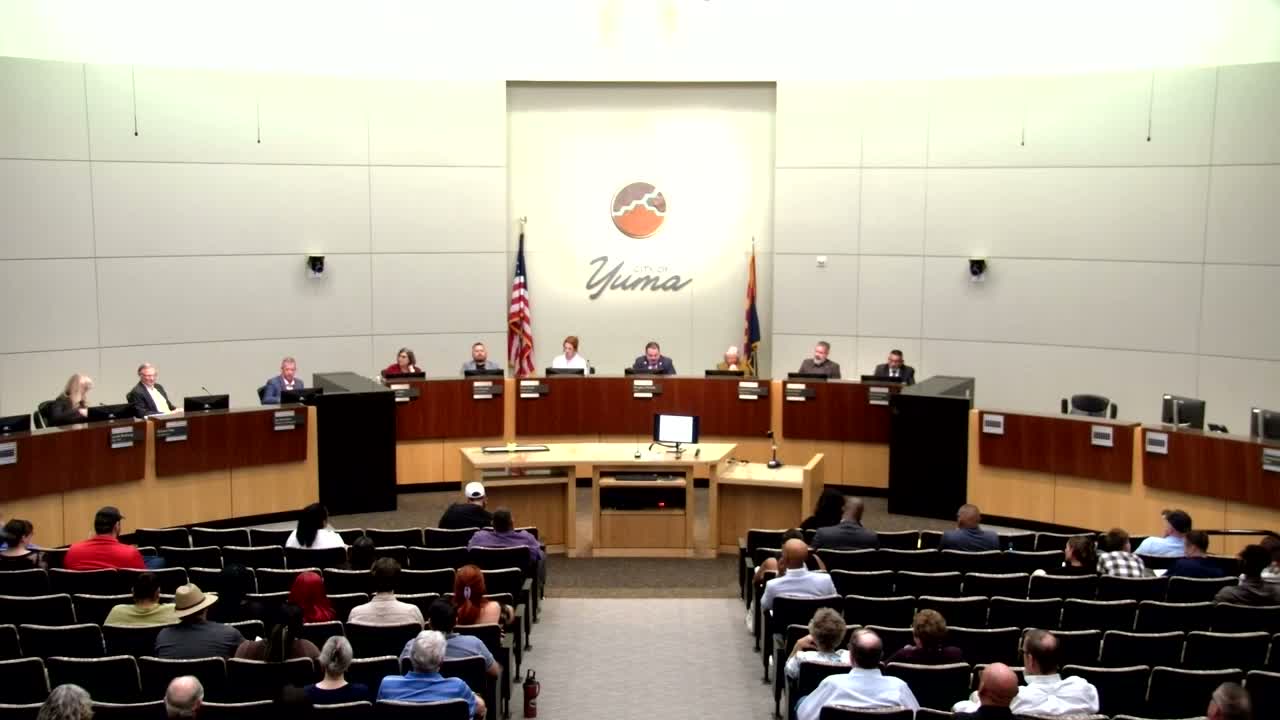
The Yuma City Council heard sustained public pushback on proposed data centers during a lengthy public-comment period on April 1, 2026.
Residents asked detailed questions about water consumption, power sourcing and long-term community impacts. “This is not sustainable for our future, and I beg you to reconsider building any data centers in our community when we already have a drought,” said Katie LaForce, a Yuma resident, citing Colorado River water stresses and per‑facility water‑use figures raised during public comment.
Other speakers raised economic and ethical concerns. Lucas Stanchi said large-scale server farms often shift energy and water costs onto residents and questioned the long-term job value of such facilities. A speaker who identified as a member of the Cocopah Indian people warned of potential impacts on tribal lands and asserted that some proposals could rely on uranium mining and mining infrastructure; that speaker asked council to engage with tribal governments and to evaluate cross‑jurisdictional effects.
Greg LaVaughn of the Greater Yuma Economic Development Corporation (GYEDC) addressed council and the public, emphasizing that “today, there are no data centers pulling permits in Yuma County” and that the projects under discussion remain in an early stage and, in many cases, confidential. He described recent private proposals for a major natural‑gas pipeline and associated generation capacity that developers say could supply multiple gigawatts of power to regional industry, and said some developers owning generation assets could provide the necessary electricity without raising ratepayer bills.
LaVaughn also said GYEDC plans an initial, elected‑official seminar on data centers with impartial presenters and energy experts; he described it as a step to inform council before decisions or permitting proceed. “We asked Tom Doyle, who has been working on data centers for over a decade, to give a very impartial, unbiased appraisal,” LaVaughn said.
Council members repeatedly asked for clearer technical data. Several asked that the presentation for officials address public‑safety implications, utility capacity and long‑term job and tax assumptions so the council and residents can assess trade‑offs. “I really want to understand the impact to Yuma,” Council Member Morales said during questions, seeking information on jobs, utility rates and community costs beyond initial construction.
Mayor Douglas J. Nichols and staff said any formal contracts or actions that bind the city would come before council and that, absent preemption by state law, the council would ultimately vote on any data center sited within City of Yuma boundaries. City staff and GYEDC also encouraged residents to submit questions in advance of the planned officials‑only seminar and indicated a public town hall could follow.
The council did not take any permitting votes at the April 1 meeting; the next steps reported were the officials‑only seminar and follow‑up outreach to the public to gather questions and data requests.
What’s next: GYEDC will hold a data‑center seminar for elected officials; the city indicated it can organize a later public session and that specific permit applications would trigger a formal public review and council action.