Get Full Government Meeting Transcripts, Videos, & Alerts Forever!
Get email alerts on the Transit topic
No spam. Unsubscribe anytime.
County hears regional transit briefing as agencies pitch federal funds to expand service
Summary
Yaveline Regional Transit and NACOG told supervisors Yavapai County transit delivered roughly 120,000 rides over three years and is using FTA 5307 dollars (cited as $1,900,000) for operations and to support workforce-housing eligibility and veterans’ access; NACOG said rural funding shortfalls create heavy local reliance and an NAU economic-impact study is underway.
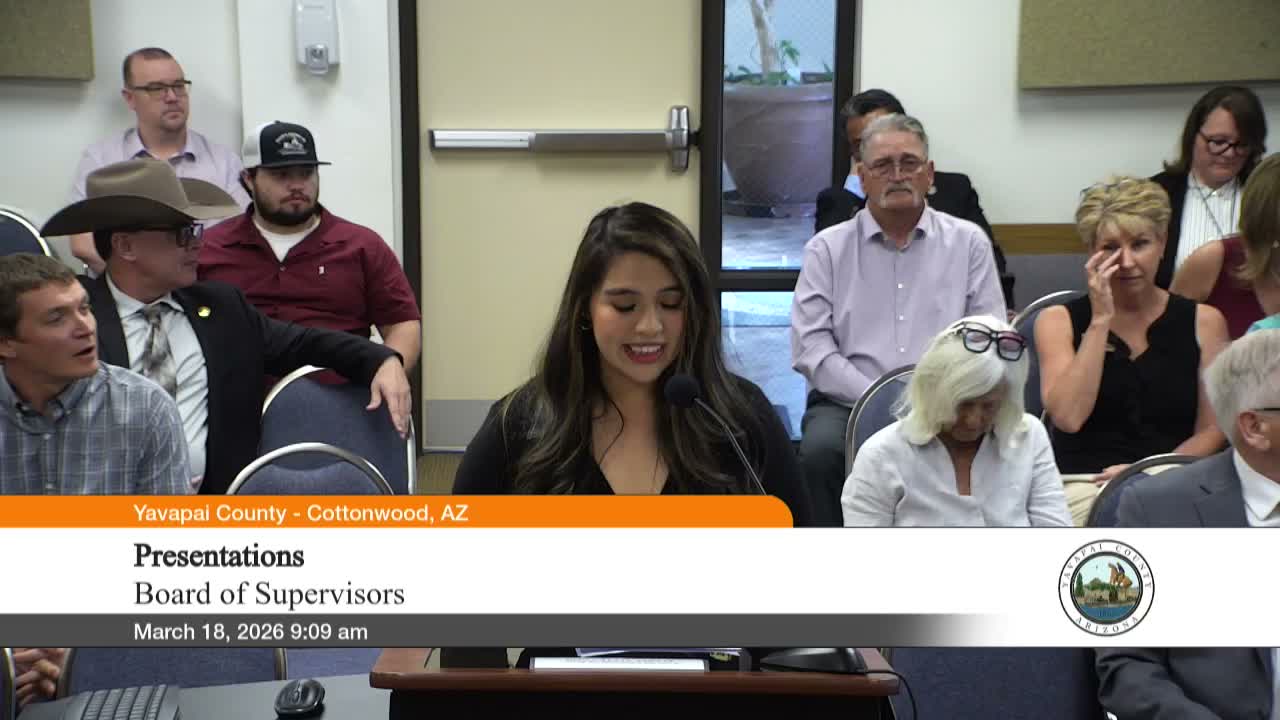
Leslie Contreras, regional development manager for Yaveline Regional Transit, told the Yavapai County Board of Supervisors that Yaveline has provided about 120,000 rides in the last three years using a fleet of small vehicles and is leveraging federal FTA 5307 funding (referenced in the presentation as $1,900,000) to sustain and expand service.
Todd Morris, transportation planner with the Northern Arizona Council of Governments (NACOG), said the Verde Valley’s combined transit systems deliver strong ridership for a rural region and that local investment covers a disproportionate share of operations because Arizona lacks a dedicated state transit fund. NACOG staff described a roughly $25,000,000 gap between rural transit requests and available state funding and said the Verde Valley relies heavily on local sources for 70% of its transit funding.
Presenters highlighted specific community benefits: transit enables workers to reach jobs (presenters said roughly 30% of rides are for employment), helps veterans access VA services, and supports tourism and events such as the Prescott Rodeo. Contreras said transit access is a qualifying factor for certain workforce-housing tax credits and described work with developers seeking roughly 82 workforce units in North Prescott that rely on nearby transit service.
Board members questioned weekend service and rural coverage. Contreras said Yaveline does not operate weekends currently but has piloted weekend trips via grant-funded programs and is seeking additional grants to expand service. NACOG representatives said the Verde Valley and Central Yavapai mobility and economic-impact studies are ongoing, with a study timeline projecting presentations in the fall and a full mobility plan by next June.
The presentation underscored funding risks: speakers noted an overreliance on federal funds and the absence of statewide dedicated transit revenue. NACOG suggested strategies such as private partnerships and developer contributions for local matching funds. Supervisors expressed support and asked staff to continue coordination with NACOG and the Yaveline operator.
The board did not take formal action on the presentation but thanked the presenters and invited follow-up when the NAU economic-impact analysis is published.