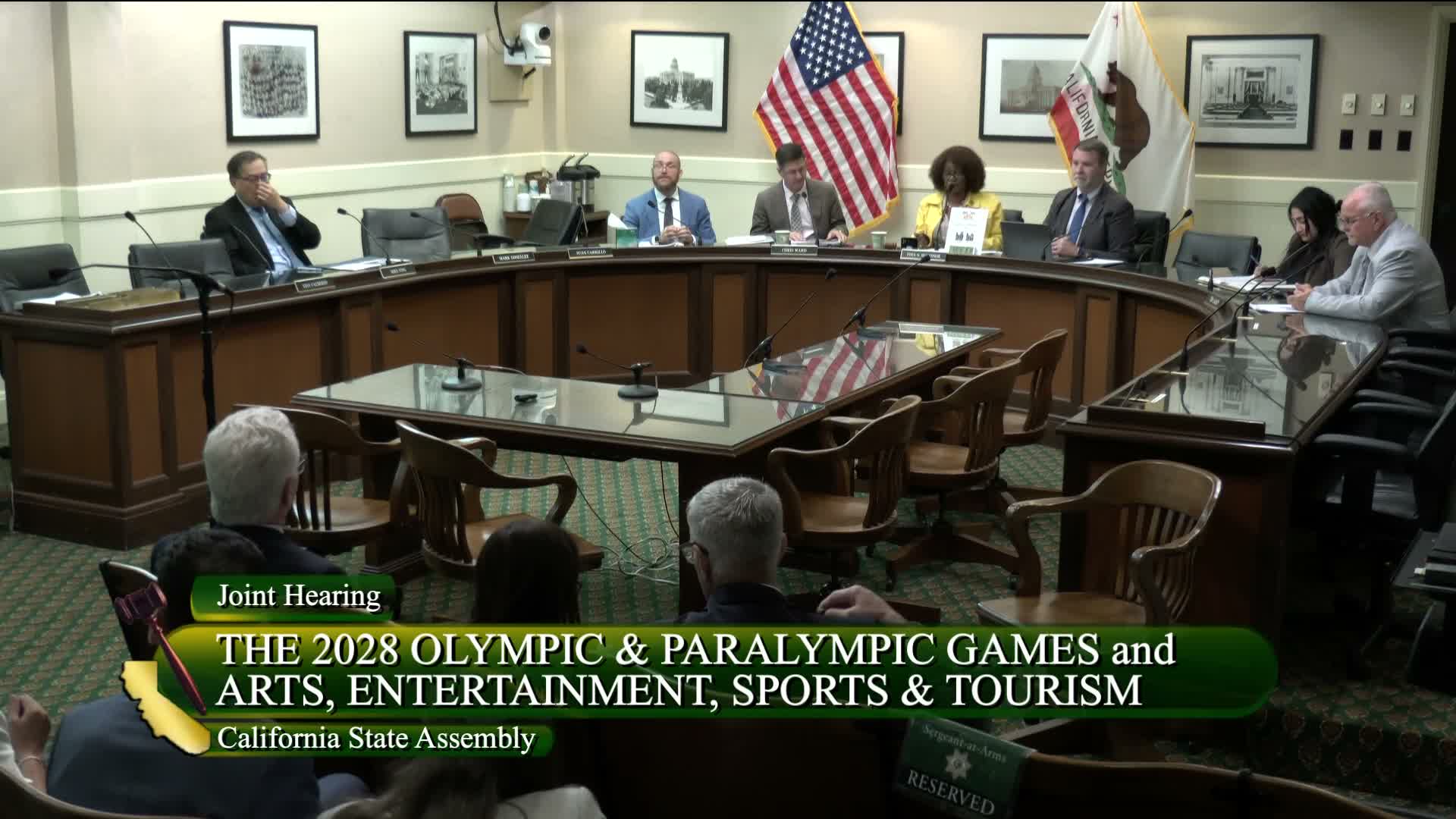
LA Metro CEO Stephanie Wiggins tells Assembly agency needs $379 million in state match to deliver Games transit projects
Loading...
Summary
LA Metro CEO Stephanie Wiggins told the Assembly the agency needs $379 million in state matching funds to complete a list of Games-related construction projects; she warned Metro faces a $429 million operational shortfall this fiscal year that could grow to $1.3 billion by 2031 and said borrowed bus capacity and enhanced transit services will be required.
Stephanie Wiggins, chief executive officer of the Los Angeles County Metropolitan Transportation Authority, told the joint Assembly hearing that Metro’s planning is structured around a “Transit First” approach and that state investment is required to deliver legacy transit improvements for the 2028 Games.
Wiggins told the committee Metro has identified about $379,000,000 in needed construction funding for projects that would be shovel-ready with the state match; she said that amount functions as the final tranche of match funding that will allow projects already through planning and environmental clearance to proceed to construction. “The $379,000,000 ask from the state is really matching funding,” Wiggins said.
She described operational challenges tied to delivering service during the Games and beyond: Metro faces an operational funding gap estimated at $429,000,000 this fiscal year and projected to widen to roughly $1,300,000,000 by fiscal 2031, Wiggins said. To meet surge demand during the Games, Metro’s plan projects a need for roughly 1,700 additional buses borrowed from other agencies and a 'games-enhanced transit service' to move spectators and workforce to venues.
Assembly members pressed Metro on deliverability given tight timelines. Wiggins said the listed projects benefit from prior local and federal planning investments, environmental clearances and preliminary engineering, and that the requested state dollars are needed now to keep schedules on track. She also emphasized that Metro cannot use normal operations funding to subsidize Games service without jeopardizing existing essential service for daily riders, many of whom are low-income.
Wiggins described multilingual passenger information, mobile/digital tools and ambassador programs being planned to help international visitors navigate the transit system, and said Metro has already secured pledges for more than half of the additional buses it needs from partner agencies.
The committee asked follow-up questions about project timelines, risk of delay and coordination across state and regional agencies; Wiggins said LA28 leads the Games mobility executive group and Metro participates with Caltrans, Metrolink and other regional partners to coordinate operations.
The hearing record shows no vote or formal action on the funding request; Wiggins and committee members framed the $379 million ask as a time-sensitive appropriation decision for the current legislative cycle.