LA28 CEO Reynolds Hoover details $7.2 billion budget, ticket and volunteer milestones for 2028 Games
Loading...
Summary
LA28 CEO Reynold Hoover told a California State Assembly joint hearing that the organizing committee’s combined Olympic and Paralympic budget is $7.2 billion, reported early ticket and volunteer milestones and touted more than $2 billion in sponsorship revenue while promising a 'no build' approach that prioritizes reuse of existing venues.
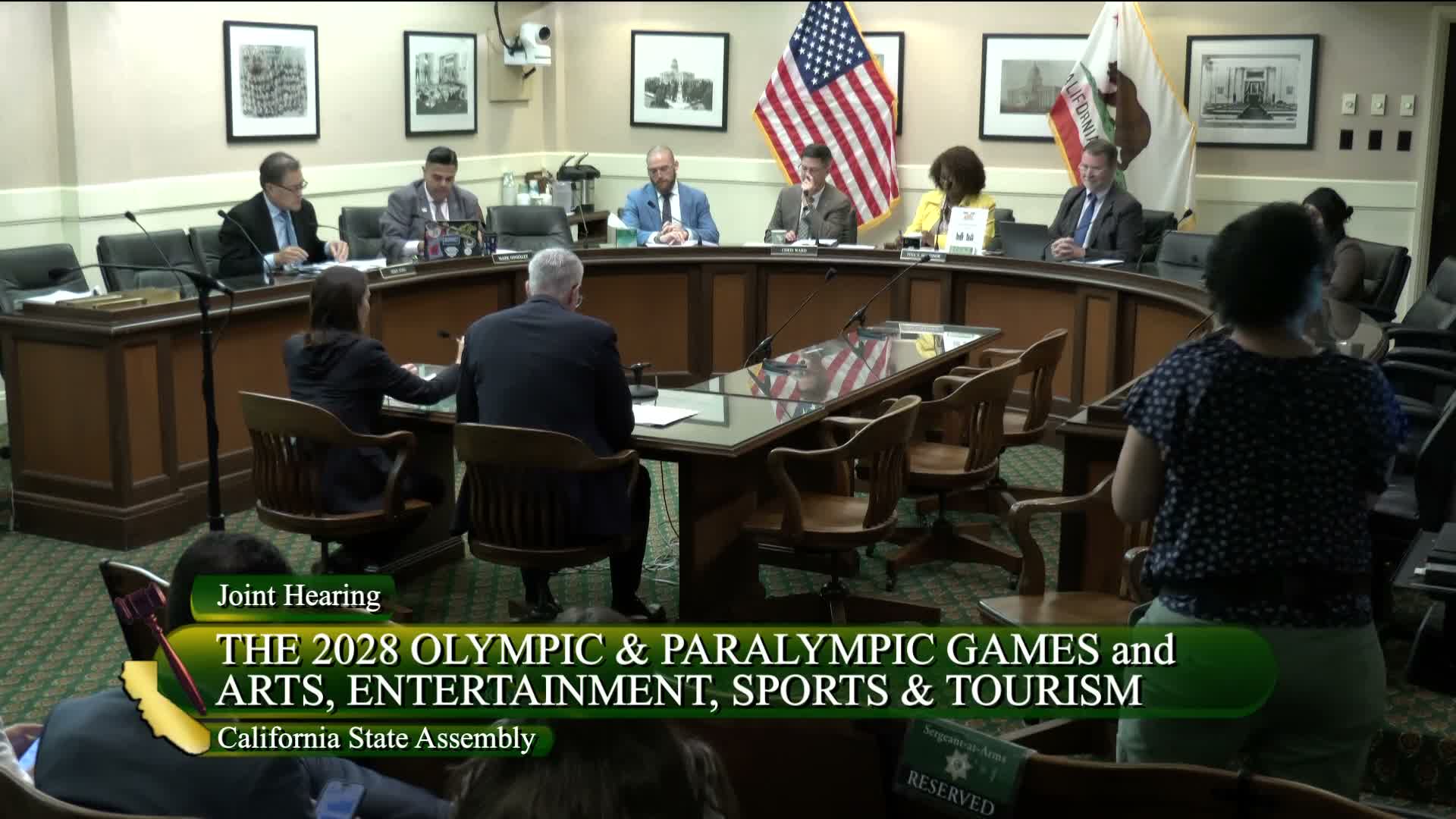
LA28 Chief Executive Reynold Hoover told the California State Assembly at a joint informational hearing that the organizing committee’s combined budget for the 2028 Olympic and Paralympic Games is $7,200,000,000 and includes both competitions.
Hoover, who introduced himself to the committee as LA28’s CEO, said the organizing committee is a private 501(c)(3) that works closely with government partners and relies on sponsorship, ticketing and hospitality revenues rather than direct federal funding. “Our budget is now $7,200,000,000 and that includes both Olympics and Paralympics,” Hoover said.
Hoover and staff highlighted early sales and volunteer metrics as evidence of public interest. In the first 24 hours after the ticket portal opened, 1.5 million people signed up, he said, and LA28 reported more than 5 million people signed up or in the sales pipeline after recent sales opened. The volunteer program opened early and saw 70,000 signups in the first 24 hours and more than 250,000 volunteers registered to date, with roughly 50,000 Angelenos activated so far.
The organizing committee also reported commercial-sponsorship milestones. Hoover said LA28 had crossed $2,000,000,000 in commercial-sponsor revenue, a pace he described as faster than any previous organizing committee, and announced additional partners signed in recent months.
On venue strategy, Hoover said LA28 is pursuing a largely "no build" approach that emphasizes use of existing stadiums and facilities and only limited temporary construction. He listed venue partners across the region — including downtown Los Angeles, Inglewood, Long Beach, Carson, Pasadena, Pomona and Anaheim — and confirmed Oklahoma City will host softball and canoe slalom preliminaries.
The presentation also covered LA28’s commitments to community benefit and sustainability. Hoover described an impact and sustainability plan released in August 2025 and a $2,000,000 Resilient Champions Fund to support local environmental resilience projects. He said LA28 is targeting 75% local spend among its addressable procurement and 25% of that in small businesses, including micro and hyper-local firms.
Asked about profitability, Hoover said a formal profit forecast was not yet available but that the organizing committee intends to leave a legacy similar to LA’s 1984 games. “It is my goal that we leave a legacy,” he said.
The committee followed LA28’s presentation with questions about fashion/design partners, housing and venue readiness; Hoover and Chief Athlete Officer Janet Evans answered and described athlete-facing programs including an Olympic fellowship that integrates former Olympians into staffing and planning roles.
The hearing closed after subsequent panels from the City of Los Angeles and LA Metro.