Get Full Government Meeting Transcripts, Videos, & Alerts Forever!
Get email alerts on the County Finance topic
No spam. Unsubscribe anytime.
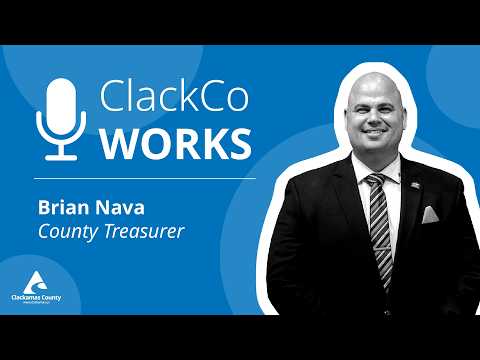
Clackamas County Treasurer Brian Nava: "We are the bank for Clackamas County"
Summary
In an interview on the Clackoworks series, Clackamas County Treasurer Brian Nava described the treasurer's office as "the bank for Clackamas County," outlining its management of the county's receipts and disbursements, investment policy under ORS 294, property-tax distributions to 120+ taxing districts and the office's internal audit role, including a recent courthouse audit.
Brian Nava, Clackamas County treasurer, said the treasurer's office functions as "the bank for Clackamas County," handling the county's receipts, disbursements, investments and internal audit oversight for a county budget the office figures at about $2,000,000,000.
Nava told Clackoworks host Dylan Blaylock that "every penny that comes in goes to a bank account held by the treasurer's office" and every outgoing payment flows through those same accounts to fund county operations. He said the office maintains more than 20 bank accounts, participates in a local government investment pool and uses money-market accounts with qualified local depositories so taxpayer dollars earn interest while remaining accessible.
Why it matters: the treasurer's choices affect how much interest the county can earn and how quickly money moves to schools, fire districts and other taxing districts that rely on timely distributions. Nava said the office distributes property-tax receipts monthly and weekly in November to more than 120 taxing districts, and that school districts receive the largest share.
On investments, Nava cited state legal limits and the county's written policy. "Per that statute's requirement, the safety of principal is number one," he said, referencing Oregon Revised Statutes (ORS) 294 and an investment policy the board of county commissioners reviews annually. Nava said the county invests in high-rated instruments such as Federal Home Loan Bank and U.S. Treasury securities, emphasizing conservative choices to protect public funds.
The treasurer also described the internal audit role now administered from his office. Nava said he established the county's internal audit function after returning from state service in 2015 and now serves as internal audit administrator; an audit oversight committee reviews reports, which the office posts publicly. Nava highlighted a recent on-time audit of the new county courthouse public-private partnership, work he said produced timely recommendations while the roughly $300 million project proceeded.
Nava explained how the treasurer's office is funded and staffed: a mix of general fund dollars and a 1-basis-point investment fee applied to funds held, and a lean staff of about seven people. "We're doing that service at a much lower rate," he said, noting outside providers would typically charge three to 12 basis points for comparable services.
On why the treasurer is an elected office, Nava framed the position as part of the county's checks and balances. He said an elected treasurer provides independent accountability distinct from the board of county commissioners and other county departments.
No formal actions or votes were taken during the interview. The conversation focused on explaining the treasurer's statutory duties, investment priorities and the office's role in oversight and fiscal operations.