Maricopa County officials ask supervisors for higher ELE‑1 election budget as vote centers and poll‑worker costs rise
Loading...
Summary
Elections and Recorder staff told the Board of Supervisors the county needs higher ELE‑1 sinking‑fund budgets for 2026 to cover anticipated record turnout, additional vote centers and higher poll‑worker pay; the Recorder will assume several early‑voting duties moved from Elections.
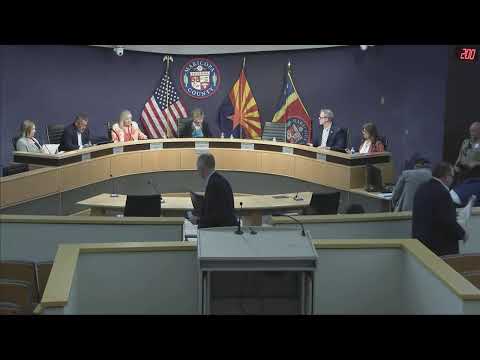
Maricopa County elections officials asked the Board of Supervisors on April 6 to approve increased ELE‑1 sinking‑fund budgets for the 2026 primary and general elections, citing a forecast of roughly 65% turnout in the general and an estimated 1.7 million ballots. Elections Director Scott Jarrett said the forecast would be the county’s highest turnout since 1970 and that the department is projecting record ballot volumes for the general election.
Jarrett said the Elections Department’s ELE‑1 request is roughly $19.7 million this cycle, driven largely by staffing (temporary poll workers and central‑count staff), ballot printing and logistics. "About 50.3% of the total budget" is for staffing, he said, and noted election‑cycle costs previously split between the Elections Department and the Recorder’s Office are being realigned following a recent board resolution.
Why it matters: Supervisors were pushed for specific line items and comparatives to prior elections because the combined FY‑27 requests represent a multi‑million‑dollar increase over 2024 actuals. County budget staff said the total ELE‑1 increase across both offices is about $12.7 million versus 2024 actuals when accounting for pre‑ and post‑resolution allocations, and offered to provide a detailed accounting of contingency draws and reserve balances.
What officials presented: Jarrett listed several cost drivers: a required publicity pamphlet tied to a likely ballot question (about $1.1 million), an estimated $973,000 added cost for a two‑page general election ballot, higher truck and courier rental rates, expanded training for poll workers and a larger temporary workforce (3,000–4,000 poll workers at voting locations and 800+ central counting staff). He also described a $600,000 contingency line the department used in 2024 to cover an unexpected additional ballot page.
Jarrett and Deputy/Assistant County Manager Zach Shura told supervisors the Elections Department had planned for a roughly $3 million increase in poll‑worker pay tied to minimum‑wage changes and increased hours, but that post‑resolution transfers of early‑voting duties to the Recorder’s Office reduced the Elections Department’s net increase to about $73,000. "We were able to use contingency in 2024 so we did not have to come back to the board" for an emergency request, Jarrett said.
Recorder’s role and site additions: Maricopa County Recorder Justin Heap told the board the Recorder’s Office absorbed approximately $3.4 million of transferred responsibilities (couriers, certain early‑voting payroll and other items) and presented its own ELE‑1 totals: roughly $8.3 million for the primary and $12 million for the general in the Recorder’s submission. Heap said the Recorder offset some early‑voting site costs using contingency so it was not asking for additional net funds beyond the transferred amounts.
Heap also described where the Recorder added early‑voting locations for 2026 to reach under‑served population centers: new 27‑day and 12‑day sites in Mesa, East Mesa, Chandler and South Phoenix (including a site at a downtown Mesa location and a site at a Mountain Park Church), plus expanded 12‑day offerings in parts of the Southeast Valley. "We opened locations based purely on where we could find them and where we think there are population centers that have not had them," Heap said.
Supervisors’ concerns and follow‑up questions: Board members repeatedly pressed staff for apples‑to‑apples comparisons to 2024, a clearer accounting of contingency use, and the methodology for placing vote centers. Several supervisors said the current draft map appeared to concentrate 27‑day (month‑long) vote centers in parts of the East Valley and asked whether that selection could unintentionally create inequities; Recorder staff said site choices were driven by heat‑map analyses, historic in‑person turnout, physical site suitability and the practical reality that many schools and organizations no longer make space available.
On voter behavior: Jarrett said 220,000 ballots were dropped off on election day in 2024 (down from roughly 290,000 in 2022) and described operational steps to reduce election‑night backlog: adding a second shift after Election Day and pretesting procedures to allow on‑site tabulation of certain mail ballots under recent state law changes. "Our goal is to have upwards of 99% of our ballots reported by the Friday after Election Day," Jarrett said, noting state cure periods for challenged signatures prevent a full 100% on that timeline.
Contingency, sinking fund and next steps: County budget staff said the county currently transfers about $13.2 million annually into the ELE sinking fund and reported a reserve balance near $17.4 million before the FY‑27 proposals; staff warned of a projected shortfall when combining Elections and Recorder requests and offered to provide a line‑by‑line reconciliation after the meeting. Kirsten Prindle (budget) said contingency lines are included to avoid emergency supplemental requests and described negotiations that reduced the Recorder’s contingency request in order to fund new roles and additional early‑voting positions.
Board action: The meeting closed the public portion of the presentation and, after questions, the Board moved unanimously to convene an executive session. Supervisors asked staff to return with detailed contingency accounting, precise site maps, and an itemized comparison of FY‑24 actuals versus FY‑27 requests before final budget adoption.
What’s next: Elections and Recorder staff committed to providing supervisors with more detailed breakdowns and a finalized vote‑center map in the weeks ahead; the board indicated it would consider the refined ELE‑1 request in the regular budget process.