Get Full Government Meeting Transcripts, Videos, & Alerts Forever!
Get email alerts on the Economic Impact topic
No spam. Unsubscribe anytime.
Local businesses press Alamosa officials over outreach and possible economic impacts of access-control plan
Summary
At a Feb. work session, business owners urged the city and CDOT to improve outreach and to clarify how parcel-level access conditions could affect operations, citing examples including gas stations, a multi-tenant property near Chili's and Monte Vista Cooperative's pumps.
Local business owners used the city’s public comment period to press Alamosa City Council and CDOT on how the proposed access control plan might affect daily operations, revenues and hiring at sites along the Highway 160/285 corridor.
Multiple commenters said they received little or no direct notice about earlier meetings and worried that access consolidation or right-in/right-out restrictions could push traffic onto private parking lots or require customers and trucks to make lengthy detours. "Once that business changes, then a lot of that traffic gets driven through our property," said Brian Cook, whose multi-tenant property north of Chili’s is shown on the draft map as affected by future access changes. "We get no concessions for how much our parking lot gets torn up by... trucks with trailers."
Monte Vista Cooperative told the council that any reduction in its highway access could force the site to close fuel-pump operations and cost local jobs. "If there's any changes to our access points, you take one away ... it affects our revenue. It could make us close down the pumps," Kaylee Lopez said during public comment.
Several speakers—Katie Doxon, Eric Burt and others—faulted the outreach process. Doxon, a property owner in the city limits, said she received an email less than 24 hours before the session and that stakeholder meetings had not been broadly or consistently publicized: "Less than 24 hours is not adequate notice... this is becoming a pattern throughout this process." The presentation team said it mailed 275 postcards and ran the legally required notice in the Valley Courier but acknowledged it could improve personal outreach and social-media promotion before the March open house.
Business leaders asked for more transparency about the IGA that will accompany adoption of the ACP. Chaz Mueller, president of State Bank, asked whether "acceptance" at a future council meeting would obligate the city to sign the IGA and asked for the draft IGA to be shared publicly. Staff replied that the IGA would contain the parcel-level conditions discussed in the presentation and that substantial changes would require concurrence among signatories and, if major, additional public process.
Speakers urged council members to weigh local economic impacts when reviewing parcel conditions. Several commenters said they welcome safety improvements but want assurances that short-term costs and business disruptions will be considered, and that property owners will see the specific access conditions for their parcels prior to any formal adoption.
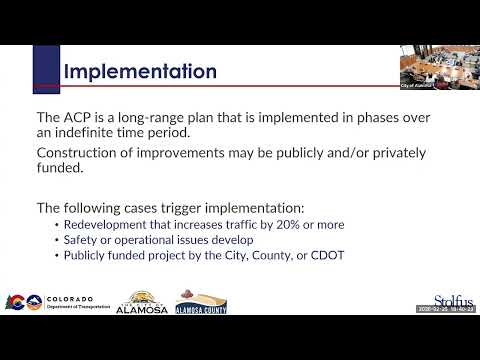
City staff and CDOT offered next steps: a March 26 open house to display parcel conditions and accept comments, continued one-on-one meetings for property owners and a pledge to post materials and contact information on the city's development services webpage. Staff apologized for outreach gaps and said they would expand notification efforts ahead of the next meeting.