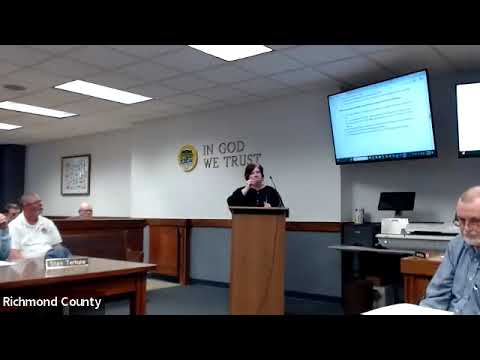
Planning commission recommends approval of Dominion Energy amendment to Mulberry battery-storage permit after safety debate
Loading...
Summary
The Richmond County Planning Commission unanimously recommended that the Board of Supervisors approve Dominion Energy's request to extend a building-permit deadline, alter a fire-suppression condition, and allow expansion of an energy-storage site from 75 MW to 325 MW after technical testimony from fire officials and Dominion engineers and public questions about safety and container counts.
The Richmond County Planning Commission on April 6 voted unanimously to recommend that the Board of Supervisors approve amendments to a 2022 special-exception permit for Dominion Energy’s Mulberry energy-storage project. The commission’s recommendation covers three changes: a requested extension to obtain a building permit, revised fire-protection language replacing a dry-pipe manual flooding requirement, and authorization for the applicant to pursue a higher overall capacity (from 75 megawatts to 325 megawatts).
Planning staff opened the hearing by saying the applicant asked that the permit deadline be extended up to three years from approval of any amendment, that a dry-pipe manual flooding requirement be removed in favor of conservative separation distances and modern containment measures, and that the proposed site capacity be increased. Hope, the planning staff member who presented the item, said staff recommended the amendments subject to revised condition wording and subsequent site-plan review.
Dominion representatives told the commission the changes reflect improvements in battery density and safety since the original 2022 approval. "Ultimately, this is about grid security," a Dominion project representative said, adding the facilities are intended to benefit system customers in the Northern Neck. Dominion’s generation development manager told the commission that engineering and final design will determine exact container counts and that the project will proceed in phases.
Local fire and emergency officials provided technical context. Mitch Paulette, identified in the record as the county fire/emergency official, described how industry practice and NFPA guidance have evolved: responding with tens of thousands of gallons of water to cool lithium batteries can spread contaminated runoff and, in some recent approaches, properly spaced and contained systems are monitored and allowed to "consume themselves" to reduce environmental impact and response risk. "It's safer to let them burn than it is to put all that water on it," he said, while stressing the county would continue coordination and training with the operator.
Members of Dominion’s technical team, including a fire-protection engineer, said modern systems can detect cell-level problems and isolate racks before thermal runaway escalates. They also said the approved 75-MW design corresponded to roughly 82 containers on the original site plan and that, using straight proportional math, a 325-MW buildout could involve on the order of 295 containers, but those figures would be finalized during phased engineering and site-plan reviews. Dominion emphasized the total developed footprint would remain within the three parcels originally approved.
A local resident who spoke during public comment expressed concern about removing the manual flooding requirement, the potential environmental consequences of off-gassing and firefighting runoff, and the large percentage increase in capacity: "Why do they need 433% increase in battery capacity?" the commenter asked, urging commissioners to request more specific container and spacing detail before final approvals. Dominion and staff responded that additional technical detail would be produced during site-plan review and that safety and spacing would be governed by applicable codes and the project’s decommissioning plan.
Commissioners debated whether to table the request for more detail or to vote on a recommendation. One commissioner moved to accept the three changes as a slate and to adjust condition 22’s language to reference the facility’s fire protection system and applicable NFPA standards; the motion was seconded and passed unanimously.
The Planning Commission’s action is a recommendation; the Board of Supervisors will make the final decision at a later meeting. Staff said it will continue coordinating with Dominion on site plans, voluntary payment discussions and the additional technical material requested by commissioners.