Get Full Government Meeting Transcripts, Videos, & Alerts Forever!
Get email alerts on the State Legislation Roundup topic
No spam. Unsubscribe anytime.
Governor signs package of bills on child care, noncompetes, health care and transit
Summary
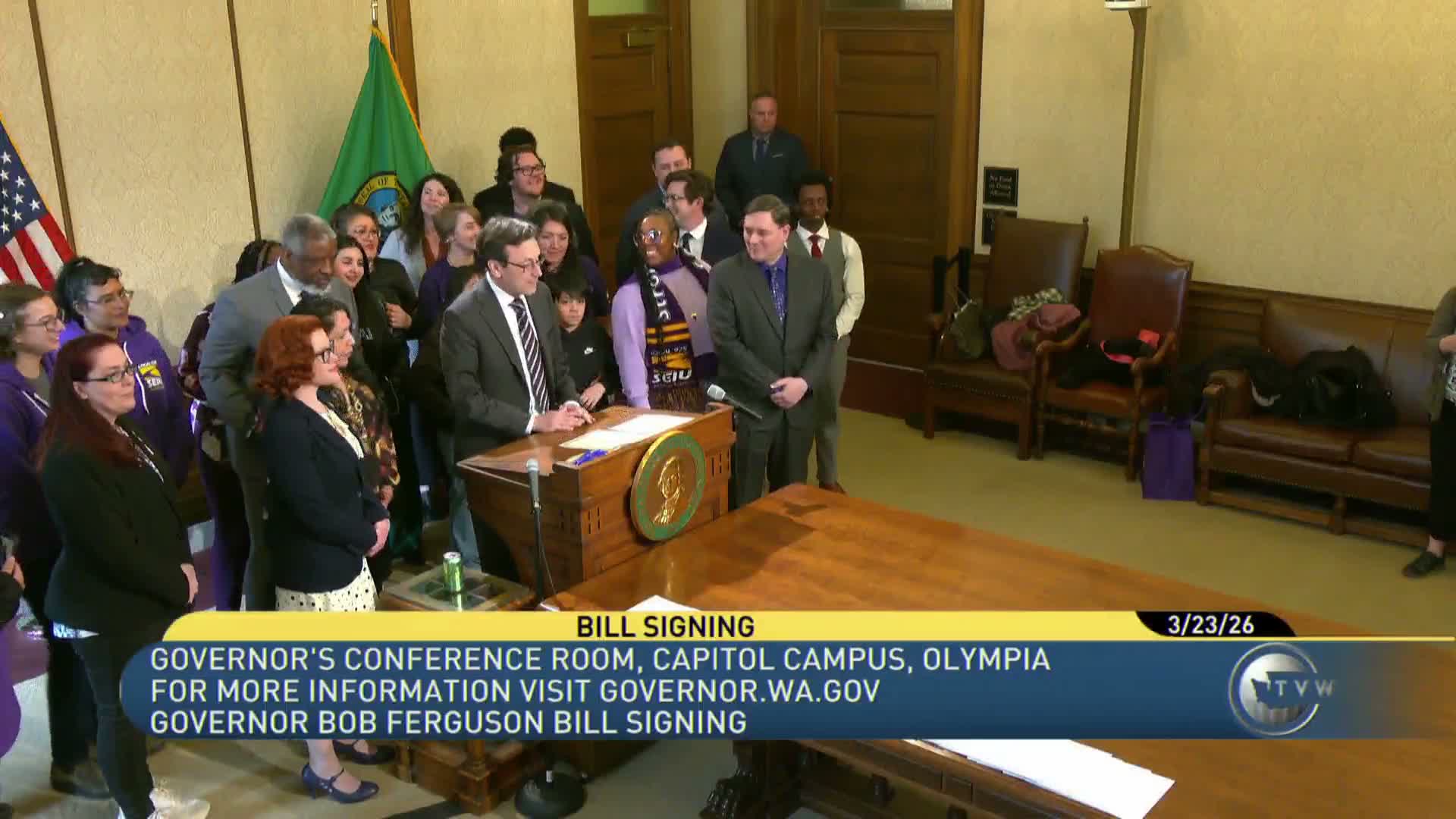
At a bill-signing event in Washington state, the governor signed a multi-bill package establishing a childcare workforce standards board, banning noncompetes, updating unemployment and health-care rules, and approving transportation and consumer-protection measures; sponsors joined for photos.
At a bill-signing event in Washington state, the governor signed a package of new laws covering child care, labor protections, health-care authorizations, insurer timelines and transportation permitting. The event brought sponsors and supporters forward for photos after each signing.
The governor said, "Child care, of course, is essential for working families," while introducing House Bill 1128, which establishes the Washington State Childcare Workforce Standards Board to recommend changes to improve recruitment, retention and employment standards for childcare workers. The measure, she said, is meant to address turnover and staffing shortages in the childcare sector; Representative Mary Fosse was identified by the governor as the bill's prime sponsor and Senator Derek Stanford as companion sponsor.
On labor policy, the governor signed House Bill 1155, which bans noncompete agreements. "Noncompete agreements are bad for business, workers, and the free market economy," the governor said, thanking Representative Liz Berry (prime sponsor) and Senator Derek Stanford (companion sponsor) for their leadership.
The governor also signed House Bill 2264 to change unemployment insurance eligibility rules so workers who voluntarily opt into a layoff can still collect benefits. She described the change as removing the requirement that an employer initiate final layoff action in order for affected employees to qualify.
Several bills affecting courts, traffic safety and Medicaid were on the agenda. House Bill 2178, requested by the Administrative Office of the Courts, brings state law into alignment with court rules on civil infractions and related procedures. House Bill 2192 expands the authority of the Washington Traffic Safety Commission to conduct fatal crash reviews and to obtain and protect sensitive records used in those reviews. House Bill 2385 postpones an expiration date in the Medicaid access plan until 01/01/2032, a change the governor said gives Congress time to address rules implemented under HR1 that affected the plan's funding.
On health-care workforce and prior-authorization rules, the governor signed Senate Bill 5185 to create a pilot program to increase the number of international medical graduates who can fully practice in Washington. She also signed Senate Bill 5395, which updates prior-authorization rules, regulates the use of AI in those workflows and requires that, when a carrier denies an authorization request, patients and providers be able to see the credentials of the clinician who made the denial.
The governor highlighted steps intended to ease administrative burdens for providers: Senate Bill 5845 requires insurers to pay or deny claims in 30 days or less unless more information is required; in that case insurers must notify providers within 21 days.
Other measures signed included bills targeting abusive conduct at school sporting events (Senate Bill 5272), refining foreclosure-prevention fees to benefit low- and fixed-income homebuyers (Senate Bill 5938), modernizing regulation for hydrogen fueling stations (Senate Bill 6269), expanding property tax assistance exemptions for seniors and certain disabled veterans (Senate Bill 6162), and granting Sound Transit and local governments additional flexibility in planning and permitting high-capacity transit projects (Senate Bill 6309).
Sponsors and community representatives joined the governor for group photos after each signing. The transcript does not specify effective dates beyond those explicitly stated in the bills themselves; effective-on dates and implementation timelines should be confirmed in each statute or agency rulemaking notice.
What's next: the measures were signed into law at this event; where the bills require further rulemaking, agency study groups, or implementation steps (for example a work group directed to report by 12/15/2026 for electric-mobility standards), those steps will follow through the responsible agencies.