Get Full Government Meeting Transcripts, Videos, & Alerts Forever!
Get email alerts on the Legislative Session Fiscal Impact topic
No spam. Unsubscribe anytime.
Workgroup hears mixed results from short legislative session: funding cuts, targeted behavioral‑health wins
Summary
Workgroup members said the short legislative session produced both program cuts and important behavioral‑health policy gains, including restored funding for the Partnership Access Line, two CCBHC positions, and targeted investments to prevent critical incidents.
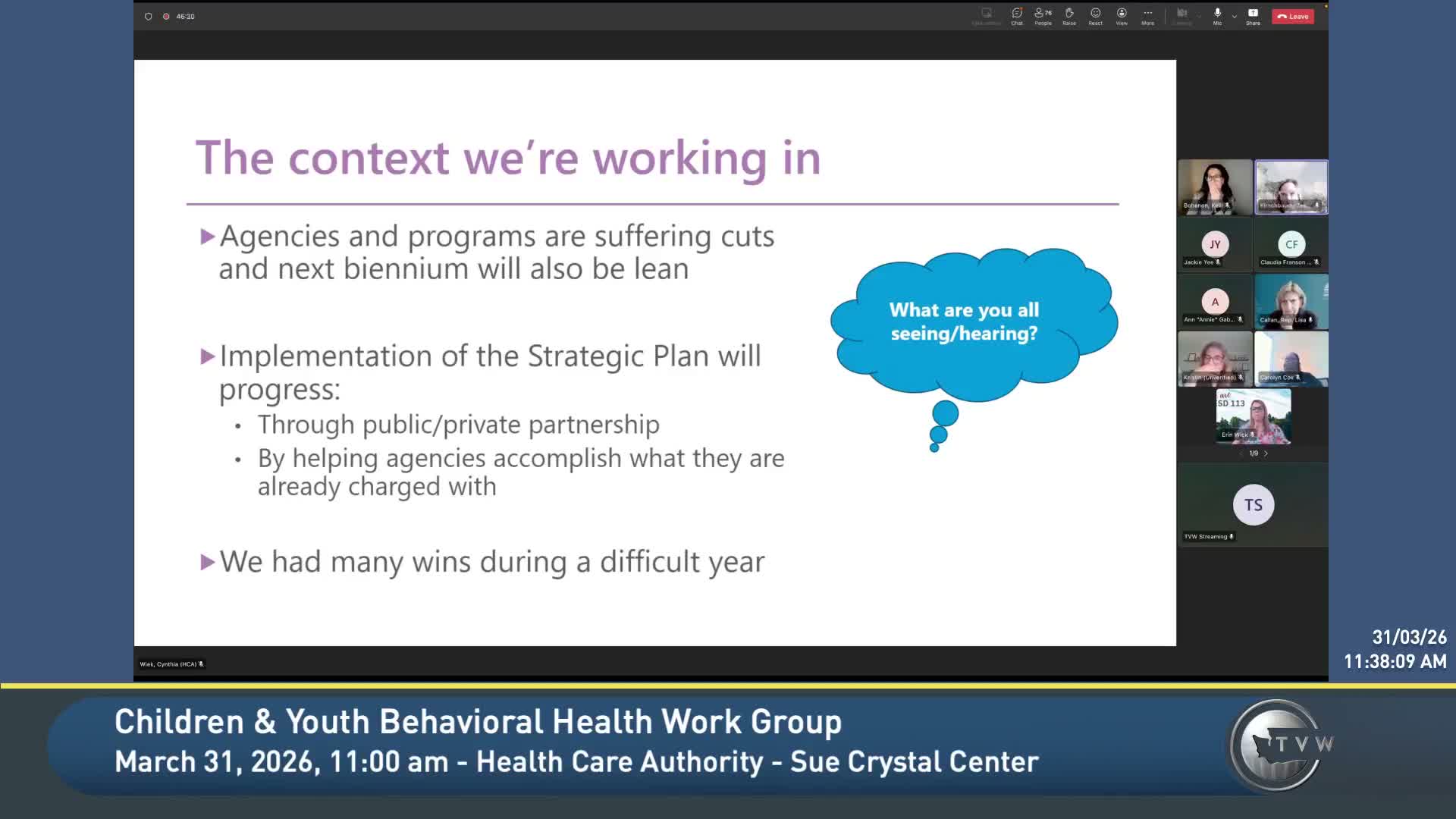
Workgroup leaders told members that the short legislative session left a constrained fiscal picture but delivered several policy wins for children, youth and behavioral health.
Representative Lisa Callan said the state faces a budget deficit and that agencies have already experienced cuts including "childcare and early learning" and reductions to some behavioral‑health services. She urged members to anticipate a lean biennium and to prioritize implementation choices accordingly.
Tisha Kirschbaum (Health Care Authority) described several specific outcomes: she said the Health Care Authority received funding to implement recent Medicaid changes and that the state is moving ahead with a CCBHC demonstration application (the application was submitted shortly before the meeting). She also said funding and capacity in the capital budget will support Evergreen Treatment Services to expand programming for pregnant and parenting women.
Sarah Rafton and Jim Theophilus noted both losses and gains: Rafton said cuts were made but that funding for two CCBHCs and restoration of the Partnership Access Line were "real wins for children and families." Theophilus emphasized that bridge‑housing beds were retained and described coalitions and bed capacity as critical.
Staff also flagged several new investments: funding to prevent critical incidents, parent supports for caregivers struggling with substance use disorder, and DSHS support for a 10‑year strategic plan for services for people with intellectual and developmental disabilities. At the same time, staff acknowledged an unfortunate cut to a homeless youth coalition that provides navigation services.
Members asked for more granular fiscal mapping and reiterated the need to track which investments are one‑time (philanthropic or capital funds) and which create ongoing obligations. Several participants emphasized workforce concerns and the potential for burnout as an implementation barrier.
Meeting staff said they will return with more detailed budget and fiscal‑mapping information and will coordinate the work group’s implementation priorities with the leadership council once it is established.