Lifetime Citizen Portal Access — AI Briefings, Alerts & Unlimited Follows
Workgroup hails passage of Washington Thriving bill; members press for tribal inclusion and implementation details
Loading...
Summary
Members of the Children & Youth Behavioral Health Workgroup described House Bill 2429 as a major step toward implementing the Washington Thriving strategic plan, but pressed for clearer tribal representation, executive coordination staffing, and public accountability as the work shifts from legislation to implementation.
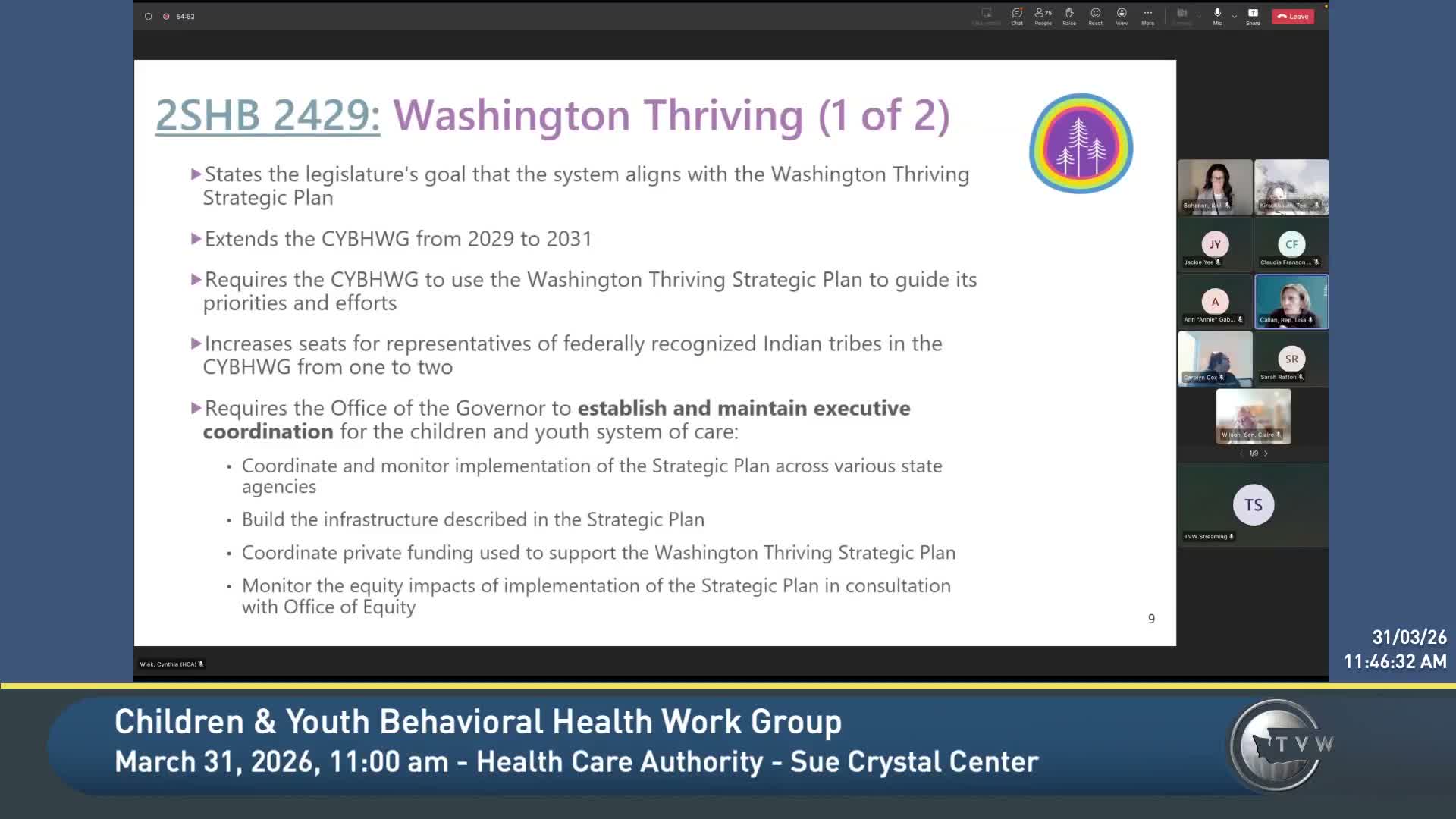
Representative Lisa Callan and the work group used Wednesday’s meeting to summarize key provisions of House Bill 2429 — the statute that directs state agencies to align with the Washington Thriving strategic plan and extends the group’s statutory sunset to 2031.
Callan said the bill ‘‘creates a directive to state agencies’’ and ‘‘establishes a leadership council and an executive coordination role’’ to shepherd implementation. The legislation also increases tribal representation on the work group and authorizes public‑private partnerships to seed implementation roles, she said.
The nut graf: attendees welcomed the bill’s passage but repeatedly pressed for clarity about how tribal governments will be engaged, who will occupy the newly created executive coordination position, and how accountability to communities and to lived‑experience advocates will be maintained during implementation.
Policy director Sarah Rafton said the session was ‘‘a very difficult session, but also highly productive,’’ and highlighted wins for children and families including funding for two Certified Community Behavioral Health Clinics (CCBHCs) and restoration of the Partnership Access Line. Rafton also noted DSHS‑funded planning for a 10‑year strategic plan addressing services for people with intellectual and developmental disabilities.
Multiple members, including Angela Fraser Powell and Senator Claire Wilson, urged direct tribal consultation and asked that tribal nations be able to select representatives through their own governance processes. Powell asked whether ‘‘all the tribes from Washington state [were] at the table’’ and proposed funding or a liaison mechanism so tribal voice is consistently represented. Senator Wilson warned past child‑welfare bills failed because of inadequate tribal engagement and urged the work group to avoid repeating that mistake.
Riley (staff) and others said the bill’s language was drafted to let tribes determine their representative; staff described planned listening sessions and consultation with the Health Care Authority’s Office of Tribal Affairs and the American Indian Health Commission to incorporate tribal priorities into implementation.
Members also discussed the design of the leadership council, which was described as a smaller, action‑oriented subcabinet that should include senior agency leaders with decision authority. The group discussed a public‑private philanthropic approach to staffing the new executive coordination role and noted that philanthropic dollars have already been raised to seed that position and to fund implementation sprints.
The work group asked for public reporting and transparent metrics so advocates and the public can ‘‘keep everybody accountable,’’ as Callan put it. Staff said implementation work will include fiscal mapping, outcome and metric development for the system of care, and explicit mechanisms to lift lived‑experience voices into decisionmaking.
The meeting closed with staff asking members to continue focus on aligning subgroups and clarifying deliverables over the next three years so that Washington Thriving becomes an operational roadmap rather than a set of disconnected activities.
The work group’s first in‑person meeting is scheduled for May 28 in Olympia; the governor’s office will handle formal appointments to open member seats (tribal seats are selected separately).