Lifetime Citizen Portal Access — AI Briefings, Alerts & Unlimited Follows
St. Pete Beach magistrate denies new repeat‑violation finding for homeowner with disability, fines several short‑term rental and maintenance cases
Loading...
Summary
Special Magistrate Erica Augello found that the property at 191 73rd Avenue was in compliance and declined to find a new repeat violation but required a written plan within 15 days; the magistrate also assessed fines or administrative costs in several short‑term rental and property‑maintenance cases and set multiple status hearings for May 11 and June 8.
Special Magistrate Erica Augello on April 13 ruled on more than two dozen code‑enforcement matters for the City of St. Pete Beach, finding a mix of compliance, continuances and monetary penalties.
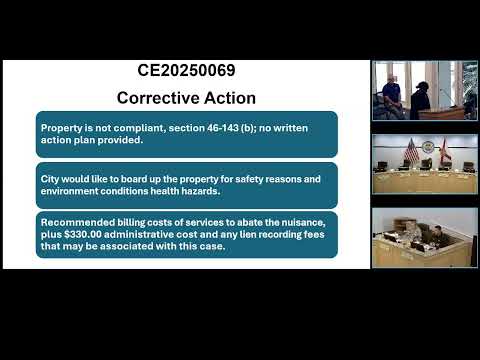
Augello declined the city’s request to find a new repeat violation at 191 73rd Avenue, the home of Jeffrey (Jeff) Myers, after city staff told the court the property had been tidied before the hearing. "I am going to find that there is no repeat violation," Augello said, while noting that an existing chronic nuisance abatement order remains in effect and that she retains jurisdiction under that order through July 2026. Augello required Myers to submit a written plan within 15 days describing how he will keep the property in the current compliant condition and said she would amend and re‑record the chronic‑nuisance order accordingly. Myers told the magistrate he is visually impaired and has struggled after hurricane and health setbacks, saying, "I feel terrible. I don't want my neighbors to have to look at something bad like that," and describing referrals to ADA‑related services and volunteer assistance he has sought.
The magistrate found violations and imposed monetary penalties in several short‑term rental cases. In one matter involving a Dolphin Watch listing, Augello concluded three stays constituted short‑term rentals and imposed a reduced fine of $500 for each of three impermissible rentals (total $1,500) plus reasonable administrative costs after determining the city’s compiled online evidence met the quasi‑judicial burden of competent, substantial evidence. In another short‑term rental case against JDH Florida Holdings LLC, owner James House acknowledged the listings: "Guilty as charged. I just took some bad advice, was unaware, and I've... plead ignorance and [am] willing to accept my fine," he told the magistrate. Augello assessed $1,000 for each of three impermissible stays in that case (total $3,000) plus $330 in administrative fees; she also ordered the property’s listings removed and that future rentals comply with the city's monthly‑rental requirement.
Several permitting and post‑storm renovation matters were continued or given deadlines. For properties where work was done without permits — including cases involving after‑the‑fact permits for mini‑split HVAC units — Building Official Luke Curtis told the magistrate that required documents (for example, AHRI equipment certificates and clearer photo evidence) were missing and that some permits are being held pending a substantial‑damage/substantial‑improvement (SDSI) determination. For one post‑storm renovation case, the magistrate set a two‑step order requiring the permit application to be formally submitted within seven days and, if complete, a permit secured within 45 days; a status hearing on progress was scheduled for June 8.
The magistrate also assessed daily fines or administrative costs in multiple maintenance cases where property owners had not corrected cited conditions. Examples: a property with expired vehicle tags and overgrown vegetation was assessed $250 per day beginning March 25 plus $330 administrative costs; another property was placed on a $250‑per‑day fine schedule for exterior disrepair until remedied. In several matters the city withdrew or reduced requests after inspectors observed on‑site compliance the morning of the hearing; in those instances the magistrate typically assessed only administrative costs.
Where evidence or statutory citations were unclear, Augello ordered continuances to allow the city to reframe legal bases (including one chronic‑nuisance matter the city asked to pursue under a specific chapter). The magistrate repeatedly urged property owners and representatives to keep lines of communication open with code enforcement and planning staff and reminded parties that written orders will follow and be mailed to the contact information on file.
The magistrate scheduled follow‑up status hearings across the docket — most commonly May 11 (status updates) and June 8 (compliance hearings) — and adjourned the session.
What’s next: Parties ordered to submit paperwork (written plans, permit applications, appeals or evidence) should expect written orders from the magistrate and follow‑up docket dates in May and June. Where fines were imposed, the magistrate’s written order will include the assessed amounts and any recording or abatement fees that may be billed to the property owner.