Get Full Government Meeting Transcripts, Videos, & Alerts Forever!
Get email alerts on the School Safety topic
No spam. Unsubscribe anytime.
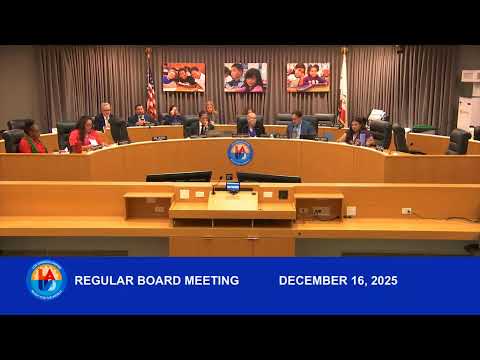
LAUSD board backs community‑based safety plan, calling for standards on safe passage and restorative practices
Summary
The board endorsed a districtwide community‑based safety framework Dec. 16 that emphasizes safe passage, peace‑building and community care. Supporters said it will protect students amid heightened immigration enforcement; some parents opposed the measure and urged return of school police.
The Los Angeles Unified School District board voted to adopt a resolution on Dec. 16 directing staff to develop a districtwide community‑based safety framework centered on safe passage, restorative practices and community care. The motion passed 5–1 with one absence after hours of testimony from principals, restorative justice teachers, students and community organizations, and debate among board members.
Board member Carla Griego, who introduced the measure, said the resolution responds to "real gaps" in school safety and aims to set a consistent standard for community‑based partners and volunteers, outline funding needs and recommend training and protocols for incidents including immigration enforcement near campuses. "Safety grows through relationships, caring staff and consistency," she said during the presentation.
Supporters included principals and staff who described local safe‑passage partnerships with city council offices and community organizations, and students who urged care‑based responses rather than policing. Los Angeles City Council members representing parts of the district described discretionary funds committed to pilot safe‑passage programs in partnership with LAUSD.
Opponents included parent groups who said they had gathered signatures urging the return of school police and questioned the readiness of volunteer safe‑passage programs; the public record showed both widespread community support and organized opposition. The resolution requires staff to return with an implementation plan, a procurement approach for a community‑based safety expert, and an assessment of funding sources and training needs.
The board’s action sets in motion a yearlong work plan: staff will issue a request for proposals for an independent safety expert, assess existing site programs, and return with recommended funding strategies and accountability measures. That plan will be developed in consultation with community partners and city agencies, according to board direction.
Advocates repeatedly tied the resolution to recent immigration enforcement activity near schools: they said community‑based safety is needed to ensure students can get to and from campus without fear. The board asked staff to coordinate with city partners on crossing guards and safe‑passage staffing as part of the plan.