Get Full Government Meeting Transcripts, Videos, & Alerts Forever!
Get email alerts on the Budget topic
No spam. Unsubscribe anytime.
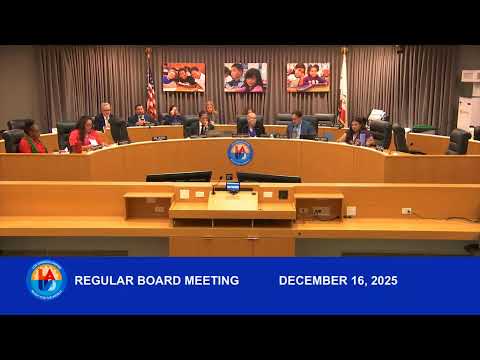
LAUSD board certifies first‑interim budget after contentious debate over cuts to equity funds
Summary
The Los Angeles Unified board voted 6–1 to certify a positive first‑interim budget Dec. 16, while approving an updated fiscal‑stabilization plan that relies on one‑time reserves and school‑level carryover changes. Parents, students and advocates warned the plan would disproportionately affect high‑need schools and urged the district to protect SENI/CENI funding.
The Los Angeles Unified School District board certified a positive first‑interim budget on Dec. 16, voting 6–1 to adopt financial projections that include one‑time solutions and a fiscal‑stabilization plan intended to avert a deeper shortfall through 2027–28. The vote came after a lengthy presentation from Chief Financial Officer Saman Bravo Karimi and hours of public testimony from students, families and community groups who warned the board the plan would hollow out supports at high‑need campuses.
The budget presentation showed the district projecting roughly $1.5 billion in unassigned ending balances this year and a positive $10 million in the third year of a three‑year forecast after several one‑time actions. Those actions include releasing previously set‑aside OPEB funds and transferring the full balance of Fund 17 into the general fund; together with the fiscal‑stabilization plan (FSP) the district estimates about $1.4 billion in savings, short of earlier targets. The administration also set aside roughly $796 million to cover salary offers already made to bargaining units, a sum the CFO said is largely committed and reduces flexibility going forward.
Board members who supported certification stressed the short‑term imperative to show fiscal control while acknowledging that the FSP is a living document that will be revised as state and federal revenue assumptions change. "We need to be realistic about the choices before us," CFO Saman Bravo Karimi told the board, while noting that further reductions will be necessary to maintain long‑term stability.
Opponents warned the approach relied too heavily on one‑time fixes and on requiring school sites to absorb risk. Board member (and critic) Doctor Rivas said she would vote yes to enable the district to move forward with a health‑benefits agreement but urged more transparency and stronger protections for equity investments. Dozens of public commenters — including students, parents and community groups — urged the board to protect the Student Equity Needs Index (SENI/CENI) allocations and to avoid layoffs that would disproportionately affect schools serving the district's most vulnerable students.
The administration said it will produce an equity impact analysis and further school‑level modeling in the coming weeks and work with the board on targeted mitigations. The CFO and superintendent also pledged increased state and federal advocacy to offset the anticipated revenue declines, including campaigning to reduce enrollment‑related funding losses tied to immigration enforcement in affected neighborhoods.
The board’s certification is a statutory step that allows the district to continue operating while it finalizes next year’s budget. It does not lock in every element of the stabilization plan; several board members said they expect continued revisions between now and the June budget adoption.
The district plans to return with additional analysis on the distributional impacts of the proposed cuts and to brief the board on potential alternatives before finalizing any school‑level reductions. "This is not the end of the conversation — it is the beginning of the hard work of protecting classrooms," Superintendent Carvalho said. The board scheduled follow‑up committee briefings and asked staff for a clearer list of central contracts and consulting expenditures that could be reduced before deeper school impacts occur.