Get email alerts on the Climate Commitment Act topic
No spam. Unsubscribe anytime.
Enumclaw hears Climate Commitment Act briefing as city utility sits near regulatory threshold
Summary
City Administrator Chris Searcy told the council that Enumclaw's municipal gas utility is "marginally" over the CCA threshold of 25,000 metric tons and outlined options including reducing gas load, seeking alternative compliance with other municipal utilities, and potential legislative or grant strategies; council asked staff to return in May with more information.
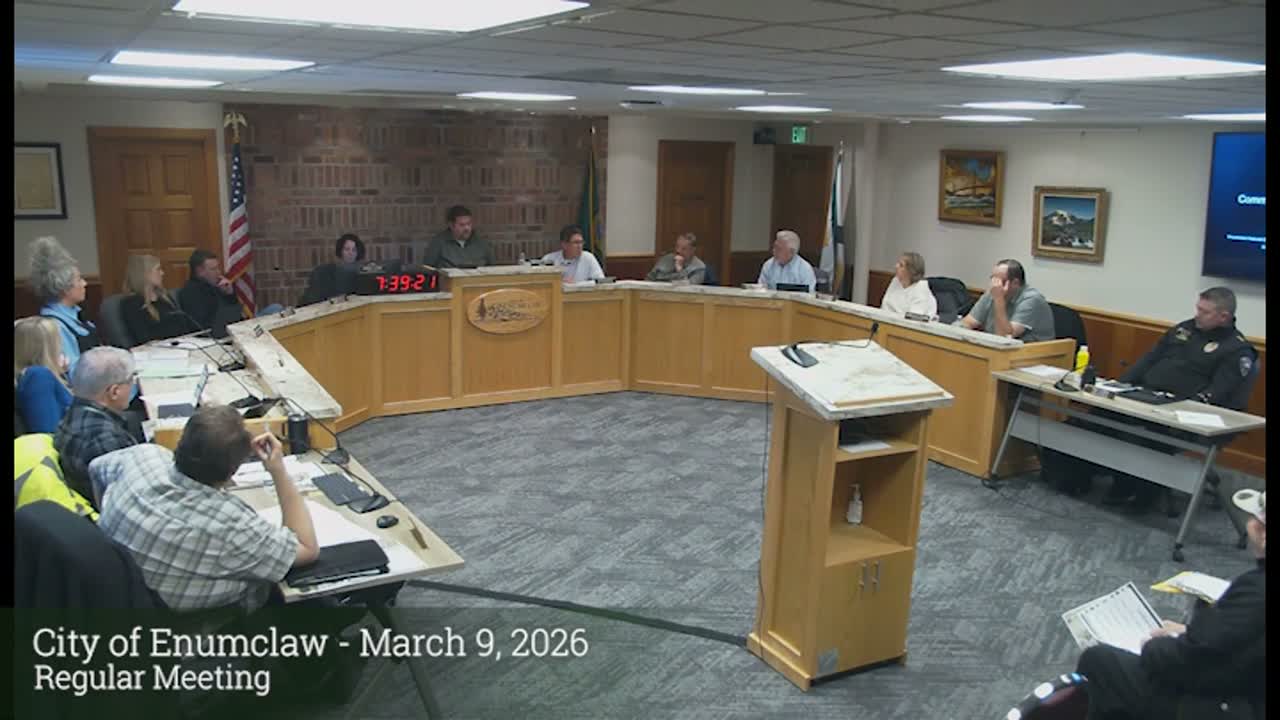
City Administrator Chris Searcy briefed the Enumclaw City Council on March 9 about the Climate Commitment Act and what it means for the city's municipal natural-gas utility, saying the city currently sits just over the 25,000 metric-ton threshold that draws a utility into the state program.
"It is the law. We need to follow it," Searcy said, explaining the CCA is a state cap-and-invest program that requires covered entities to obtain annual carbon allowances equal to their greenhouse-gas emissions. "Our average emissions for '23 through '25 was a little over 25,000 metric tons," he said, noting the city is only marginally above the cutoff and that ecology can retain a utility in the program if it is within 10 percent of the threshold.
Searcy described the program mechanics: the state provides declining "no-cost" allowances, requires some allowances to be consigned to auction, and reduces the no-cost share year over year; municipalities must purchase additional allowances at auction. He said Enumclaw began participating in the auctions after losing an appeal of the baseline calculation, and that the city calculates a compliance charge that appears on customer bills. "We started out at about six cents [per CCF] for legacy customers," Searcy said, adding nonlegacy customers who connected after July 25, 2021, pay a higher, straight-math conversion.
The presentation flagged several policy choices for council consideration: pursuing full cost recovery from new development, developing programs to reduce customer gas loads (for example heat-pump conversions), seeking an alternative municipal compliance path with other municipal utilities such as Ellensburg, or pursuing grant funds for decarbonization planning. Searcy said the city does not have in-house staff capacity to run a large customer-conversion program and would need technical support and potentially additional personnel.
Searcy gave order-of-magnitude historic figures: "The first year was about $250,000 in 2023," rising toward figures in the mid-hundreds of thousands in later years and with the potential to exceed $1 million annually depending on allowance prices and program linkage. He cautioned that future costs are uncertain because they depend on carbon prices, program linkage with other jurisdictions and the pace of demand reduction statewide.
Council members asked for clearer cost projections and for staff to revisit the topic after the council has had time to review materials and consult with other municipal utilities. Searcy said staff would return with more detailed projections and possible policy options in May.
The council made no policy decision at the meeting; the workshop was presented for information and to solicit council direction on whether to pursue legislative or intermunicipal strategies going forward.
What happens next: staff will prepare cost projections and potential policy options and bring the topic back to the council in May for further direction and potential follow-up work with legislative representatives or partner cities.
AI generated
The text on this page is AI generated. Summaries, highlights, analysis, and video transcripts are all produced from the original source material.
AI can make mistakes, so if you spot one, and we will fix it for everyone.
Note: the source content is unaltered by us. Any content source we link to, be it a video, an audio recording, or a document, is presented exactly as its publisher released it. That publisher is usually a government body, sometimes an individual official or another organisation.