Get Full Government Meeting Transcripts, Videos, & Alerts Forever!
Get email alerts on the Education Equity topic
No spam. Unsubscribe anytime.
New Haven Unified presents equity report card showing improvements and persistent gaps
Summary
District coordinator Clint Puckett presented an equity report card to the New Haven Unified Board showing higher relative NWEA percentiles in math and reading, a 22% chronic absenteeism rate districtwide, and subgroup differences in program enrollment and suspensions; trustees asked for follow-up analyses on program effects and grade-vs.-test divergences.
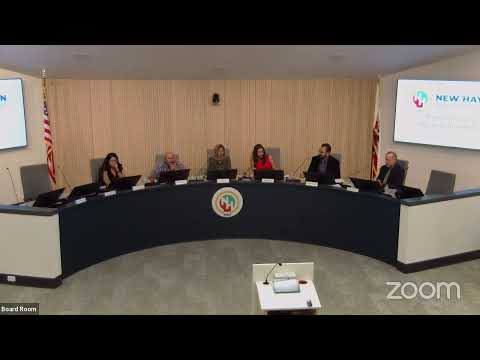
Clint Puckett, coordinator of assessment and evaluation for New Haven Unified, told the school board on Oct. 1 that the district’s equity report card shows mixed results: students scored around the 61st percentile in NWEA math and the 50th percentile in reading, while districtwide Spring 2024 SBAC results showed about 35.65% of students met or exceeded the standard and roughly 50% met reading standards.
Puckett said the report uses data from the student information system (ARES), state SBAC testing and NWEA benchmark assessments. He noted that marks, growth measures and standardized test results can diverge because report-card grades reflect multiple measures of classroom performance while SBAC represents a single standardized test.
“This percentile is represented here with the little numbers and the dials,” Puckett said, describing how NWEA compares district performance to national norms. He also called out a districtwide chronic absenteeism figure of about 22% (students missing 10% or more of school days) and said suspensions and expulsions are trending down.
Trustee Nishihara asked for more rigorous, program-level analysis next year to measure the effect of the district’s C STEM program on math outcomes. Vice President Kumar pressed staff on why local grade marks and SBAC results differ, asking whether expectations or assessments are misaligned. Puckett and staff responded that grades reflect cumulative, multi-measure classroom evaluations while SBAC is a single assessment focused on standards.
The presentation included program-enrollment breakdowns by ethnicity and cautioned that small subgroup sizes (for example, American Indian/Alaska Native students) can cause large year-to-year swings. Puckett highlighted district efforts to increase representation in choir, band and AP/honors pathways, and noted new speech and debate offerings at middle schools to build a pipeline to high-school forensics.
Board members and staff said they will return with more targeted analyses. The superintendent and staff emphasized efforts to use the data to guide interventions, professional development and resource allocation across sites.
The board did not take formal action on the report; the presentation was provided for information and follow-up.