Get Full Government Meeting Transcripts, Videos, & Alerts Forever!
Get email alerts on the Public Safety topic
No spam. Unsubscribe anytime.
Denver officials credit Place Network Investigations with sharp drop in shootings, plan expansion
Summary
City leaders presented data showing a large year‑over‑year decline in shootings at targeted Place Network Investigations (PNI) sites, described neighborhood interventions and ARPA funding that supported them, and said the city will expand the PNI approach to additional locations while acknowledging challenges rebuilding community trust in some areas.
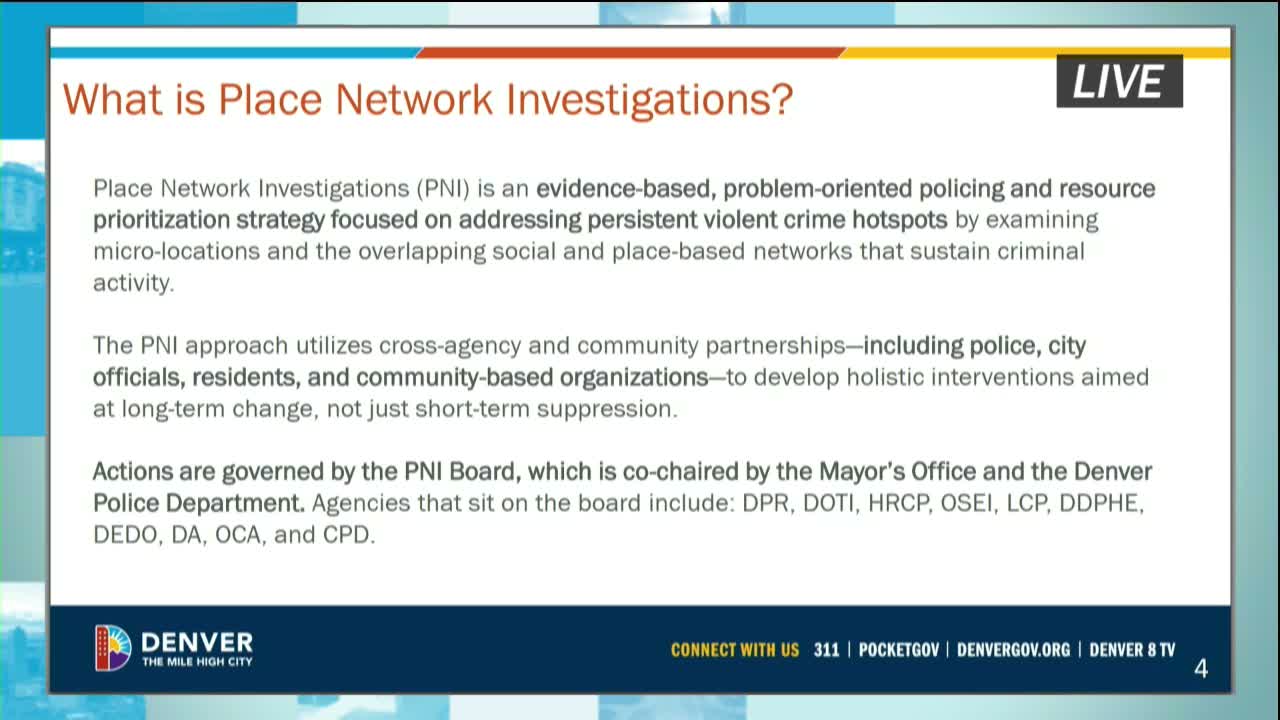
Denver leaders told the mayor-and-council joint meeting that the city’s Place Network Investigations (PNI) strategy has coincided with steep drops in violent incidents at the neighborhoods where it has been deployed.
Mayor (speaker 2) summarized program metrics during the briefing and said the city expanded from a single PNI site in 2023 to six in 2024, and that the six sites collectively saw nonfatal shootings fall from 22 in 2024 to 2 year‑to‑date in 2025. “You’ll see some really great results,” the Mayor said while walking through outcomes, adding that reductions are driven by a mix of community activation and cross‑departmental work.
Denver Police Chief Vaughn Thomas, who introduced the department’s rollout, said the approach draws on academic partners and multiagency planning. “I’m Denver Police Chief Vaughn Thomas,” he said, explaining the program’s phased work, site selection for persistently violent locations and the move to hand more sustained activity over to community partners as sites stabilize. He described PNI as “more of an investment strategy rather than an enforcement strategy,” and said success includes both reduced police contact and increased positive activation in parks and commercial corridors.
At the neighborhood level, a commander from the chief’s office described tactics used across sites: upgraded park lighting, mobile light towers, joint park‑ranger and police patrols, trash cleanups, community tournaments, façade and parking improvements funded in part by ARPA grants, and targeted enforcement to close businesses identified as “corrupting” crime patterns. The presentation named specific locations with notable results, including Paco Sanchez (more than 700 days without a shooting reported in the briefing), Colfax & Verbena, Leadsdale & Oneida, and the 4,300–4,800 blocks of North Peoria.
The presentation noted $499,000 in ARPA funds directed to local businesses at PNI sites to support security and activation work and said community organizing committees are taking on maintenance responsibilities in some neighborhoods so police can “pull back” once conditions improve.
Officials acknowledged limitations and risks. The commander said rebuilding trust is difficult after federal immigration enforcement actions and cited an example where ICE raids undermined momentum in one site: “we lost all our trust … after the ice raids,” he said, noting that recovery has been slow. Presenters also said some areas—such as LoDo—have dynamics that may require problem‑oriented policing or different tactics rather than a single PNI template.
Chief Thomas said the department will continue to prioritize PNI locations within existing budgets and adjust staffing as needed; the briefing also previewed a planned PNI start at Colfax & Pearl in the late April cycle. No formal council votes were recorded during the meeting.
The city framed PNI as a long‑term, cross‑agency investment that pairs infrastructure changes and community programming with selective enforcement and business‑code actions, and officials said they will continue to expand the model while tracking site‑level outcomes.