Get Full Government Meeting Transcripts, Videos, & Alerts Forever!
Get email alerts on the Shared Micromobility topic
No spam. Unsubscribe anytime.
Denver committee pauses vote on Veo as single operator after public concern over ACCESS riders and transparency
Summary
DOTTI recommended a 3-year license with Veo as Denver's single shared-bike-and-scooter operator, citing lower pricing, a new resident rate and expanded adaptive vehicles; public commenters urged extending Lime's ACCESS program and councilmembers asked for the contract and scoring, prompting the committee to postpone the vote to April 1.
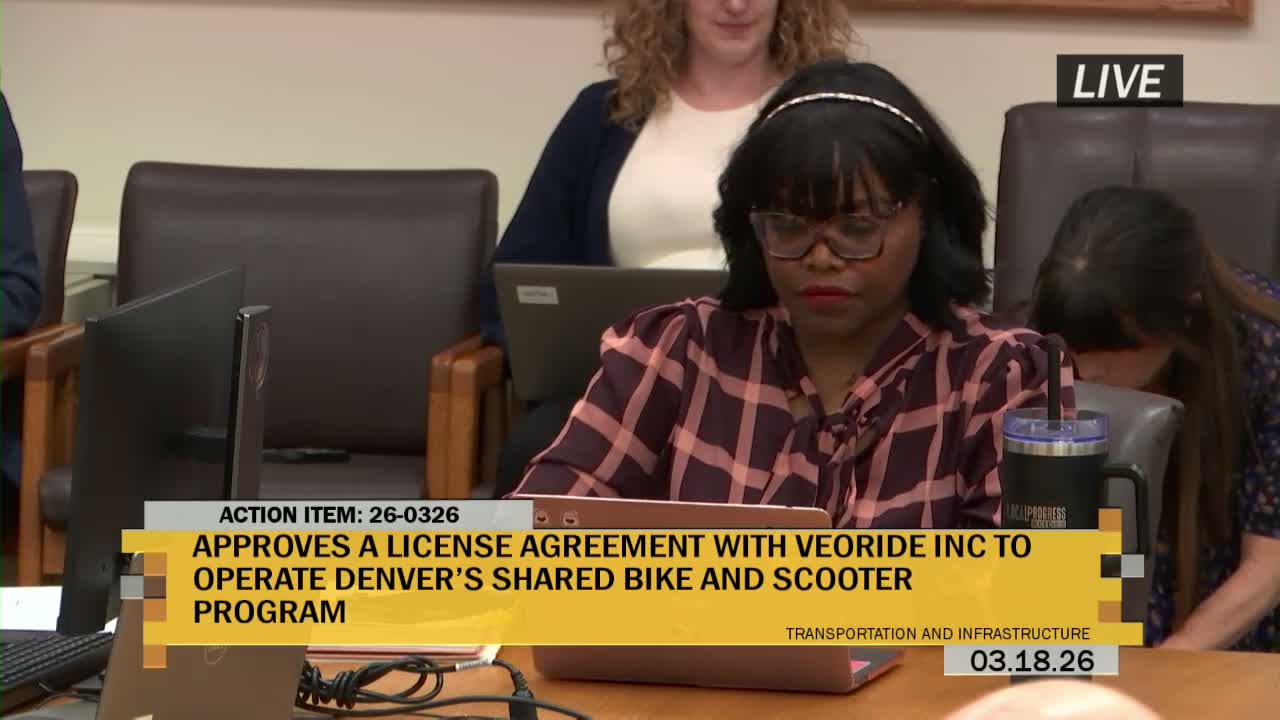
The Transportation and Infrastructure Committee on March 18 heard DOTTI's recommendation to award a three-year license to Veo to operate Denver's shared bike-and-scooter program, but postponed formal action to April 1 after sustained public comment and members' requests for the contract and scoring details.
DOTTI legislative liaison Elena McWhorter described an 18-month procurement that prioritized Vision Zero safety goals, equity and affordable access. Nathan Pope, DOTTI's senior city planner who led the RFP, said Veo "demonstrated the strongest responses" in interviews, demonstrations and financial review. Council members were shown contract features aimed at riders and equity applicants: a roughly 10% lower base-per-minute rate (about 39' per minute), a Denver resident pass priced at 25' per minute, and a new income-qualified ACCESS benefit that gives 60 minutes free per day instead of three separate free rides.
"We're going to have better, more affordable pricing," Pope said, adding the contract includes market-transition and data-handoff requirements, 20 service-level metrics with escalating accountability, and a revenue-share model in which Veo would pay $250 per device per year (DOTTI estimated that would bring in "over $2,000,000" across the contract).
Veo representative Alex Keating described the company's background and fleet. Keating highlighted that a majority of the planned vehicles have larger wheels and that Veo operates seated scooters, cargo scooters and a self-balancing trike intended to improve accessibility for riders with mobility challenges. DOTTI said the contract requires a minimum share of adaptive devices and real-time safety features, including sidewalk-riding and erratic-riding detection and audible coaching to the rider.
Public commenters split along lines of system design and transition risk. Several ACCESS riders and Lime-affiliated speakers urged the council to extend existing Lime contracts for 12 to 18 months to avoid disrupting riders who rely on Lime's ACCESS service. Colby Campbell, who identified himself as an ACCESS user, said extending Lime would "help test a new company or provide users to get used to dealing with a new type of access." Dustin Wilburn of Lime cautioned that "Denver shouldn't gamble the future of micro mobility" on an operator unproven at this scale.
Neighborhood and pedestrian-safety advocates, and some downtown residents, supported moving to a single operator to reduce fragmentation. Michael Miller, co-chair of the LoDo pedestrian-safety committee, said two vendors produce "fragmented data" and make enforcement more difficult; David Kurth (UPDONA) and Elle Baker (LoDo) similarly argued a single operator yields a clearer point of accountability.
Council members pressed DOTTI and Veo on several technical and policy points: how Denver residency will be verified for the resident pass (Veo said third-party ID verification and customizable back-end settings will be used), how equity-deployment zones were derived (DOTTI cited the DOTTI Equity Index and block-group data), device counts (DOTTI said the cap is 10,000 devices with roughly 6,000'7,000 expected at launch), and contingency plans if Veo fails to meet standards (DOTTI said the contract allows bringing in a second operator or reassigning a license).
Several members repeatedly requested to see the full contract language and the RFP scoring. Council members raised concerns about rapid transitions for ACCESS riders, the need to own and control program data while protecting user privacy, and the risk that a single-operator market could degrade service if the operator underperforms. One member cited national examples and asked DOTTI to explain how Denver's approach differs.
After discussion, a motion to postpone consideration of the Veo license agreement to April 1 was made and seconded. The committee recorded a roll-call vote of six ayes (Alvidrez; Glynn; Hines; Cashman; Sandoval; Chair Lewis) and postponed the item. A separate motion to postpone the related on-call contract amendments was made and seconded and the committee postponed those items to April 15. The committee then took no further action on the contract and adjourned.
What happens next: DOTTI told the committee it will provide the contract and the RFP scoring details in writing; the item remains on the committee calendar for April 1. If the committee reintroduces the resolution, it would go to the mayor and then to full council per the schedule DOTTI presented.
Quotes that capture the hearing: Colby Campbell, an ACCESS rider: "Lime Access came to me, and it made it so easy to get to her" (referring to an urgent medical trip). Dustin Wilburn (Lime): "Moving too quickly to a smaller untested operator could leave vulnerable riders without reliable transportation." Nathan Pope (DOTTI): "Through that whole procurement process, [Veo] were the strongest across all the criteria."