Get Full Government Meeting Transcripts, Videos, & Alerts Forever!
Get email alerts on the Wildfire Mitigation topic
No spam. Unsubscribe anytime.
PNM explains wildfire mitigation, says PSPS used only as last resort; urges residents to sign up for alerts
Summary
PNM officials outlined their wildfire mitigation program and explained how public safety power shutoffs (PSPS) are triggered, who would be notified and how restoration work is prioritized, and urged Corrales residents to register for outage alerts and LifeWatch if they have medical needs.
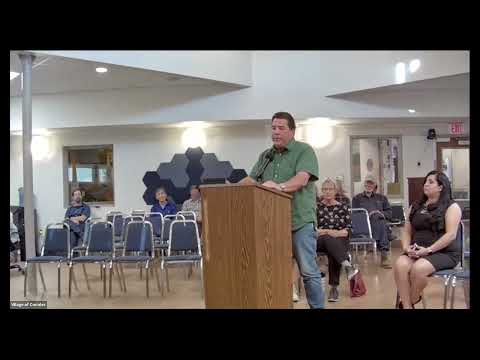
PNM representatives presented the utility's wildfire mitigation strategy to the Village of Corrales council, describing a suite of prevention measures and the circumstances under which the company would de‑energize lines through a public safety power shutoff (PSPS).
Deondra Lopez, PNM’s local government community manager for the Albuquerque area, and Thad Petzold, the utility’s associate director for wildfire and vegetation management, told the council the company uses a composite risk index that incorporates wind, fuel conditions and modeled fire behavior to monitor risk up to seven days in advance. Petzold said the company implemented a PSPS policy last year and uses it "only as a last resort" when thresholds indicate a credible risk of ignition from its lines.
Petzold said the utility is pursuing a layered approach: increased inspections and enhanced vegetation management in high‑fire‑risk areas, hazard‑tree removal, equipment upgrades (for example replacing expulsion fuses and targeted undergrounding) and changes to system settings during extreme weather to allow faster de‑energizing of lines if faults occur. He described operational steps before and during a PSPS: advance notification of first responders and local officials, mobilization of line crews (including out‑of‑state contractors when needed), and patrols of de‑energized circuits after winds subside. Petzold said restoration work can involve walking or flying long cross‑country line miles and may take 48–72 hours to inspect and clear large stretches in some events; in a recent Las Vegas event PNM shut off power to about 2,300 customers and restored service to the affected area within roughly three hours after winds dropped below the utility’s safety threshold.
Council members asked detailed questions about vegetation management and responsibility for private trees. Petzold said PNM does not own customers’ trees and that tree owners are responsible for maintenance, but when a tree poses a hazard to a primary voltage line the utility will require a line‑clearance certified trimmer to perform work; line‑clearance certification and strict ANSI/ISA standards guide those activities. He said PNM contracts with large, self‑certifying firms (he named examples) for many corridors and goes out to bid for vegetation contracts periodically.
Lopez and Petzold urged residents to sign up for outage alerts and PNM’s LifeWatch registry (for customers with medical needs). They said that LifeWatch participation does not prevent inclusion in a PSPS event, but the utility will make extra efforts to reach registered customers ahead of planned de‑energization (including in‑person visits when required). PNM also offered a tree‑planting brochure and guidance on Power‑line‑friendly species for the New Mexico climate.
The utility emphasized that PSPS decisions are not made lightly and are intended to reduce the likelihood of catastrophic ignitions from power infrastructure. The council asked staff to post PNM materials and sign‑up links on the village website.
The presentation closed with thanks from the council and an offer from PNM to continue outreach.