Committee hears bill to ban "stay-or-pay" training-repayment clauses; action laid over for drafting
Loading...
Summary
Senate File 25-33, which would prohibit certain training-repayment "stay-or-pay" clauses, received testimony from worker advocates and employer groups; the committee adopted an A9 amendment to narrow some exclusions but laid the bill over for further drafting.
Senate File 25-33, a bill to prohibit so-called "stay-or-pay" or "training-repayment" clauses that can obligate departing employees to repay employers, was the subject of extended testimony and debate in the Senate Judiciary & Public Safety Committee on April 13. The committee adopted an amendment that narrows covered provisions but laid the bill over for additional drafting.
Sponsor Senator Mann described the problem with examples across sectors, saying the clauses can trap workers by imposing payback obligations ranging from a few thousand dollars to tens of thousands. "These terms require workers who receive, 'on the job training,' many times of dubious necessity to pay back the alleged cost of this training if they leave their jobs," Mann said, and offered anecdotes including nurses and truck drivers hit with multi-thousand-dollar bills.
The committee adopted an A9 amendment, offered by the sponsor, clarifying that the prohibition would not reach sign-on bonuses, retention bonuses, relocation agreements or other payments made outside the primary employment contract; the amendment passed by voice vote.
Chris Hicks, senior policy adviser at Protect Borrowers, testified in support of the bill, citing studies and litigation and arguing the clauses reduce worker mobility and can produce excessive repayment demands. "These clauses cement a chilling effect on workers who might otherwise assert their workplace rights," Hicks said.
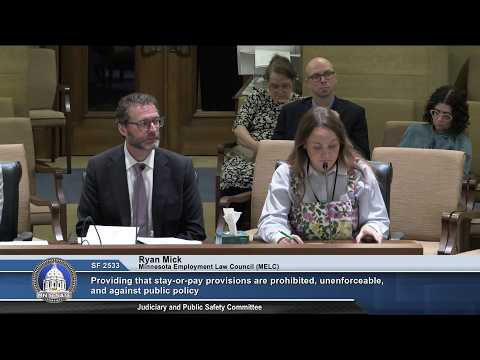
Employer-side witnesses, including Ryan Mick (representing the Minnesota Employment Law Council) and Lauren Shothorst (Minnesota Chamber of Commerce), said they support addressing abusive "trap" clauses but urged clearer drafting to avoid unintended consequences such as banning legitimate tuition reimbursement, advance loans, commission advances or employer-funded immigration assistance. Mick said the amendment addressed some stakeholder concerns but asked for more time to refine language around loans and other benefits.
Members also debated remedies in the draft: the bill as drafted includes a civil remedy allowing an aggrieved employee or similarly situated employees to bring actions and a statutory $5,000 penalty per violation in addition to actual damages and attorneys' fees. Senator Holmstrom unsuccessfully moved to remove the attorneys' fees provision and related remedies; the motion failed on a tie vote. Committee discussion flagged potential ambiguity about whether the Department of Labor could treat the penalty as an accrual-per-day administrative penalty; the sponsor said the intent was a one-time penalty per violation.
After extended discussion and requests for comfort language about loans, immigration assistance and other carve-outs, the committee laid the bill on the table for further drafting and indicated it could revisit the measure later in the week.