Get Full Government Meeting Transcripts, Videos, & Alerts Forever!
Get email alerts on the Housing topic
No spam. Unsubscribe anytime.
Receiver reports modest progress at Governor's Square; city pledge and grant applications remain critical
Summary
Justin Heinle, court-appointed receiver for Governor's Square, told Harrisburg City Council occupancy is 23% (49 units), delinquency has fallen to about 15%, and eight units have been restored; he said $250,000 city funds remain unused, $3.5 million in grants are pending, and an $11 million funding gap complicates a sale or exit strategy.
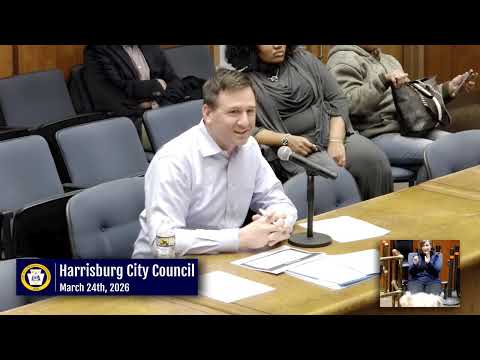
Justin Heinle, the court-appointed receiver and owner of Midtown Asset Consulting, told Harrisburg City Council on March 24 that Governor's Square is in “fragile but stable” condition and that the property’s occupancy has climbed to about 23 percent, or 49 occupied units.
Heinle said the receivership team has reduced delinquency to roughly 15 percent, restored eight units so far and has eight more in the pipeline. “We do daily rounds of the facility to ensure that it is maintained in a proper manner,” Heinle said, adding that board-ups and tighter access control have reduced criminal activity.
The report flagged the property’s weak financial position when the receiver took over: rent collections had dropped to about $19,000 in the months before receivership. Heinle said the receivership’s bank balance stood near $153,000 at the time of his presentation; a $250,000 city pledge remains unused. He said his team has applied for roughly $3.5 million in grants and employs a professional grant writer to pursue further options.
Heinle described a four‑phase capital improvement plan focused on buildings north of McLeay Street, where occupancy and building condition are worst. He said about 81 units appear recoverable; those units are expected to require an average of $10,000–$20,000 each for “recovery” (work to make units habitable), whereas fully gutted units could require much higher sums.
On exit options, Heinle said a sale would be preferable to long‑term municipal ownership but warned that an $11 million funding gap and extensive deferred maintenance will limit immediate buyer interest. “I’m gonna need at least a year to get ourselves into a position where we can even have those conversations,” he said, and he forecast it could take years afterward to align stakeholders and complete a transfer.
Resident Debbie “Gigi” Taylor described prompt, visible changes since Heinle’s team arrived: better lighting, cameras and rapid repairs when tenants report leaks. “Justin fixed it. I called one day, not even 24 hours later, it was fixed,” she said, urging council to continue support.
Council members asked about lead‑abatement opportunities, frequency of security patrols and per‑unit recovery costs; Heinle said he would coordinate with state and local programs where eligible and that off‑duty police and on‑site staff have supported recent board‑up operations. He committed to returning to council with updates approximately every six months and invited council members for a summer site visit to see renovated units.
Next steps: Heinle said the receivership will continue to seek grant funding, modulate capital spending to preserve cash, and pursue an exit strategy that may include repositioning assets or a sale contingent on stakeholder concessions.