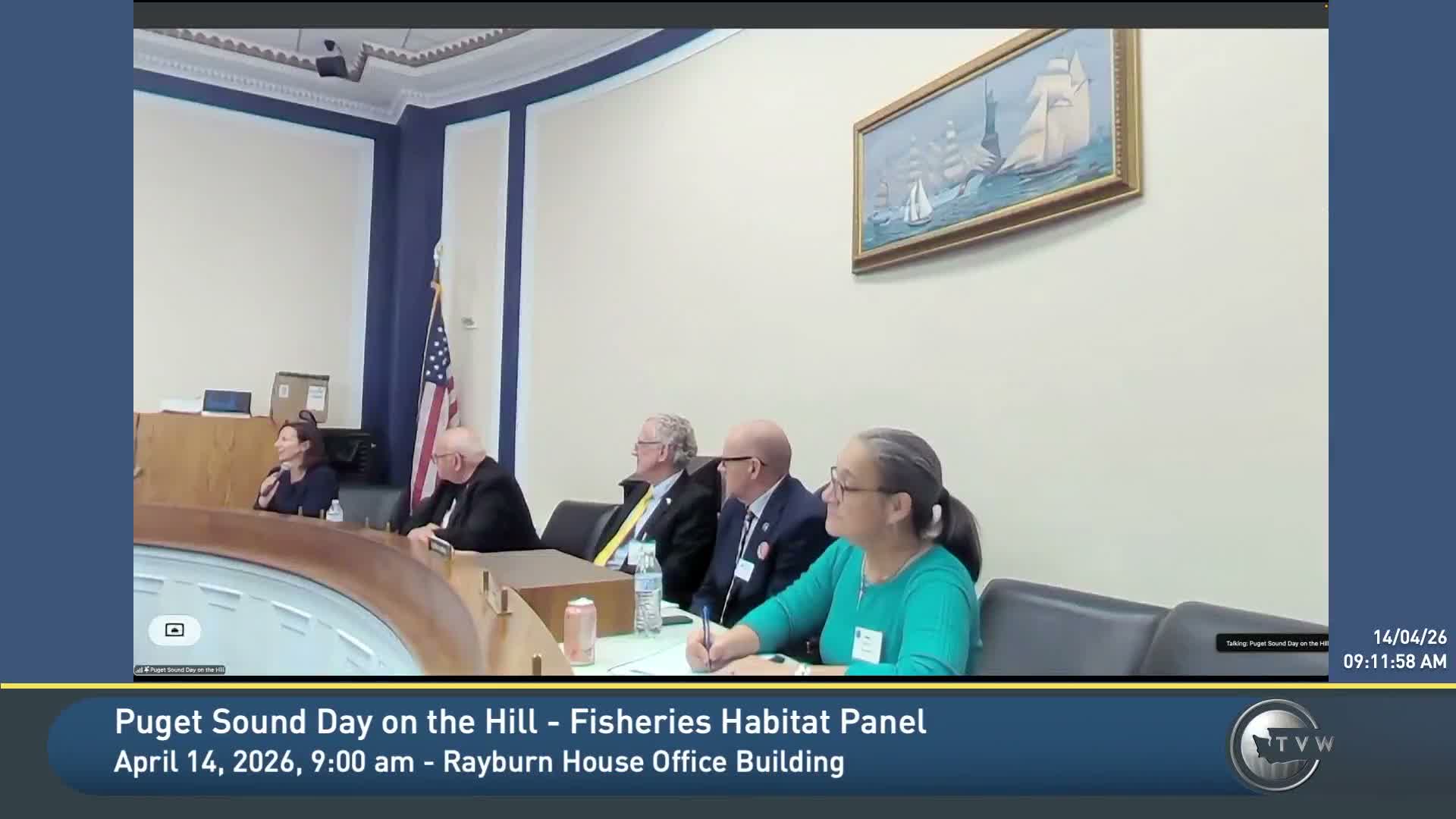
Panelists say federal investment multiplies economic value of the blue economy
Loading...
Summary
Tribal leaders, shellfish farmers and fishing-industry advocates told a Washington, D.C. panel that federal programs and science investments boost jobs, habitat restoration and commercial and recreational fisheries, citing global and U.S. blue-economy estimates and specific program needs.
A Washington, D.C. panel of tribal leaders, shellfish growers and fishing-industry advocates told attendees that federal investments in habitat and fisheries programs produce large economic and environmental returns for the U.S. "blue economy." Moderator Elizabeth opened the discussion by citing a World Economic Forum projection that the global blue economy will be worth about $3.3 trillion in 2026 and an estimated $825 billion contributed in the United States; she also referenced a working figure of roughly $18 billion per year in federal investment across agencies such as NOAA and EPA.
"For every $1 of a federal investment, we're looking at $46 of economic value," Elizabeth said in framing the discussion. Panelists urged continued funding for monitoring, restoration and hatchery programs and emphasized that science must guide spending priorities.
Ron Allen, chairman and CEO of the Jamestown Squam Tribe, described years of tribal work to identify pollution sources, restore estuaries and certify shellfish harvest areas, framing those efforts as both cultural stewardship and local economic activity. "For the tribes, it's a cultural value as well," Allen said, describing long-term cross-agency restoration projects.
Bob Rolf, representing the East Coast Shellfish Growers Association, said shellfish farming provides low-input, restorative protein and cited industry estimates for the East and West coasts. "We provide jobs, economic development, about a $195,000,000 worth of, sustainably farmed shellfish and another similar amount on the West Coast," he said, and described nutrient-removal and habitat benefits tied to oyster cages.
Larry Phillips of the American Sportfishing Association stressed recreational fishing’s scale and economic contribution. Citing roughly 40 million recreational anglers in the U.S. and about $230 billion in related economic activity, Phillips urged investments in science, hatcheries and monitoring so communities can sustain fishing access and associated jobs.
Speakers repeatedly tied the economic case to habitat and water-quality work—pointing to Sea Grant, NOAA research centers and conservation groups as partners—and asked policymakers to consider the broad set of benefits from investments that improve fisheries habitat.
The session closed with moderator Elizabeth inviting questions from the audience; panelists said more coordinated federal funding and science-based priorities could raise the odds that habitat investments deliver measurable benefits for commercial fisheries, recreational anglers and tribal communities.