Get Full Government Meeting Transcripts, Videos, & Alerts Forever!
Get email alerts on the Student Wellbeing topic
No spam. Unsubscribe anytime.
Board adopts updated mental‑health policy after debate over yoga, parental consent and training
Summary
After hours of public and trustee discussion, the board approved revisions to BP 51 41.5 (mental health) to align with state law; changes include restoring 'digital resiliency,' specifying grades 7–12 in one provision, and clarifying that meditation and yoga be presented as nonspiritual coping strategies on district posters.
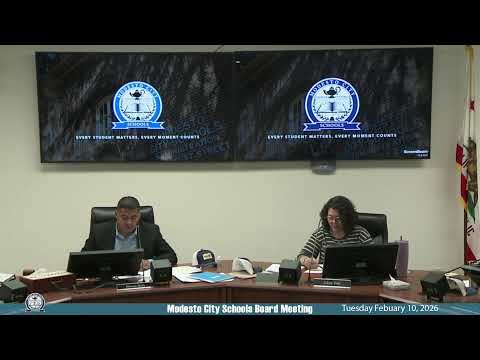
The Modesto City Schools Board of Trustees adopted revised Board Policy BP 51 41.5 (mental health) at its Feb. 10 second‑reading, after public comment and extended trustee discussion focused on parental notification and the inclusion of meditation and yoga among suggested coping strategies.
Tony Lomeli, senior director of student support services (speaker 22), said the policy updates reflect changes in California education and family codes regarding student mental‑health services, staff training, referral protocols and access. Lomeli noted the policy includes guidance about how staff share information about mental‑health services, and the district’s plan to meet state training requirements.
Public commenters and several trustees raised concerns over three main points: (1) how the district will select the 40% of classified employees who must be trained, (2) whether students aged 12 or older can consent and the role of parental consent, and (3) whether yoga and meditation constitute spiritual practices that should be treated differently. Vice President Daley said she would not vote for the policy as originally written because of nutrition and spiritual‑practice concerns but suggested a compromise to add parental notification requirements. Lomeli and other staff clarified that the family code provisions allowing clinicians to withhold parent involvement in limited, potentially dangerous circumstances have been law since 2013 and procedures will remain consistent with mandated‑reporting obligations.
On a motion to approve the second reading with revisions, trustees voted to: (a) add back the phrase “including digital resiliency,” (b) annotate the paragraph requiring staff‑family training with “students (grades 7–12)” in parentheses to clarify target audiences, and (c) specify on the poster that “meditation and yoga” are to be presented as nonspiritual coping strategies. The board carried the motion and approved the policy with those changes.
Trustees and staff agreed to follow up with implementation details, including how training will be scheduled and how parents will be notified about opt‑out or consent options for particular activities.