Get Full Government Meeting Transcripts, Videos, & Alerts Forever!
Get email alerts on the Child Welfare Audit topic
No spam. Unsubscribe anytime.
County reports progress on child‑welfare audit: referrals down, reforms under way
Summary
DCFS updated the board on audit follow‑up, reporting a drop in open referrals from a peak near 3,997 to 1,497 and listed completed and in‑progress fixes to documentation, training and interagency data sharing; staff committed to provide the board an updated dashboard and an April committee report.
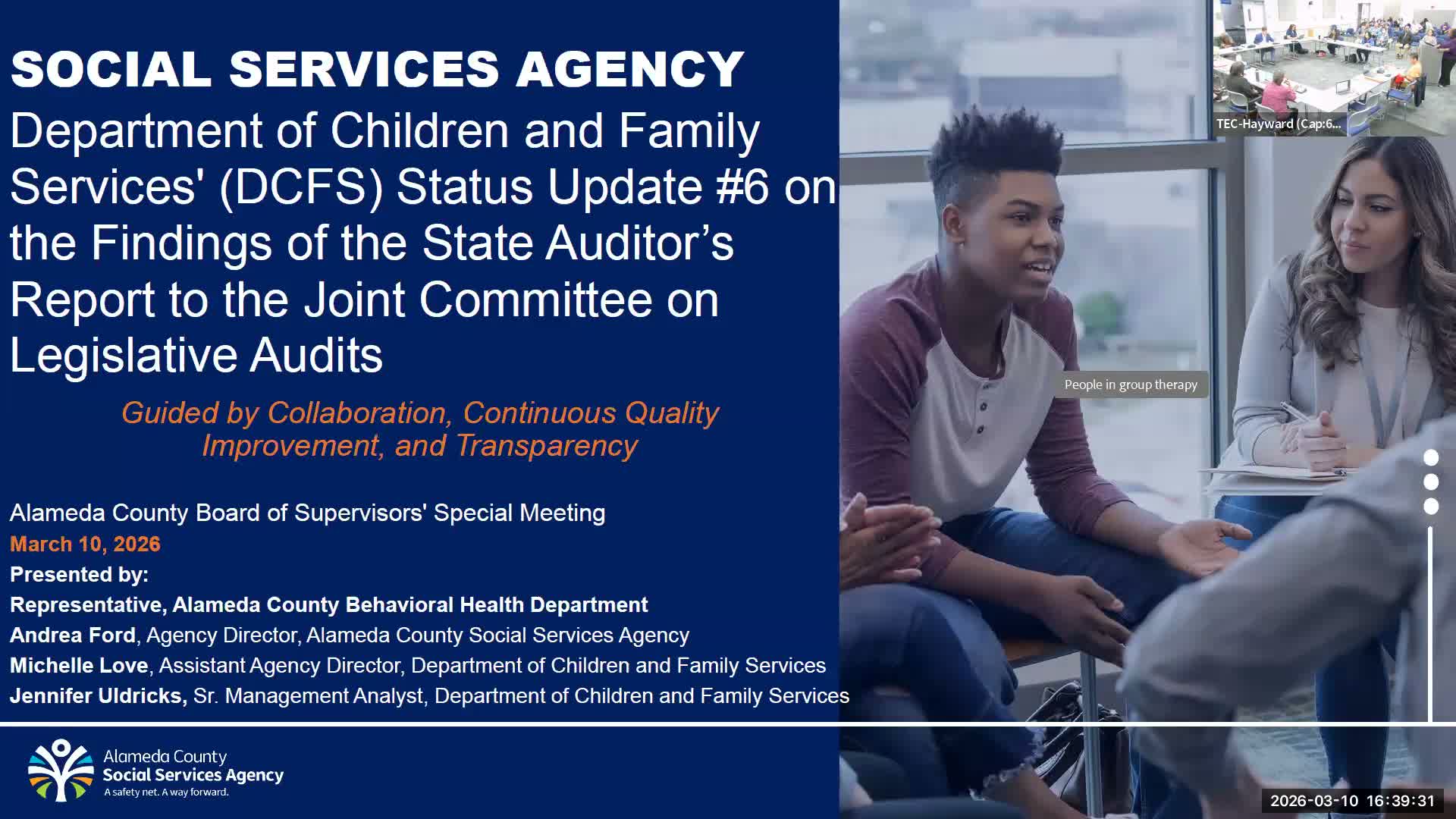
The Alameda County Department of Children and Family Services told supervisors on March 10 that it has implemented multiple reforms tied to a recent audit and has reduced a backlog of open referrals by more than half.
Michelle Love, DCFS leadership and behavioral‑health partners presented audit follow‑up work that included improvements to case documentation and court reports, new templates to capture service referral dates and monthly child‑visit tracking, mandatory shadowing for new staff and a revised approach to supervisor review. Love reported 1,497 open referrals at the time of the update, down from a peak close to 3,997 earlier in the audit period — a reduction the department said it achieved through active assignment and closure efforts.
Behavioral Health representatives described expanded access pathways (including school referrals and a single access portal under CalAIM) and a shared assessment tool to improve coordination. The presenters said they have formed a high‑needs committee across child welfare, probation and behavioral health to address a small subset of youth who require intensive resources and placement stability.
DCFS also reviewed a timeline of work tied to the state on‑site review and audit uploads; staff noted completed items (for example, relative‑notification within 30 days and several documentation improvements) and several ongoing tasks such as improved MOU/data‑sharing arrangements, transitional‑shelter care oversight and a workforce survey/focus‑group process to better understand retention impediments.
Supervisors pressed for both quantitative and qualitative indicators of service quality — including sibling placement rates, placement with relatives and examples of positive outcomes. Staff said the department has updated the public dashboard (data refreshes monthly for key metrics) and will provide the board with the April upload and further analysis. DCFS also flagged legislative opportunities it has proposed, including a bill referenced in the presentation (identified in materials as AB 141846) intended to strengthen relative placement preference during dependency proceedings.
Next steps: DCFS will return to the Social Services Committee in late March/April with the audit upload and a fuller progress report. Staff committed to send board members the updated dashboard link and the materials uploaded to the auditor’s system.