Lifetime Citizen Portal Access — AI Briefings, Alerts & Unlimited Follows
Alameda County supervisors weigh Measure W spending, budget risks as federal and state cuts loom
Loading...
Summary
Supervisors received a budget and Measure W update amid federal and state policy uncertainty that threatens Medi‑Cal and safety‑net funding; staff proposed a cautious two‑year $34 million per‑year essential‑services spending plan and will return in April with detailed allocations after public input.
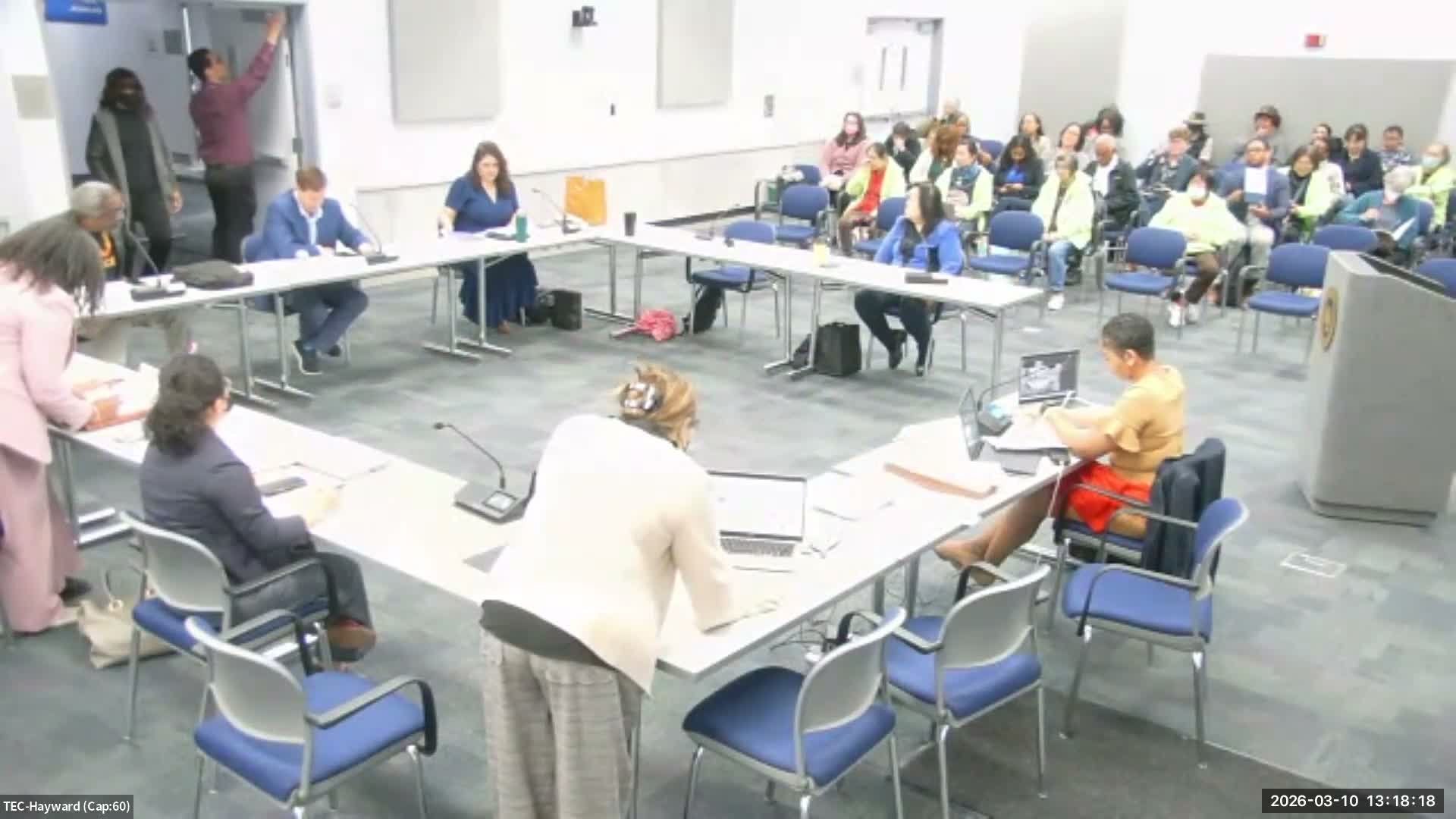
Alameda County supervisors on March 10 heard a detailed budget and financing briefing and discussed a two‑year spending framework for Measure W as the county prepares its FY26–27 budget. County staff warned that federal actions (including HR 1) and state spending rules could reduce federal support for Medi‑Cal and other safety‑net programs, placing new pressure on county services.
Razzley Taddeo and Amy Shrago of the county administrator's office presented economic indicators and the county’s fiscal outlook, noting the approved FY25–26 budget totals about $6.1 billion in spending and general fund appropriations of roughly $4.3 billion. Staff described an ongoing structural deficit and highlighted exposure in health‑care and safety‑net financing. The presentation cited local and national labor‑market shifts and recent industry layoffs as added uncertainty for county revenue projections.
On Measure W — the half‑cent sales tax approved by voters in 2020 — staff summarized prior board allocations and proposed a two‑year Essential County Services Fund strategy. Staff described Measure W planning totals of roughly $1.83 billion, including about $1.4 billion for a “Home Together” housing fund and an essential‑services envelope of around $258 million, with projected ongoing collections of about $170 million a year. For immediate action, staff recommended a two‑year program at $34 million per year divided among four priorities: stabilizing the safety net; meeting basic needs countywide; housing stability, tenant protections and capacity building; and one‑time capital and major maintenance.
Staff and several supervisors stressed prudence given federal and state uncertainty. The presentation noted possible measures to bridge state and federal cuts, including use of other county funds or layered funding strategies, and emphasized returning in April with specific allocations, a list of potential RFPs and an implementation timeline.
Public commentators, including leaders and staff from community‑based organizations, senior services groups, food‑security programs and immigrant/refugee service providers, urged the board to preserve prevention and culturally specific programs and to prioritize unincorporated communities. Multiple speakers asked the board to allocate a minimum share (many requested 35%) of essential‑services funds to unincorporated areas. Kimberly Victoria of Eden Power Collective and other speakers highlighted disparities in Ashland, Cherryland and San Lorenzo and asked the board for a clear formula to ensure multi‑year commitments for those neighborhoods.
Supervisors sought clarifying detail on the proposed carve‑outs: staff said the recommended two‑year $34 million annual program includes a roughly 20% carve‑out to serve unincorporated areas within those annual amounts, plus some one‑time capital allocations targeted to unincorporated projects. Several supervisors proposed shifting housing‑production or preservation items into the Home Together Fund (where the bulk of housing dollars are planned) to preserve Essential Fund dollars for time‑limited bridge needs such as Prop 1 mitigation and Medi‑Cal‑related shortfalls.
Next steps: staff said it will return with a more detailed April package that includes budget allocations, potential RFPs for two‑year contracts, a list of contracts that could be augmented, and an implementation timeline. The board did not adopt final allocations at the meeting; it directed staff to continue community engagement and to provide the requested detail for board review.