Get Full Government Meeting Transcripts, Videos, & Alerts Forever!
Get email alerts on the Zoning Cup Authority topic
No spam. Unsubscribe anytime.
Council asks staff to inventory CUP authority and recommend code updates after resident complaints
Summary
The council unanimously directed staff to return with a list of conditional-use permit types the zoning administrator currently handles, possible municipal-code updates to reduce CUP reliance, and a timeline/fee implications for shifting certain permits to the Planning Commission.
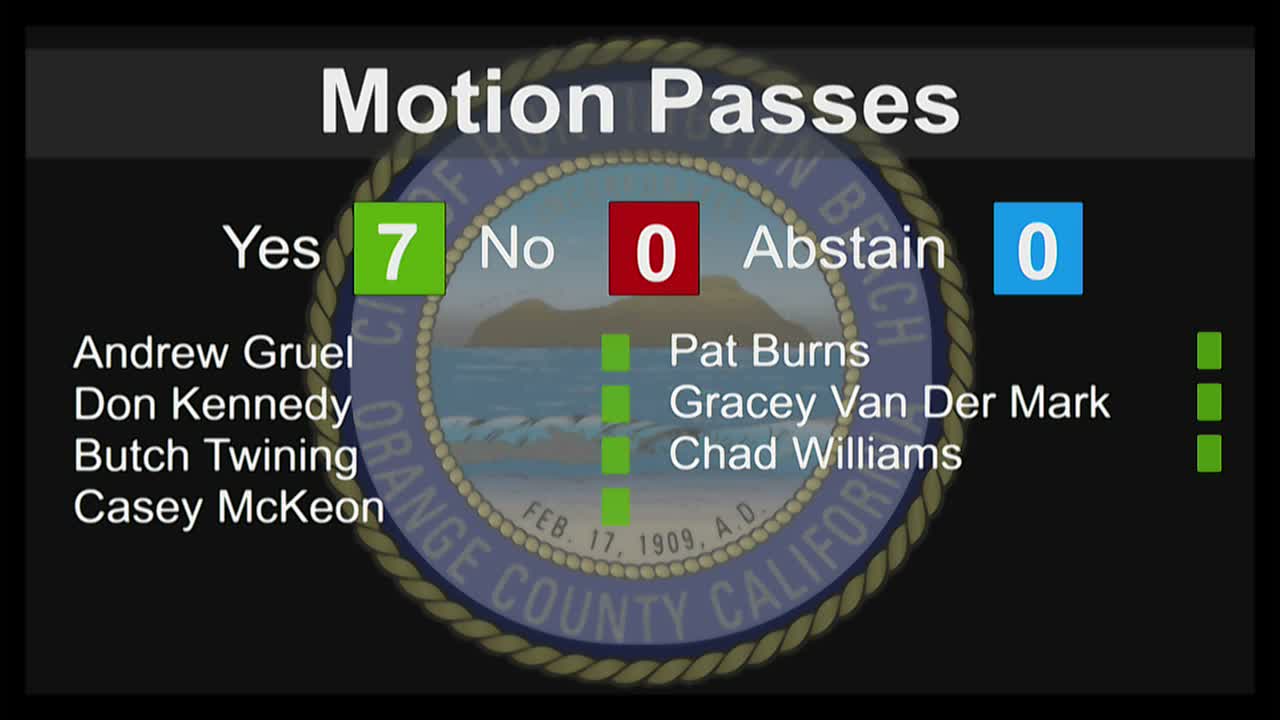
The Huntington Beach City Council on March 17 voted unanimously to ask staff for a fact-finding report on how conditional use permits (CUPs) are handled in the city and whether some discretionary approvals should be shifted from the zoning administrator to the Planning Commission.
Councilmember Pat Burns introduced the item, arguing that a single zoning administrator makes decisions that can have outsized neighborhood impacts and that the public deserves more community review for certain high-impact discretionary approvals. ‘‘Some of these projects change the community drastically,’’ Burns said during the discussion, citing recent large single-family rebuilds that neighbors said reduced solar access and changed streetscapes.
Council and staff discussed trade-offs: routing more permits to the Planning Commission increases public hearings and staff time (and therefore fees), but it can provide fuller public deliberation for proposals that materially change neighborhoods. Planning staff told the council the municipal code already distinguishes by project scale (for example, variances under 20% go to the zoning administrator; larger variances go to the Planning Commission), and fees are tied to the staff time needed to process an application.
Council directed staff to return with a package that includes: (1) a list of all CUP/variance authorities currently assigned to the zoning administrator, (2) recommendations for code changes that could convert some CUPs to administrative or ministerial reviews, (3) a timeline for code amendments and associated public-notice requirements, and (4) fee implications or a recommendation on whether a new fee study is required. Staff indicated they can produce the initial list and recommendations to the council for further instruction, and the motion passed 7–0.
Council members emphasized a targeted approach: preserve fast, low-impact administrative reviews that benefit businesses while moving higher-impact, neighborhood-affecting actions into a public hearing forum. Several speakers during earlier public comment had urged modernization and stakeholder engagement in any change to preserve predictability for local businesses.
Next steps: staff will submit the CUP-authority inventory and early recommendations; the council can then direct formal code amendments and, if necessary, a fee study and ordinance process.