Get Full Government Meeting Transcripts, Videos, & Alerts Forever!
Get email alerts on the Kratom Policy topic
No spam. Unsubscribe anytime.
Yolo County health officer warns kratom poses risks; board asks staff for cost analysis on local ordinances
Summary
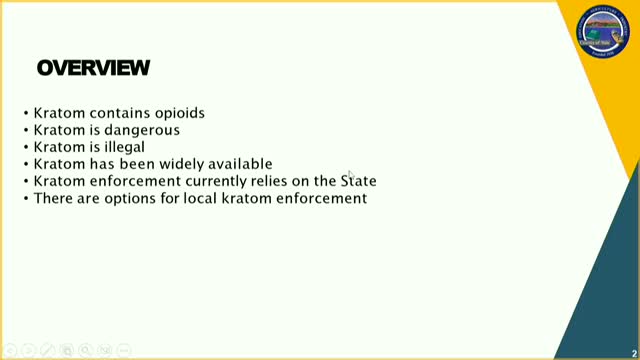
Yolo County Health Officer Dr. Amy Sisson told the Board of Supervisors that kratom contains opioid‑acting compounds and has been linked to seven county deaths since 2017. Staff recommended continuing referrals to the state; the board asked staff to return with cost and impact information on a county ordinance option.
Dr. Amy Sisson, Yolo County health officer, told the Board of Supervisors on April 14 that kratom contains opioid‑acting compounds and poses public‑health risks, and recommended that the county continue referring retailers who sell kratom to the California Department of Public Health for enforcement while considering local options.
The briefing was informational only. Sisson told the board that county review of death certificates identified seven deaths mentioning kratom since 2017; five involved other substances such as fentanyl or benzodiazepines and two involved only kratom, according to her presentation. She said kratom products contain pharmacologically active compounds including metragynine and 7‑hydroxymitragynine and that 7‑hydroxymitragynine is significantly more potent than morphine, as explained in the slide deck.
Why it matters: kratom sits in a legal gray area locally — Sisson said manufacture, distribution and sale are illegal but possession and use are not — and the county lacks direct authority under state food‑and‑drug statutes to seize packaged kratom without CDPH involvement. That limits local enforcement options unless the board chooses to pursue changes to local rules.
What staff recommended and what the board discussed: Sisson presented three approaches: (1) continue the current practice of referring retailers who sell kratom to the California Department of Public Health (CDPH) for investigation and enforcement (the staff recommendation); (2) amend the county’s existing tobacco retail ordinance to add kratom and permit local inspections and enforcement; or (3) adopt a separate local ordinance banning kratom sales and authorizing county enforcement. Sisson said option 2 would likely be the simplest if the county seeks local enforcement, because tobacco inspections already target the same retail channel.
Board members pressed staff on costs and scope. Several supervisors voiced support for continuing referrals to CDPH in the near term but asked staff to return with an impact and cost analysis for adding kratom to the county tobacco ordinance (option 2) and to coordinate with cities about countywide coverage. One supervisor described the current CDPH warning letters as effective but said a local ordinance might further reduce shipments from some online vendors.
Legal and enforcement limits: Sisson said Yolo County does not have Sherman Act (CDPH Food and Drug Branch) authority and therefore cannot itself regulate packaged foods under those statutes; instead, local environmental health enforces the California Retail Food Code for prepared foods. She noted that CDPH and other state agencies have issued warning letters and that referrals to the state have led to follow‑up investigations.
Next steps: the board directed staff to continue option 1 (referrals to CDPH) and to return with cost and impact information on option 2, including how the county would coordinate with cities and account for enforcement costs. Dr. Sisson and staff said they would report back with more specifics for a future agenda.