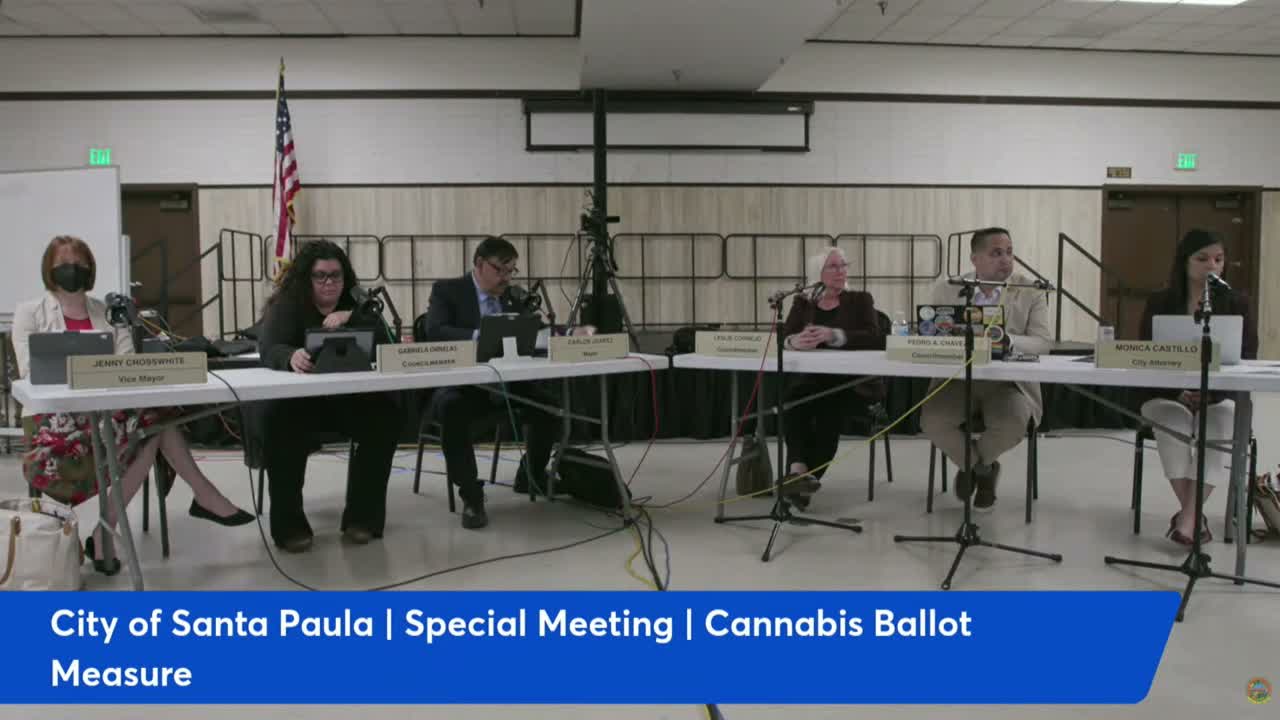
Santa Paula council hears hours of public testimony on cannabis ballot measure; motion to place measure fails 1–4
Loading...
Summary
City staff outlined legal options and cost estimates for a possible November cannabis ballot measure; dozens of residents testified, mostly opposing retail stores over youth and public‑health concerns, and a council motion to place a measure on the ballot failed by a 1–4 roll-call vote.
The Santa Paula City Council on April 6 heard a staff presentation and more than three hours of public comment on whether the city should allow retail cannabis and place a measure on the November ballot, but a motion to move forward failed on a 1–4 roll-call vote.
City staff framed the discussion by reviewing state law and local options. Economic development director James Mason told the council that Proposition 64 (2016), which legalized adult‑use cannabis statewide, allows cities to permit or prohibit commercial cannabis and to regulate zoning, licensing and taxation. Mason noted that Santa Paula currently prohibits all commercial cannabis activities except lab testing, and that a voter-approved Measure N (passed Nov. 6, 2018, with roughly 71.7% approval) established a placeholder business tax should retail ever be permitted. Mason summarized regional revenue trends, saying early adopter cities saw peak receipts that have since declined, and that estimates for Santa Paula if retail were allowed range broadly depending on tax rate and market draw.
City Manager Dan Singer outlined three staff options: 1) direct staff to place a full ballot measure on the November ballot with ordinance language prepared for voters to approve; 2) conduct a public‑opinion survey and return with results before deciding; or 3) fund a broader public‑engagement process with consultants, outreach and legal drafting. Singer described the tiered costs of those approaches, saying the most extensive option could run on the order of $90,000 (including legal and consultant work), while a basic ballot‑language approach could be implemented for roughly $25,000 to $50,000. Singer also cited a rough projected annual tax range of $300,000 to $600,000 based on regional comparables, but cautioned those figures vary with demand and tax rate.
Public comment dominated the meeting. Residents speaking against retail stores commonly cited youth exposure, public‑health studies and personal family experiences. ‘‘We already have problems in our schools with students vaping marijuana,’’ said resident Robert Bagdasian, who presented petition signatures urging the council to maintain the ban. Several speakers referenced scientific studies and local health reports they said linked increased retail availability to worse adolescent outcomes; others shared first‑person accounts of addiction in their families and urged the council to prioritize youth protection over potential revenues.
Other residents and at least one industry‑experienced speaker urged local regulation and voter choice. ‘‘Cannabis already exists in every community,’’ said Sienna Marie Sezum, who identified herself as a professional with licensing and compliance experience, and argued that local regulation allows cities to capture tax revenue, require testing and limit locations near schools. Proponents said licensed dispensaries can reduce illegal sales and generate funds for services.
The meeting also included less common, but consequential, claims: immigration attorney Pedro Chavez warned that admitting past marijuana use can have long‑term immigration consequences under federal law for some applicants, a legal risk he urged the council to consider for mixed‑status families.
Council members debated process and timing as the county deadline to file ballot materials loomed in late June. Supporters of taking the question to voters said a ballot measure would settle the issue and allow the electorate to decide; opponents warned of community division, the short timeline, survey reliability concerns and uncertain net revenue after enforcement and administrative costs. Several council members also questioned whether staff time and limited city resources should be spent on the process now.
Council Member Chavez moved to place a cannabis measure on the November ballot; Council Member Nelson seconded. The motion failed on a roll‑call vote: Chavez — yes; Ornelas — no; Cornejo — no; Vice Mayor Crosswhite — no; Mayor Juarez — no. With that result the council did not direct staff to proceed with ballot language or the staff’s basic approach that night.
What’s next: Council members indicated several paths remain available, including requesting additional research, commissioning a survey, drafting an ordinance for later consideration, or taking no further action. The staff report and the record of public comment will remain part of the municipal record if the council revisits the topic.
Meeting adjournment: Mayor Juarez thanked the public for respectful comment and adjourned the meeting.