Get Full Government Meeting Transcripts, Videos, & Alerts Forever!
Get email alerts on the Government Reform topic
No spam. Unsubscribe anytime.
Board hears hours of public opposition to Prop E streamlining recommendations
Summary
A packed hearing on March 17 drew extensive testimony opposing recommendations from the Prop E Commission Streamlining Task Force to move many chartered commissions into the administrative code and to alter appointment and disciplinary powers; speakers warned the proposals would weaken oversight and concentrate power in the mayor’s office.
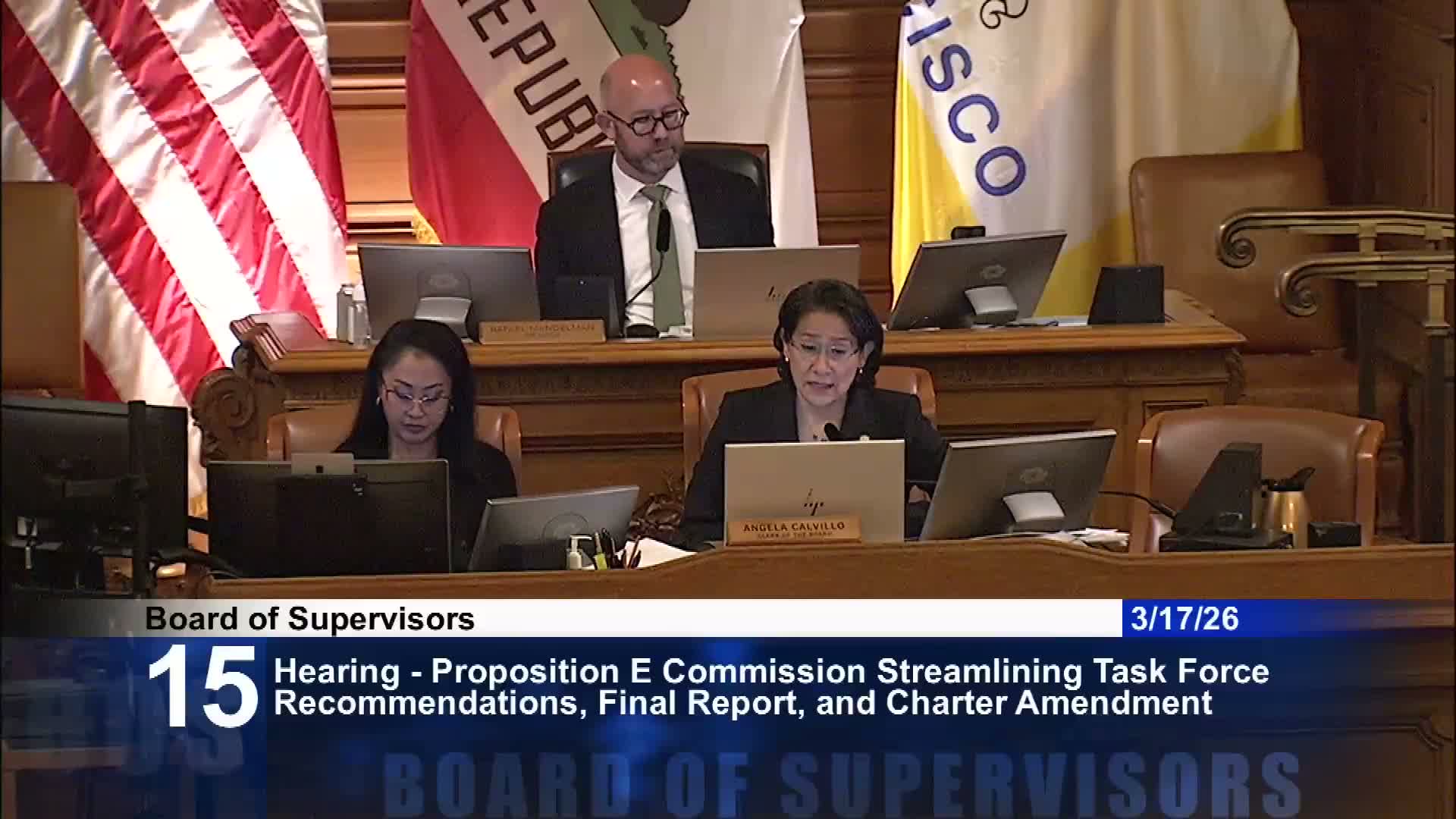
The San Francisco Board of Supervisors spent much of its March 17 meeting hearing a detailed presentation from the Prop E Commission Streamlining Task Force and more than two hours of public comment sharply critical of the task force’s final recommendations.
Chair Ed Harrington, the task force chair, delivered an overview of the year-long review created by Proposition E (approved by voters in November 2024). Rachel Alonzo, project director in the city administrator’s office, summarized the group’s fourfold approach: reduce the number of public bodies from roughly 152 to 87, move about 20 bodies from the city charter into the administrative code, clarify commission responsibilities (including some recommendations on department head hiring and removal processes), and apply consistent seat qualifications, sunset reviews and term limits to many advisory bodies. Harrington said the changes were intended to “increase accountability, reduce duplication, and make public engagement more strategic.”
The hearing quickly became contentious. Supervisors asked for detail on multiple contested proposals — including recommendations to move the Commission on the Status of Women, Human Rights Commission, Environment Commission and the Youth Commission out of the charter — and the task force acknowledged disagreement on a number of items. Harrington told the board the group had heard from “over 1,000 people” during its outreach and that many proposed changes were meant to be starting points for the board to refine or reject.
Public comment that followed was overwhelmingly critical. Patrick Monette Shaw, who submitted written testimony, urged the board to require additional hearings and said the task force “has been fully hoisted into the bully pulpit,” arguing the board should duplicate the files and conduct fuller review. Commissioner Margaret Brodkin, who helped create the Children, Youth and Families Commission, said, “Our charter is a declaration of our values,” and warned that removing commissions from the charter would subject them to political whims.
Speakers representing disability, immigrant, arts, homeless advocacy and union organizations pressed the board to keep certain commissions’ charter status intact because, they said, those bodies provide enforceable oversight and protections that advisory bodies lack. Multiple speakers said changes to the police commission’s disciplinary process — a task force proposal that would increase the role of administrative law judges and department chiefs in discipline — risked eroding civilian oversight. Paul Chignell, a retired SFPD captain speaking for city police interests, said the proposed change “would dismantle the most important component of police reforms” and urged rejection.
Union leaders and nonprofit advocates raised similar concerns about the proposed shift to at‑will commissioner appointments and three‑year sunsets on advisory bodies, saying the changes would reduce institutional knowledge and allow political interference. The League of Women Voters and several civic associations urged preserving seats that historically ensured diverse, nonpartisan input into city decisions. Advocates for people experiencing homelessness warned that consolidating or downgrading homeless oversight bodies would remove crucial accountability on shelter and service delivery.
Task force members and staff repeatedly emphasized the recommendations are proposals, not board actions. Rachel Alonzo said the presentations and materials were submitted to help the board decide what — if anything — to adopt. Chair Harrington told supervisors the task force expected the board to “choose what to do with” the recommendations and said some changes could be implemented in code while others might remain in the charter.
President Mandelmann closed the item by thanking task force members and staff and filing the report with the board; he said that while some noncontroversial items could move quickly, the board would likely diverge from several task force recommendations. The board did not take votes on any charter changes at the meeting.
What happens next: the task force’s ordinance is on a 30‑day hold and the draft charter amendment would require further board action to proceed to the ballot. Supervisors have several weeks to refine or introduce their own versions or to reject parts of the task force proposals.