Get Full Government Meeting Transcripts, Videos, & Alerts Forever!
Get email alerts on the Charter City topic
No spam. Unsubscribe anytime.
Fountain Valley council orders community survey after hours of public opposition to charter-city effort
Summary
After more than three hours of public comment and council debate, Fountain Valley's City Council authorized a statistically valid community survey and directed staff to engage consultants; council targeted 2028 as the earliest possible ballot year and asked for extensive outreach materials and translation services.
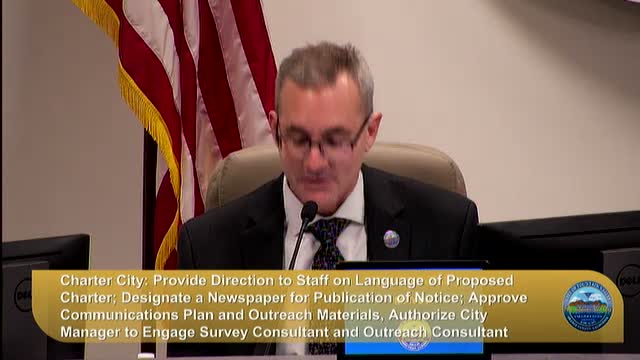
After extended public comment that drew dozens of residents opposed to changes in local governance, the Fountain Valley City Council on Tuesday authorized the city manager to hire a survey consultant to gauge community support for converting the city from a general-law to a charter city.
The council's action, taken after a presentation on other cities' experiences and lengthy discussion among members, instructs staff to develop an impartial, statistically valid survey and to return to council with proposed questions and a timeline. Councilmembers set 2028 as the earliest target for any potential ballot placement, saying more time is needed for outreach and deliberation.
Why it matters: supporters argue a charter could give Fountain Valley more local control over municipal policies in areas that are not "matters of statewide concern," while opponents said charter status risks increased legal costs, reduced guardrails, and politicization of city government. Much of the public comment focused on comparisons with Huntington Beach and Bellflower, with dozens urging the council not to proceed.
What council heard: Residents repeatedly told the council that they had not asked for a charter and that the city should not spend taxpayer dollars on a ballot measure without clearer demonstrated need. "Be careful. This will divide the community," one resident said. Others cited the risk of costly litigation and the potential for future councils to change rules that currently provide state-level accountability.
Council response: Councilmember Ted Buoy (speaker 6) stressed that the decision would remain with voters and framed the survey as a pause to gather unbiased information: "Nothing happens without voters' consent," he said, calling for neutral educational material and for the council to avoid rushing the process. Vice Mayor Patrick Harper (speaker 5) successfully moved to retain the survey authorization while pausing other immediate steps; the amended motion passed 4-0 with Councilmember Kim Constantine abstaining.
Next steps: The council asked staff to solicit proposals from survey firms, to include multilingual outreach (the motion referenced Spanish and Vietnamese and suggested adding Turkish), and to report back with sample questions for council approval. If the survey shows significant support, councilmembers said they would continue the process; otherwise they indicated they would not pursue placement on the ballot.
Where this leaves the city: The action does not place a charter measure on any ballot. It directs staff to fund and design a public-opinion survey and expand public education and outreach. The council emphasized that any changes would require voter approval and that the charter cannot override "matters of statewide concern" established by courts and state law.
Outcome and follow-up: Council directed the city manager to solicit multiple proposals for a scientifically designed survey and to return for council approval of survey questions, outreach materials, and a recommended timeline. The council's action was procedural and focused on testing community support rather than immediately drafting charter language.