Get Full Government Meeting Transcripts, Videos, & Alerts Forever!
Get email alerts on the Short Term Rentals topic
No spam. Unsubscribe anytime.
Whittier council approves first reading of amended short-term rental ordinance after heated public hearing
Summary
After hours of public testimony and council debate, the Whittier City Council voted to introduce Ordinance No. 3175 (ZCA 24-3) on first reading, setting a 300-foot buffer between short-term rentals, allowing up to two STR units per parcel, and requiring one off-street parking space per STR unit; high and very high fire severity zones remain excluded.
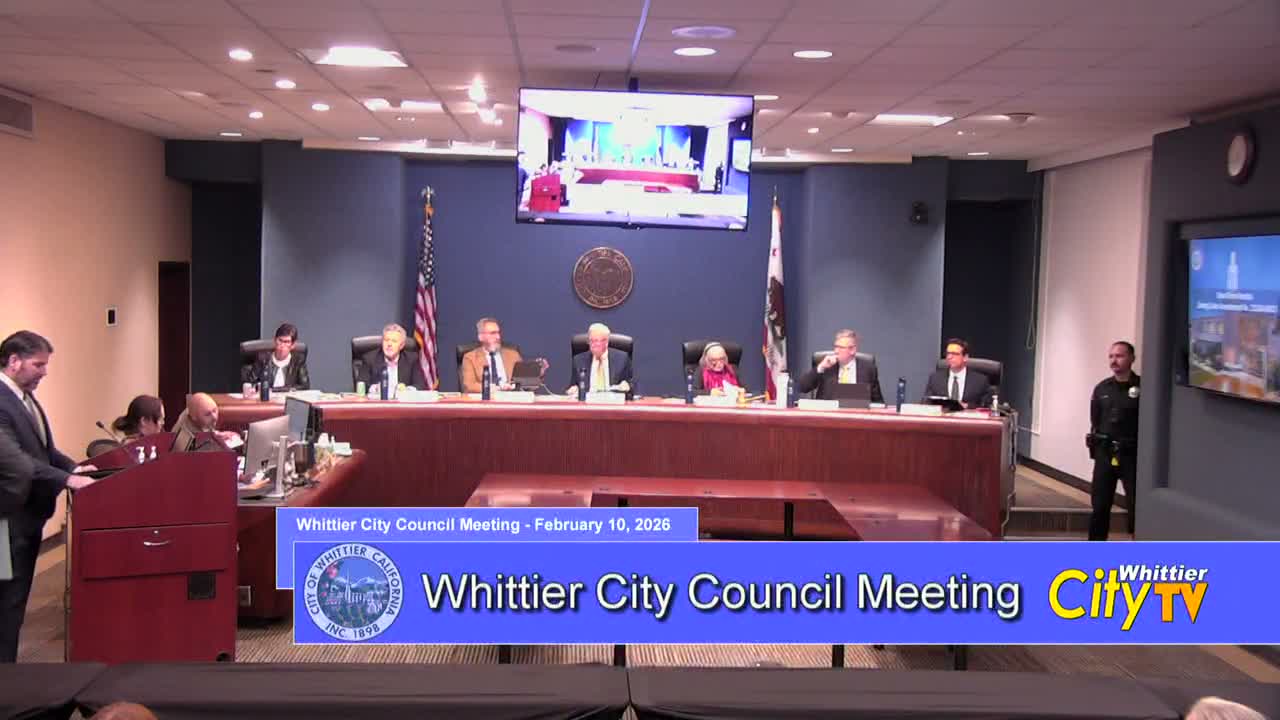
The Whittier City Council on Feb. 10 introduced and adopted on first reading an amended ordinance regulating short-term rentals, following a lengthy staff presentation, more than two dozen public commenters and extended council debate.
Ben Pongetti, the city’s director of community development, told the council the ordinance package has evolved over multiple meetings since March 2023 and identified three issues for reconsideration: the required buffer distance between STRs, the off‑street parking standard and whether to allow more than one STR unit per parcel. Pongetti said the city’s research identified roughly 140 short-term rentals currently operating in Whittier and reiterated that accessory dwelling units and junior ADUs would remain ineligible for short-term rental use under the proposed code changes.
The public hearing drew sustained turnout from hillside homeowners who said short-term rentals increase wildfire risk, obstruct emergency access on narrow roads and lower neighborhood livability. “The exception seems designed to benefit a few while placing a great number of homeowners at risk,” one hillside resident testified, urging the council not to permit ‘‘hosted’’ exceptions in the high and very high fire severity zones. Multiple speakers cited recent regional wildfires and local safety concerns and asked the council to uphold prior votes that had banned STRs in those highest-risk zones.
Speakers who operate or support STRs asked the council to preserve options for responsible hosts outside the fire zones and to avoid overly rigid parking or unit-count rules. One host asked the council to consider a phased or scaled approach that would permit operations outside hazardous hillside areas while retaining protections for vulnerable neighborhoods.
Council members and staff debated options for buffer distances (1,000 feet, 500 feet and 300 feet), the number of permitted STR units per parcel (1, 2, or 3) and whether off-street parking requirements should simply match the underlying zoning or be customized for STRs. City staff said ADU parking rules derive from state law and that STR regulation is a local discretion where the council could require a specific minimum number of off-street spaces.
After deliberation the council directed staff to amend the ordinance to: set a 300‑foot separation between permitted short‑term rental properties; permit up to two short‑term rental units on a single parcel; and require one off‑street parking space per short‑term rental unit (the parking requirement multiplies when multiple STR units are permitted on a parcel). Council members confirmed the ordinance would continue to prohibit STRs located in the high and very high fire‑severity zones unless the council explicitly reopens that question.
City legal counsel read a motion to introduce and conduct first reading of the amended ordinance, as revised by council directions that evening. A council member moved the motion and another seconded. The council then closed the public hearing and, by roll call, voted to introduce the ordinance on first reading. The motion carried; the ordinance will return for a second reading and final adoption at a subsequent meeting.
The meeting record shows the adopted first‑reading motion and the text of Ordinance No. 3175 (the zoning code amendment ZCA 24‑3) will be updated to reflect the council’s instructions on buffer distance, per‑parcel limitations and the new parking metric before the next hearing.