Get Full Government Meeting Transcripts, Videos, & Alerts Forever!
Get email alerts on the Short Term Rentals topic
No spam. Unsubscribe anytime.
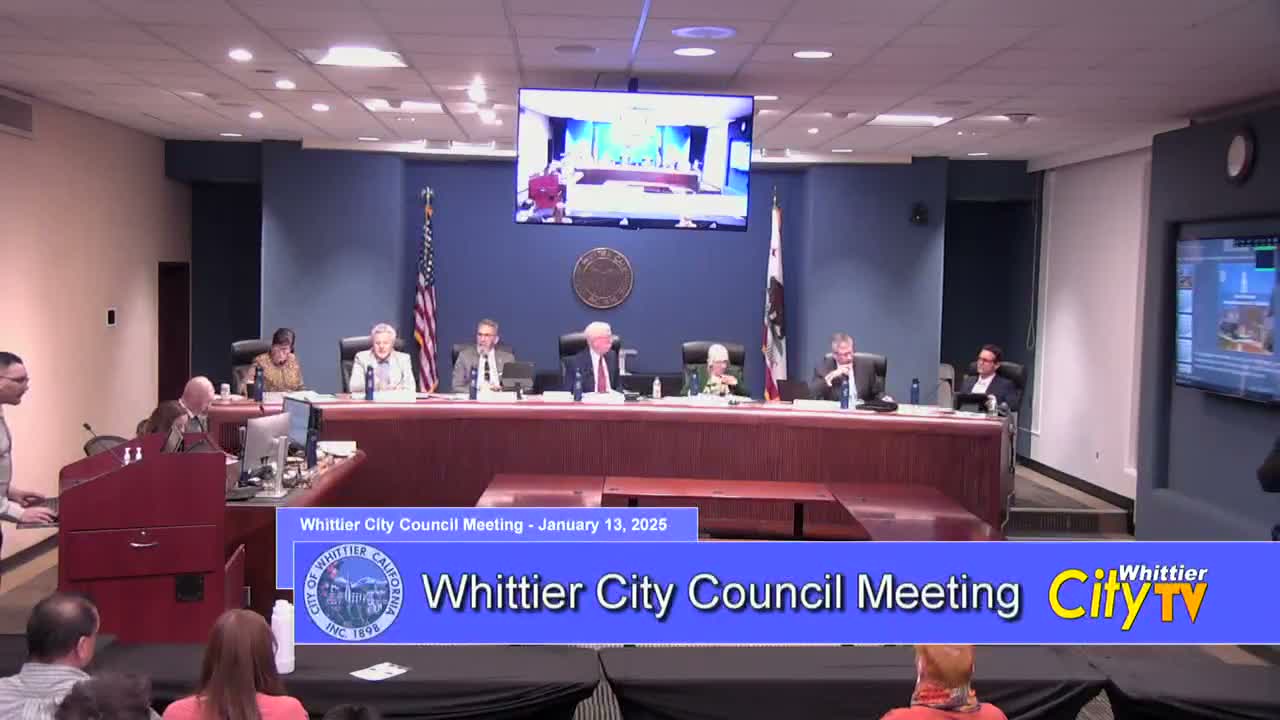
Whittier council adopts policy direction for short‑term rental ordinance after hourslong public hearing
Summary
After a lengthy public hearing with roughly two dozen speakers, the Whittier City Council voted to set policy parameters for a short‑term rental ordinance and introduced ordinance 31‑75 (ZCA 24‑003) at first reading, including a 2‑night minimum, up to three STRs per owner, a 500‑foot buffer, and a ban in high and very‑high fire severity zones.
The Whittier City Council on Jan. 13 set a series of policy choices for a short‑term rental ordinance and introduced ordinance 31‑75, the first reading of zoning code amendment ZCA 24‑003. Staff told the council the draft ordinance incorporated 13 best‑practice items and requested a $25,000 budget allocation to purchase monitoring software to help implement the rules.
Community Development staff member Pongetti summarized the ordinance’s key elements and said the planning commission had recommended a three‑night minimum but left policy discretion to the council. He told members the draft would require STR operators to obtain permits, collect transient occupancy tax and reside in Whittier to ensure local responsiveness to complaints.
Residents filled the council chambers for a two‑hour public hearing on the topic. Pierre Averon, speaking for Starlight Estates neighbors, urged the council to retain a ban on STRs in the city’s three mapped fire hazard severity zones, citing the recent Palisades and Eaton fires and the mixed terrain in Whittier Hills. “Do not remove those protections from the ordinance,” Averon said, emphasizing evacuation and access concerns.
Other hillside residents described narrow, one‑way streets where additional guest vehicles can impede emergency access and said they had observed smoking, fireworks and other conduct they described as risky. Laurel Moore, who lives on South Circle Drive, told the council that two STRs across the street routinely block driveways and that parking enforcement has not resolved the problem.
STR hosts and business owners urged a different balance. Fabio Soto, who operates three rentals in Uptown Whittier, thanked staff for the benchmarking and asked the council to consider a two‑night minimum and looser buffer rules in commercial areas. A host who identified himself as Nathan said his STR had operated for five years without complaints and cited national studies he said show no increased fire risk from STRs.
After public testimony, council members debated five contested policy choices point by point. The council voted to set the minimum stay at two nights (motion carried), allow up to three STRs per owner who lives in the city, and set the separation buffer at 500 feet. On the public‑safety question the council voted to ban STRs in the “high” and “very high” fire severity zones shown on the state map; one council member recused from that vote. The council also decided that parking requirements for STR permits should generally follow the underlying zone’s parking standard.
With those directions recorded, the council approved the introduction and first reading of ordinance 31‑75 and adopted a companion budget resolution to appropriate implementation funds for software and administration. The ordinance was advanced as a first reading; staff said they would return with final ordinance language and an implementation timeline and recommended a review after about one year to assess enforcement and unintended effects.
Council members and staff repeatedly emphasized the city can adjust the ordinance after it is in effect. “We can circle back and make changes after we see how it’s implemented,” Pongetti said. The council’s votes were procedural actions to set final policy choices and to place the amended ordinance on the calendar for subsequent action.
The public hearing drew extensive neighborhood testimony and divided views on whether STRs are chiefly an economic benefit or a localized public‑safety and parking hazard; the council’s motion package aims to balance both concerns while restricting STR operations in mapped fire‑hazard areas.