Get Full Government Meeting Transcripts, Videos, & Alerts Forever!
Get email alerts on the Wildfire Resiliency topic
No spam. Unsubscribe anytime.
Centennial adopts Colorado Wildfire Resiliency Code for mapped WUI areas; 7–2 vote
Summary
Centennial City Council voted 7–2 on April 7 to adopt the 2025 Colorado Wildfire Resiliency Code and state map for mapped wildland-urban interface areas, applying structure-hardening and defensible-space rules to roughly 1,500 acres and about 780 parcels in the city; staff will begin targeted outreach ahead of the code's June 30, 2026 effective date.
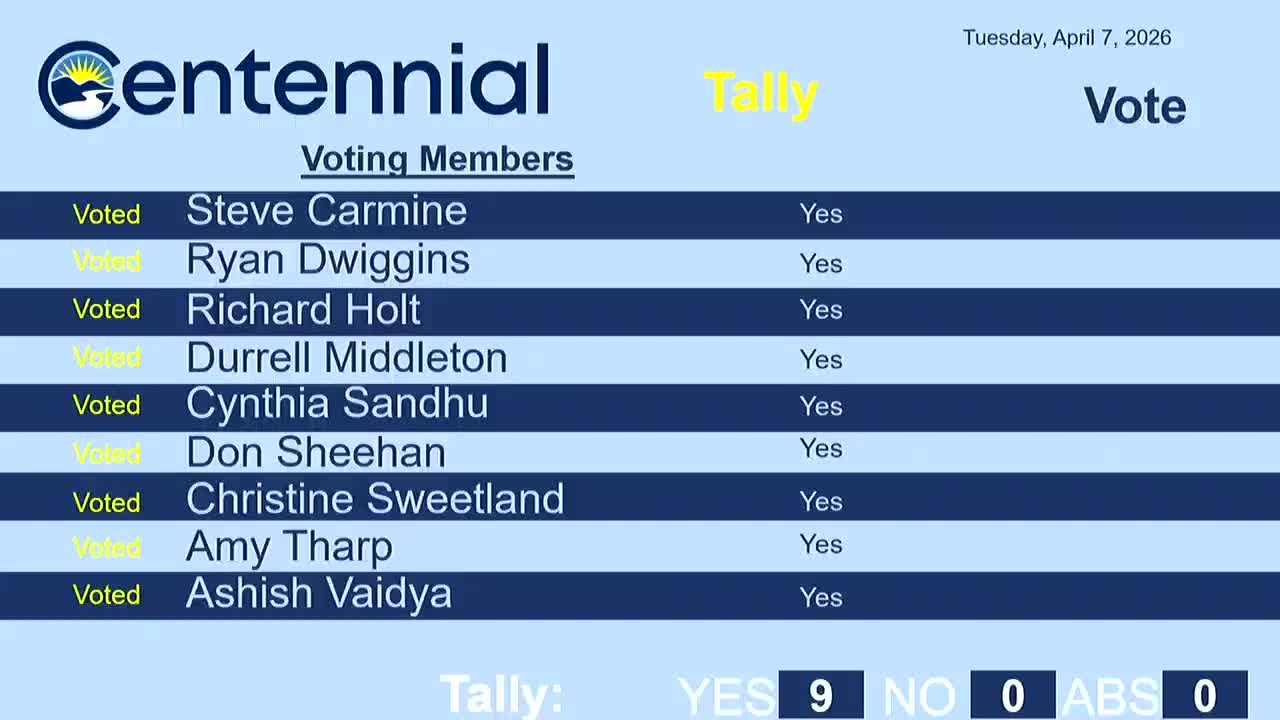
Centennial’s City Council adopted Ordinance 2026-O-03 on April 7, approving the 2025 Colorado Wildfire Resiliency Code and associated state map for the city’s mapped wildland-urban interface (WUI) areas. Mayor Pro Tem Tharpe moved the measure; the motion carried 7–2, with councilmembers Bull and Sheehan recorded as opposed.
Staff presentations described the measure as a construction- and site-focused safety standard intended to reduce the risk of structure-to-structure wildfire spread. Planning Manager Michael Grama said the city’s three mapped WUI areas total about 1,500 acres — roughly 8% of the city’s land area — and affect about 780 legal parcels, approximately 740 of which are residential. Grama said the state’s 2025 map (based on 2022 data) will be the baseline for Centennial, and council may update the map later by resolution.
Chief Building Official Joseph Montoya outlined the technical triggers and requirements. New construction and exterior alterations that change 25% or more of exterior wall surface area would trigger “structure hardening” requirements; additions of 500 square feet or more would also trigger the standard. Required measures include ember-resistant attic and crawl space vents, tempered or multi-pane glazing, Class A roofing in WUI zones, ignition-resistant decking, and a defensible-space vegetation-management zone as close as five feet from structures. Montoya estimated typical developer cost increases of about $3,000–$12,000 per home depending on materials and choices, and gave rough unit figures — about $10–$25 per window for upgraded glazing, $4–$8 per square foot for upgraded siding, and $5–$10 per square foot for upgraded decking.
Councilmembers pressed staff on how the code will evolve and its implications. Councilmember de Wiggins asked how future map changes would be handled; Grama said the ordinance uses the 2025 map but allows council to update the map by resolution following state updates (staff expects map updates every three years). Councilmember Vaidya asked whether adoption could lower homeowner insurance premiums; staff said they could not predict insurer behavior, though insurers have previously expressed support for wildfire mitigation measures. Councilmember Sheehan relayed concerns from the Home Builders Association about cost and material restrictions and said those concerns factored into his no vote. Staff responded that Colorado’s code was modeled on the International WUI Code with Colorado-specific modifications and that many requirements reflect industry-accepted standards.
The ordinance passed with staff noting the code will take effect on June 30, 2026; building permit applications submitted before that date will be reviewed under current regulations. Staff said it will provide targeted outreach and internal training for property owners and developers in mapped areas before the effective date.