Committee advances foreclosure statute-of-limitations bill amid debate over 'last payment' trigger
Loading...
Summary
The Judicial Proceedings Committee advanced House Bill 523, which would bar most foreclosure complaints filed later than 10 years after a borrower's last payment. Lawmakers and stakeholders sparred over whether the bill should use the 'date of last payment' or the more commonly used 'date of default' as the trigger and whether the change raises constitutional or implementation problems.
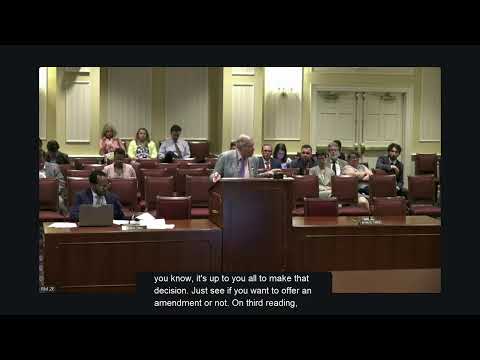
The Judicial Proceedings Committee advanced House Bill 523 on April 13, moving a proposal that would require a foreclosure complaint on residential property to be filed within 10 years after the borrower's date of last payment.
The bill's sponsor and staff told senators the measure also would require certain documentary showing by secured parties who commence foreclosure on debt that was in default for five or more years before acquisition; committee amendments removed one document-production clause and pushed the effective date to Oct. 1, 2026.
The bill prompted extended questioning about the statutory trigger. Senator Henson (S14) pressed staff and counsel on whether the bill defines "date of last payment," noting lending documents commonly use a defined "date of default" that can be easier to administer. "Is there a definition for last payment?" Henson asked, raising scenarios in which a borrower mails a check or a lender stops accepting payments and how those facts would be reconciled in practice.
Legislative staff (S7) and stakeholders said the change came from amendments adopted in the House and that the committee's posture altered the bill's timeline. Counsel for affected lenders and servicers (S12) told the committee his clients had agreed to a 10-year statute of limitations so long as there was time to adjust, and urged the body to strike or clarify the five-year provision and the effective date if outstanding legal issues could not be resolved.
Advocates and committee members drew different conclusions. One senator called the amendment that substituted "date of last payment" for "date of default" potentially ambiguous and said it could unintentionally remove borrower protections tied to pre-foreclosure notices. "That date is specific and clear," Henson said of the preferred alternative; she asked to work with sponsor staff to draft clarifying language that preserves notice rights and avoids constitutional problems with vested contract rights.
The chairman told members the version of the bill before the committee included amendments that were the product of stakeholder negotiations and that the bill could not advance out of committee without those changes. The committee voted to adopt the amendments and advance the bill as amended; the transcript records at least one 'no' vote on the recorded roll call (Senator Henson). The transcript does not include a complete roll-call tally in the segment provided.
What happens next: the sponsor and interested senators said they will continue to negotiate technical language before third-reading floor action, and several senators asked counsel and stakeholders to work with the sponsor on precise definitions for "payment" and on the bill's prospective or retroactive application.
Authorities and procedural posture: committee staff presented the bill text and amendments and noted the bill's effective date and changed provisions; members discussed interplay with bankruptcy and federal regulatory regimes but did not cite specific court cases or statutes beyond general references to relevant foreclosure and bankruptcy law.
The committee discussion spanned multiple exchanges and public-policy concerns about notice, retroactivity and whether the legislative trigger should mirror established lending documents or rely on a simpler payment-based rule.