Get Full Government Meeting Transcripts, Videos, & Alerts Forever!
Get email alerts on the School Budget topic
No spam. Unsubscribe anytime.
SFUSD deputy superintendent lays out multi‑year shortfalls and fiscal stabilization options
Summary
Deputy Superintendent Chris Mompanitas told the Board of Education on March 4 that the San Francisco Unified School District faces a structural shortfall driven by enrollment and attendance trends, and presented a three‑page Fiscal Stabilization Plan with options ranging from $15M in central‑office reductions to larger savings if the board authorizes broader measures.
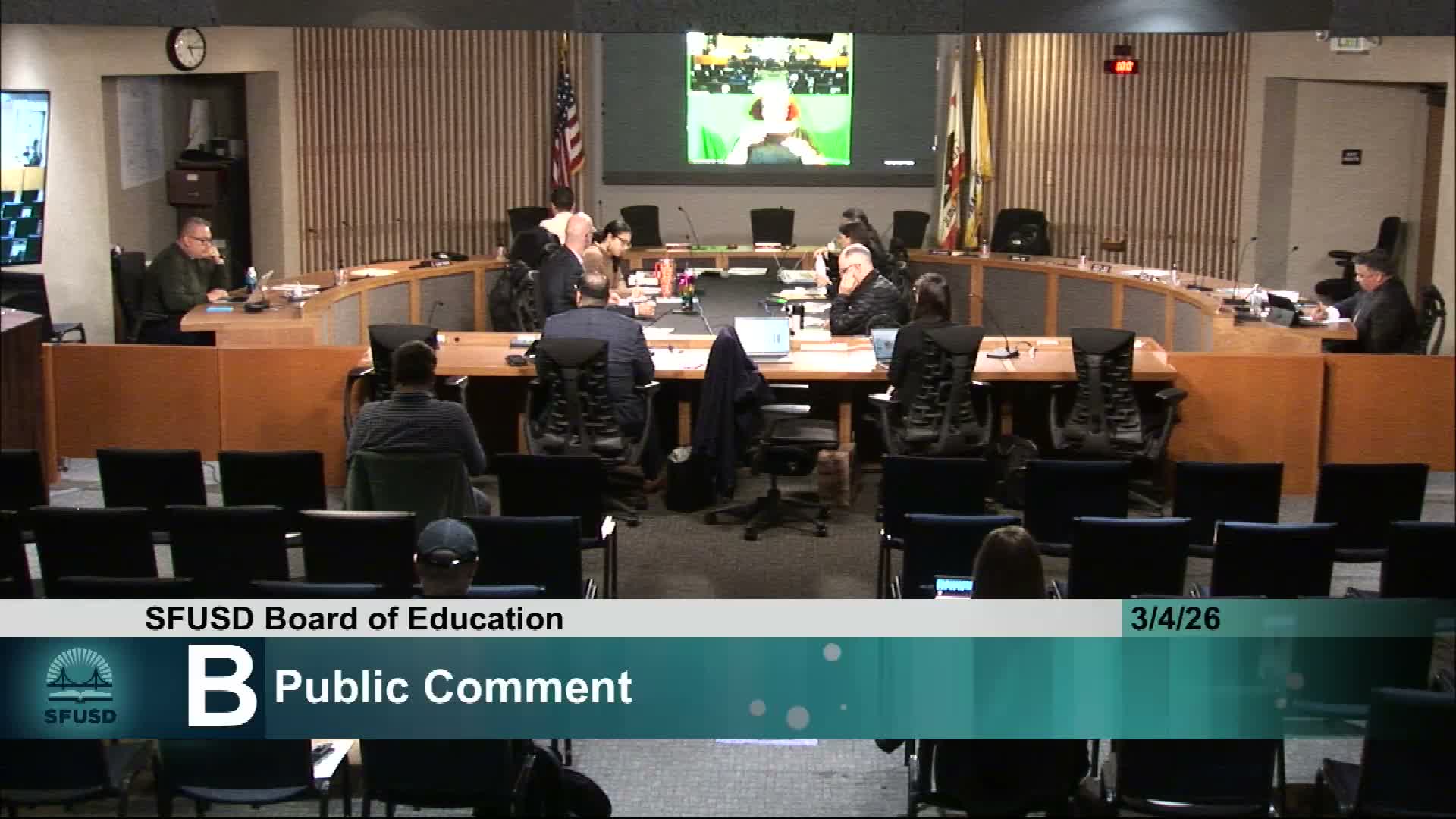
Deputy Superintendent of Business Services Chris Mompanitas told the San Francisco Unified School District Board of Education at a special March 4 study session that the district faces a structural budget shortfall and presented a multi‑year projection and a three‑page Fiscal Stabilization Plan (FSP) to address it.
The presentation, delivered as staff introduced interim executive director Jennifer Shuster, CFO Niru Jayaraman and Director of Position Control Daniel Muñoz, framed revenues as roughly 4 percent federal, about 68 percent state (LCFF and related funds) and about 28 percent local. Mompanitas said the district uses state planning factors and an enrollment‑based calculator to set revenue assumptions and that staff is now using updated governor’s budget figures for COLA and other estimates.
Why it matters: the district is funded on average daily attendance (ADA), not raw enrollment, and Mompanitas highlighted a material gap: funded ADA near 44,790 vs. enrollment around 48,768. That attendance gap and a decline in the district’s unduplicated pupil percentage (about 60 percent this year, with a 55 percent threshold for some concentration funding) reduce state revenue and complicate staffing and program decisions.
Staff reported progress shrinking the projected restricted‑side deficit to about $44 million by shifting eligible costs to restricted funds, trimming vacant positions and other in‑year savings. The presentation showed a projected ending unrestricted fund balance (line E) of about $60.2 million and explained required non‑spendable reserves and an ‘‘open agreement’’ assignment that holds placeholders for unsettled bargaining obligations.
Mompanitas outlined three tiers of FSP measures: (1) items already underway and included in the current multi‑year projection—align staffing with projected enrollment and central‑office reductions (about $17 million and $3 million in the examples shown); (2) near‑term central‑office reductions and contract/supply savings planned for FY27 (the staff figure presented was roughly $15.26 million); and (3) larger, more contingent options that would require board direction and could include program or site consolidations, further staff realignment and tightening of discretionary allocations. Staff estimated program consolidation savings at about $1 million per smaller program/site and said the $3 million figure in the packet corresponded to three consolidations in a single year (FY28), not nine.
Board members pressed staff on forecasting accuracy and transparency. Jennifer Shuster, interim executive director of the budget office, said post‑COVID turnover had eroded some institutional knowledge but that the office has adopted better monitoring practices, completed a first position reconciliation and is using state tools (ProjectionPro) and the FCMAT guidance to improve projections. Niru Jayaraman said analysis showed some prior staffing models used overly optimistic enrollment inputs; the budget office has tightened the process and added reconciliation and appeals steps to reduce double‑counting and ‘‘optimistic budgeting.’’
Commissioners and staff also discussed how parcel tax revenues (QTEA, FWEA) are governed by ballot language and MOUs, and how one‑time restricted funds (for example a JUUL/Altria settlement) were allocated directly to school sites and therefore disappear when spent.
Public comment included Bernice Casey’s statement that the meeting had not been posted at all regular locations; a staff member responded that the agenda had been posted on BoardDocs and at physical locations to meet the Brown Act requirements. That exchange was limited to clarification rather than a formal challenge during the session.
On implementation and next steps, Daniel Muñoz described work now under way on position control—reconciling vacancies, identifying ‘‘ghost’’ positions and issuing a position control manual—and said a position‑control board policy and accompanying administrative regulation are expected soon. Mompanitas asked the board for direction about how aggressive to be in the FSP; staff cautioned that including the larger, third‑page measures at second interim could face state scrutiny but would improve the district’s paper certification if the board wished to take that approach.
The board requested additional materials: a legible formula or one‑pager showing how staffing allocations incorporate student need and focal populations; a year‑by‑year reconciliation of differences between projected and actual revenues for recent years; and clearer public summaries of what the district currently does to support high‑need schools and how much those efforts cost per school or per pupil. Mompanitas and his staff agreed to provide those follow‑up materials in advance of upcoming budget deadlines. The board will consider the second interim multi‑year projection and the updated FSP at its next scheduled meeting. The special study session adjourned at 7:39 p.m.