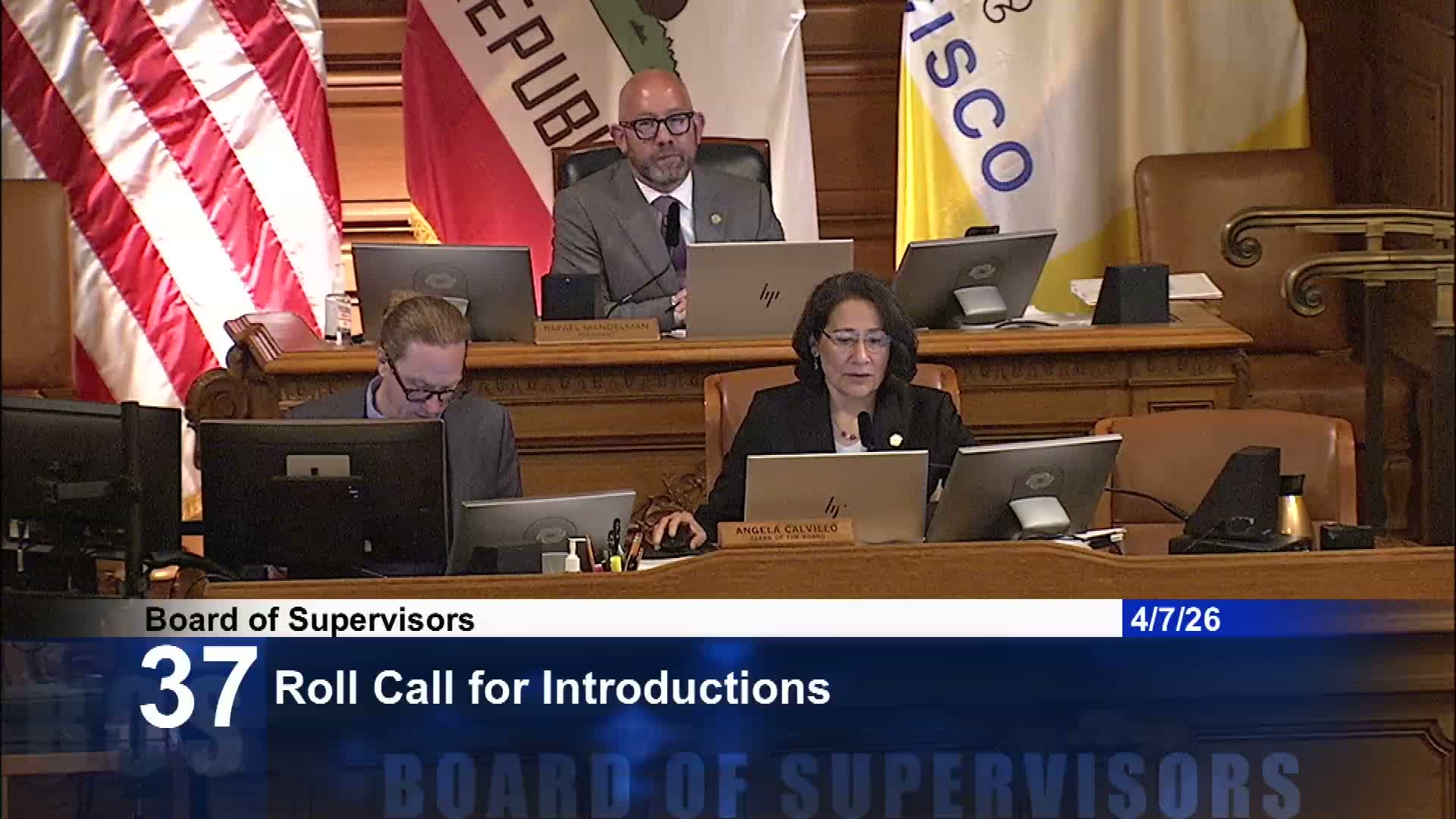
Board upholds Planning Commission's de facto denial of North Beach conditional‑use appeal, rejects homeowners' request to avoid reinstating lost units
Loading...
Summary
The San Francisco Board of Supervisors on April 7 upheld the Planning Commission's de facto denial of a conditional use authorization for 524–526 Vallejo St. and associated San Antonio Place addresses, rejecting homeowners' request to legalize a single‑family layout and sending options back to planners. The hearing centered on whether a 2013 four‑unit permit was lawfully issued and whether tenants' lost rent‑controlled units must be restored.
The San Francisco Board of Supervisors voted on April 7 to uphold the Planning Commission's de facto denial of a conditional use authorization (CU) tied to a contested property at 524–526 Vallejo Street (and 4A/4B San Antonio Place), a decision supervisors said preserves the city's housing protections and avoids setting a precedent that could legitimize after‑the‑fact unit mergers.
The hearing produced a forceful split between the homeowners who appealed the commission decision and tenant advocates, planning staff, and building inspectors who said the record shows four legal dwelling units were authorized and that approving a CU to legalize a merged layout would cause a net loss of rent‑controlled housing.
"We are not here because we disagree with housing policy," appellant Caitlin Holloway told the board in her presentation. "We are here because the policy applied to the reality of this property produces an inherent gridlock ... We are asking this board to simply help us find a way through." Holloway asked supervisors to legalize the building as a two‑unit property that reflects the structure's historical configuration and to avoid the permanent displacement of her family.
Planning Department staff recommended denial. A department representative summarized the record: approved building permit plans showing four units, a neighborhood notification period in 2011, multiple inspector visits, assessor records listing the property as a four‑unit dwelling, and written statements from long‑term tenants. The department said authorizing the proposed project would legalize an unauthorized merger and result in a net loss of two rent‑controlled units that conflicts with the housing element and city policy.
"The legal status, not its current occupancy, governs our evaluations of mergers," planning staff said, urging the board to uphold the commission's de facto denial.
Public testimony illustrated the divide. Neighbors and community groups argued that the property had been operated as a four‑unit, rent‑controlled building and that approving the appeal would let developers profit from illegal demolitions and create a damaging precedent. Stephen Torres of the San Francisco Tenants Union said approving the CU would "legitimize illegal demolitions of rent‑controlled housing."
Tenant advocates submitted declarations and a 3R disclosure report indicating the property's multifamily status; former tenants told the board they lived in distinct rental units at the address for years.
Opposing those accounts, the homeowners and their architect said the 4‑unit permit at the center of the case was never physically built and that the city's own records contained conflicting entries. Architect Stephen Sutro testified that the approved plans differ from the as‑built condition and argued that the timeline of inspections and subsequent sales raises questions about how the 2016 certificate of final completion was issued.
Representatives from the Department of Building Inspection (DBI) confirmed they have issued a notice of violation tied to the property and said DBI was conducting an internal inquiry into how the certificate of final completion was processed; DBI staff said the inspector who signed the 2016 sign‑off has been subject to prior unrelated personnel investigations but did not provide details on personnel matters in the hearing.
Several supervisors pressed both sides on practical consequences. Supervisor Sauter, whose district includes Telegraph Hill, urged caution about creating a repeatable pathway that would reward bad actors while acknowledging the hardship a strict reading could impose on the current occupants. "We don't want legal mergers like this to be forgiven or incentivized," Sauter said, while also proposing a compromise path that could add authorized units without immediately forcing the family from their home.
Sauter moved a package: (1) approve the Planning Commission's de facto denial (item 32), (2) table item 33 (the motion to disapprove the commission), and (3) direct findings that would express the board's openness to a three‑unit solution if feasible. A separate vote on an amended set of findings that would explicitly urge planners to pursue a three‑unit solution tied to this property failed on a 5–5 vote.
The board then voted on the remainder of the motion to approve item 32 (upholding the commission's de facto denial) and to table item 33; that motion passed 10–0. Deputy City Attorney advised that, because the Planning Commission did not issue findings in the event of a de facto denial, the board should adopt findings to support its decision for the public record; the clerk will prepare findings consistent with the board's action.
At the end of the hearing President Mandelmann summarized the majority's stance: while the board recognizes the family's hardship, the evidence in the public record and the city's anti‑displacement policies compelled the board to uphold Planning's recommendation today.
What happens next: because the board affirmed the de facto denial, the appellants must abate the violation by either (a) legalizing the property as four units (pursuing required abatement and permits), or (b) submitting a new application (for example a 3‑unit scheme) that would go back to the Planning Commission for review. Planning staff confirmed a 2023 permit application for reconversion is on file but certain plans are protected under SB 1414; staff said they would work with the owners on feasible options.
The hearing was notable for (1) extensive community turnout with dozens of public speakers, (2) detailed documentary records submitted by tenants and planning staff, and (3) DBI's confirmation of an internal inquiry into the 2016 final sign‑off.