Get Full Government Meeting Transcripts, Videos, & Alerts Forever!
Get email alerts on the Economic Development topic
No spam. Unsubscribe anytime.
Council approves first reading of community benefit districts ordinance
Summary
Council adopted, on first reading, a municipal ordinance to add Chapter 5.14 enabling community benefit districts with a 30% petition threshold and up to 20-year terms; downtown business leaders supported it while residents raised concerns about petition thresholds and assessments.
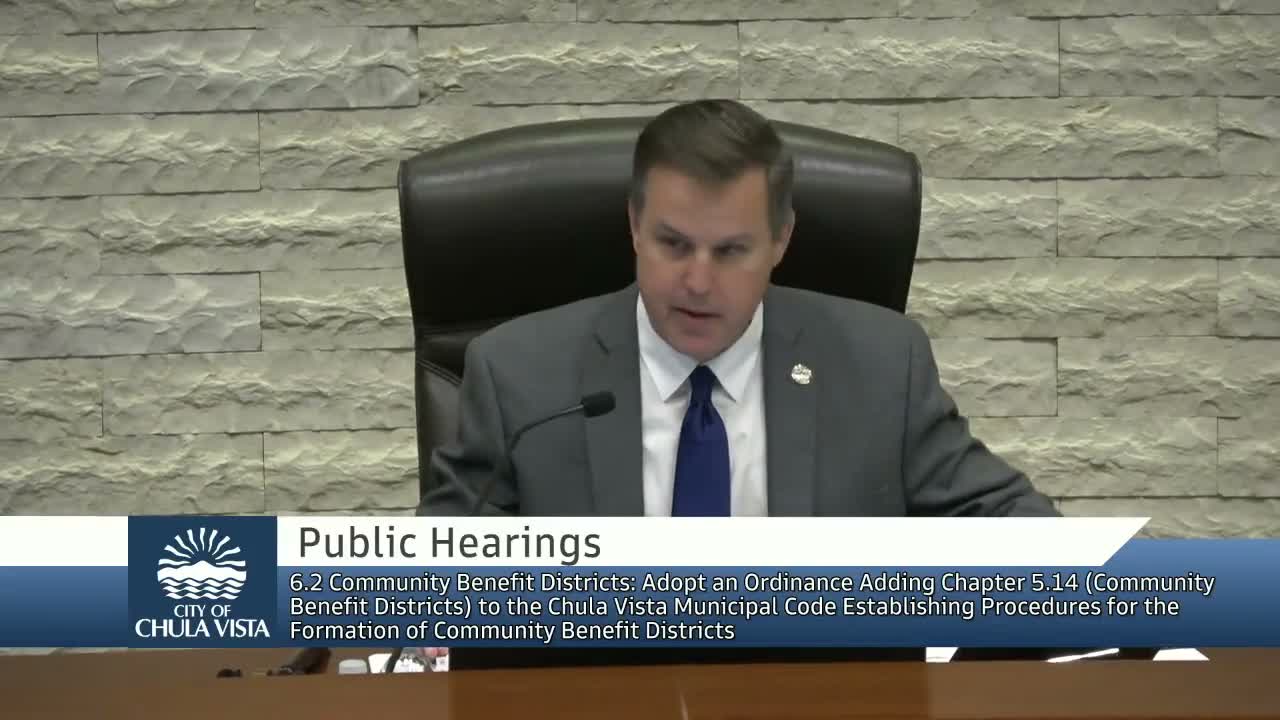
The Chula Vista City Council voted on March 17 to adopt on first reading an ordinance adding Chapter 5.14 to the municipal code to authorize formation of locally governed community benefit districts.
City staff described the ordinance as a locally tailored tool built on the Property and Business Improvement District (PBID) Law of 1994. The proposal allows a petition to kick off balloting if property or business owners representing more than 30% of assessments sign the petition (compared with a 50% threshold under state law in some contexts), would limit single-owner petitions when an owner's assessment exceeds 20% of the district, and permits a maximum 20-year term before renewal.
"The proposal would take the petition signed by property or business owners paying more than 30% of assessments," staff explained while walking through examples and national/state precedents. Staff said the ordinance is intended to give local business clusters a self-directed tool to fund economic development, maintenance and marketing services similar to the city's existing 3rd Avenue PBID.
Dominic LeMandry, district manager for the Downtown Chula Vista Association, described the existing 3rd Avenue PBID's 25+ years of work—landscaping, planters and events—and endorsed the ordinance as a way to replicate those benefits in other neighborhoods. Several public commenters expressed concern that a 30% petition threshold could allow a minority of property owners to initiate a process that leads to assessments; one resident asked for more comparative data about 3rd Avenue outcomes and how assessment funds have been used.
Council Member (District 2) moved to adopt Chapter 5.14; Council Member (District 4) seconded. The motion passed on the first reading.
The ordinance now proceeds through the next steps of the code-adoption process and any subsequent ballot or renewal procedures required under the law.