Get Full Government Meeting Transcripts, Videos, & Alerts Forever!
Get email alerts on the Strategic Planning topic
No spam. Unsubscribe anytime.
Washington County CJCC approves three one-year strategic action plans to strengthen council, behavioral health coordination and pretrial compliance
Summary
Washington County's Criminal Justice Coordinating Council unanimously approved three one-year action plans presented by Justice Management Institute to strengthen the CJCC, improve coordination across behavioral health and justice systems, and reduce pretrial failures to appear through shared data and clearer definitions. JMI will deliver a full draft by May 11 for review and the council will consider final approval June 9.
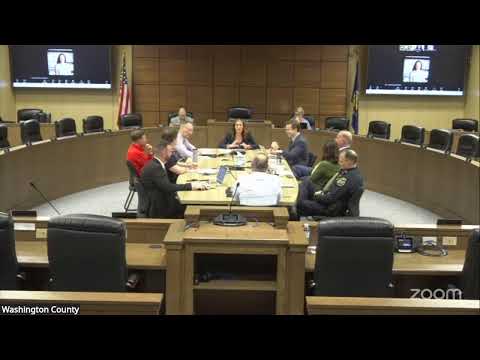
The Washington County Criminal Justice Coordinating Council on May 11 approved three one-year action plans developed with consultants from the Justice Management Institute (JMI) to strengthen the council, coordinate behavioral health responses and target pretrial compliance problems.
The plans—presented by JMI consultants Amy (speaker 5) and Gabby (speaker 7)—outline short-term, achievable objectives and a greater role for shared data. Amy said the documents are intentionally one-year plans to enable quicker, measurable progress: “A lot of these initiatives that you’ve come up with are kind of shorter-term goals…so I think this works well for you,” she said. JMI will produce a full strategic plan by May 11; members will have until May 27 to submit feedback, and the council is scheduled to consider final approval at its June 9 meeting.
Why it matters: council members said the work is intended to create a durable, cross-system foundation for ongoing collaboration. The plans prioritize data collection, clear governance and communications so the CJCC can identify where to focus limited staff time and county resources.
Strengthen the CJCC: Gabby described four objectives for priority area 1—establishing a unified vision (including a prework questionnaire for members), deciding a leadership model (vice chair or co-chair), creating data-sharing agreements and five KPIs, and developing a communications working group with written guidelines. The plan’s timeline begins July 1, 2026, and runs roughly one year. Several members cautioned about maintaining momentum over a spaced timeline but the council moved to accept the draft goals; the motion was seconded and carried without opposition.
Behavioral health coordination: Julie (speaker 10) presented priority area 2, which aims to strengthen the behavioral health continuum and improve coordination between justice and health systems. The work group will (1) convene leaders with decision-making authority, (2) produce a Sequential Intercept Model (SIM) map (training with state resources is scheduled for September), and (3) improve data-driven reporting back to the CJCC. The council voted to accept the plan.
Pretrial compliance and failure-to-appear data: Priority area 3 focuses on reducing failures to appear and failures to comply while cases are pending. The work group will clarify definitions, identify relevant agency data, and review evidence-based practices and cross-county examples before recommending specific interventions. Members named expected participants in the pretrial work group, including Captain Laymon, DA Bratz, Agent Cannon, Andy Freeman and Attorney Parham; Judge Leach was also listed as present at earlier work sessions. Council members and staff stressed that some improvements are already being tested locally but that shared data and cross-agency conversation are needed to avoid unintended consequences. The council accepted the recommended approach.
Process and next steps: Amy said JMI will circulate a more detailed draft by May 11; the council has until May 27 to submit edits; and the final item will appear on the June 9 agenda for an approval vote. JMI indicated it will not attend the June meeting unless asked.
What members emphasized: multiple speakers underscored the importance of data-driven decision-making—using KPIs and data-sharing agreements to ensure interventions target the right populations and avoid wasted expense or unintended harms. One participant warned that timelines should not stretch momentum over too long a period; others said Washington County’s existing relationships allow some deadlines to be spaced without urgent risk.
The council adjourned after confirming the next regular meeting for June 9 at 7:30 a.m.