Get Full Government Meeting Transcripts, Videos, & Alerts Forever!
Get email alerts on the Homeownership topic
No spam. Unsubscribe anytime.
Office of Housing details $25 million annual homeownership budget and pipeline of permanently affordable homes
Summary
Seattle's Office of Housing outlined home repair, weatherization, down-payment assistance and permanently affordable homeownership programs, reporting a $25 million annual homeownership budget in 2026, 358 permanently affordable homes in operation and a pipeline of 22 projects totaling about 455 homes.
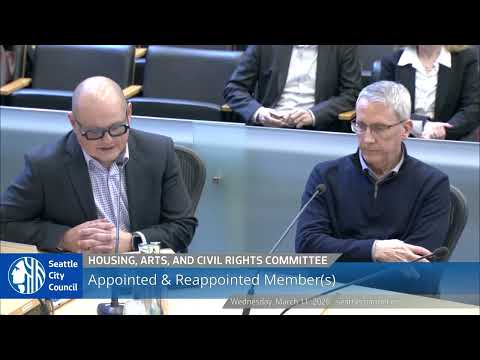
Office of Housing officials told the committee that homeownership programs are a key anti-displacement strategy and a tool to address racial wealth disparities. Kelly Larson, director of policy and planning, and Joy Hunt, interim manager for homeownership, presented program details, funding sources and a project pipeline.
Larson said the office's 2026 homeownership investments include $16 million for acquisition and development of for-sale permanently affordable homes and $9 million for weatherization and home repair. She said JumpStart payroll expense tax provides $10 million annually, the housing levy commits $7 million annually, and 5% of MHA revenues are dedicated to homeownership (about $1 million in 2026), producing an estimated $25 million in total annual homeownership funding.
Joy Hunt described repair and weatherization programs: Home repair loans range from $3,000 to $24,000 at 0% interest; urgent health-and-safety needs can be covered by grants up to $20,000. The weatherization program provides insulation, ductless heat pumps, hot-water heater replacement and related energy-efficiency upgrades. Eligibility for these programs generally requires Seattle residency (or City Light customer status) and incomes at or below 80% of area median income (AMI).
On permanently affordable homeownership, OH said buyers must be income-eligible (<=80% AMI) and homes are priced using an affordability formula that typically targets about 65% of AMI-based affordability assumptions; resale restrictions and long-term land leases keep homes affordable to successive buyers. OH reported 358 permanently affordable homes in operation (largely family-sized units) and a pipeline of 22 projects totaling approximately 455 homes. Notable projects include Habitat for Humanity's Liberty Commons (58 units opening in July), Homestead Community Land Trust's Woodland View (19 homes in Phinney Ridge), and a Goodwill Baptist Church site in the Central District that will add 34 permanently affordable homes.
Presenters noted challenges: a multi-year wait for some state matching funds (presenters cited about a three-year lag for certain state awards), high interest rates on construction loans, and the need for stewardship funding to support emerging developers. The office also described the Rainier Valley Affordable Homeownership Initiative, which targets 100 permanently affordable homes across Sound Transit surplus sites and has nine sites awarded so far.
In committee Q&A, Council President Hollingsworth and others asked about expanding eligibility or assistance for homeowners who fall outside strict AMI cutoffs and about property tax relief and stabilization tools; OH said it has raised income thresholds for repair and weatherization programs from 50% to 80% AMI and is exploring complementary strategies (property tax relief, layered down-payment assistance) and continued collaboration with the Black Home Initiative and state programs such as the covenant homeownership account. OH said 191 covenant-home loans were funded in King County, 39 of them in Seattle, as a point of reference for the committee.
The briefing did not include committee votes; members thanked staff and asked for follow-up on specific funding and policy questions.