Get Full Government Meeting Transcripts, Videos, & Alerts Forever!
Get email alerts on the Housing Element topic
No spam. Unsubscribe anytime.
Council adopts 2025 housing element progress report as residents press need for more extremely low‑income units
Summary
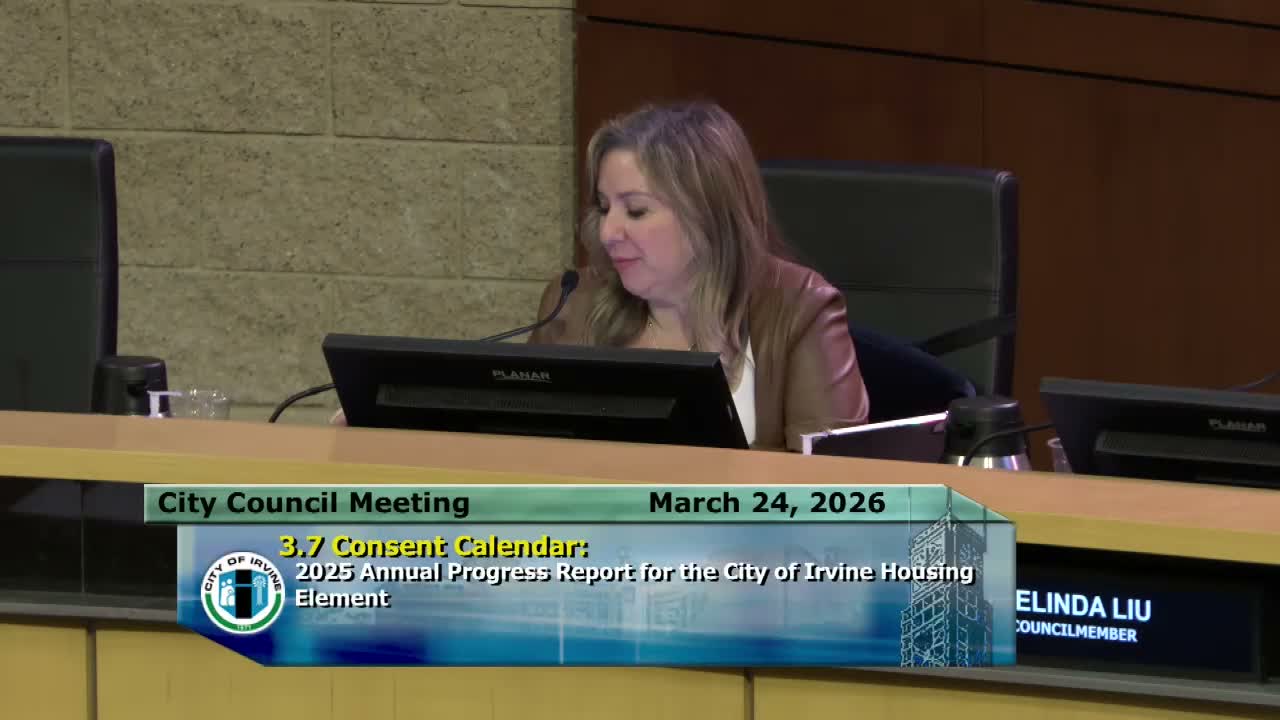
Council adopted the 2025 Housing Element Annual Progress Report (item 3.7) 7–0 after public comment urged prioritizing extremely low‑income units and specialized housing (including deaf‑community needs). Staff reported 5,517 affordable units on the books and a remaining RHNA of 23,610 for the sixth cycle.
The Irvine City Council unanimously adopted the 2025 Housing Element Annual Progress Report (item 3.7) at its March 24 meeting after a staff presentation and more than a dozen public comments highlighting gaps for the lowest‑income households.
A staff presenter summarized the city's current affordable housing inventory as 5,517 units across the usual state income categories and explained the regional housing needs allocation (RHNA) for the current (sixth) cycle totals 23,610 units; the presentation noted the city has not yet met its remaining allocation for the cycle. The presenter also explained that state categories for "extremely low" and "acutely low" units are expected to be incorporated in the next RHNA cycle.
Public commenters pressed council members to prioritize funding and programs for extremely low‑ and very low‑income households and raised an absence of specialized housing for deaf residents. "There are only two deaf housing properties in Los Angeles and none in Orange County," one speaker said, urging the city to consider dedicated deaf housing to prevent a pipeline from school to homelessness.
Mayor Egan and staff described ongoing local interventions, including a partnership with the Irvine Company to lease apartments for families identified through school homelessness lists under a short‑term grant model. The mayor said the program is designed to place families in Irvine Company units with households paying roughly 30% of income as rent for a limited period and noted the city will seek state recognition for creative programs that do not fit standard reporting boxes.
The council approved item 3.7 by roll call vote, 7–0. No ordinance or rezoning was enacted as part of the APR adoption; the report is a status update to satisfy state reporting requirements and to inform future policy discussions.