Consultant presents Fullerton Safe Streets plan: ~200 improvements packaged into 10 bids; May SS4A funding round looming
Loading...
Summary
Lochner consultant Carlos Velasquez presented a Safe Streets for All action plan that maps about 200 recommended safety projects and packages them into 10 implementable corridors; staff and commissioners discussed grant competitiveness, low survey response counts, and next steps toward council adoption and May grant deadlines.
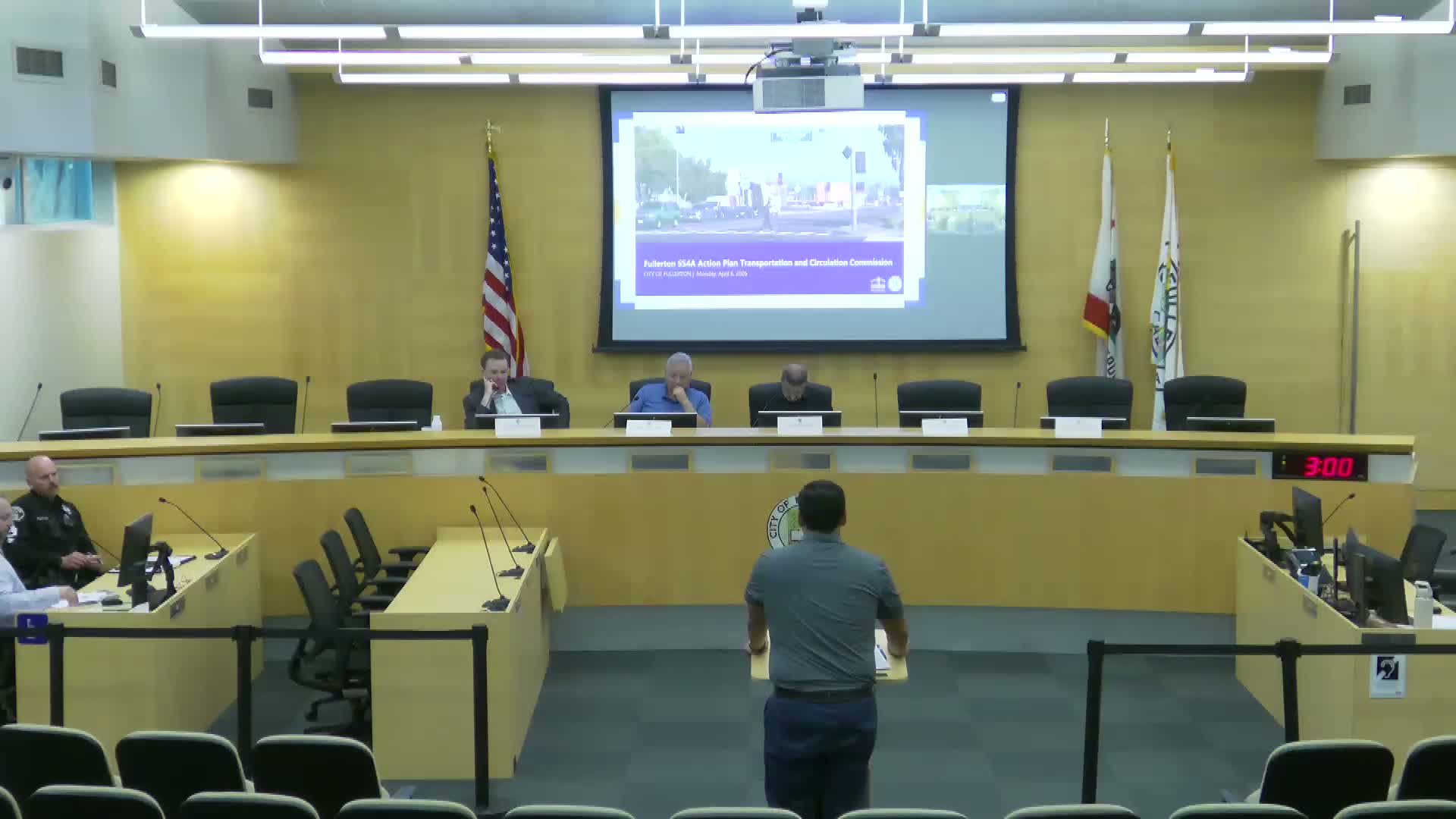
Carlos Velasquez, a principal and project manager for Lochner, presented the draft Safe Streets for All action plan to the Transportation & Circulation Commission on April 6, describing the plan’s goals, outreach, data basis and proposed countermeasures.
“We were contracted by the city of Fullerton to lead the development of the city's safety action plan,” Velasquez said. He described a five‑year project that combined collision data (a five‑year window), six in‑person engagement events, and two community surveys to identify hotspots and candidate countermeasures such as leading pedestrian intervals, retroreflective backplates, speed‑feedback signs, curb extensions, bicycle turn boxes and rectangular rapid flashing beacons (RRFBs).
Velasquez said the plan cataloged “well over, probably close to 200 projects” across the city and packaged those recommendations into 10 larger project bundles to improve grant competitiveness and implementation feasibility. He identified high‑priority corridors in southern Fullerton and candidate improvements near Cal State Fullerton, noting the consultant coordinated proposed changes with campus mobility staff.
Commissioners and the public asked about specific concerns. Resident Julie Rayburn said roundabouts near Woods and Wilshire have produced frequent honking and unsafe conditions for pedestrians, adding, “I don't feel safe, and it's right in front of my house.” Velasquez said roundabouts and traffic circles were reviewed but no new roundabouts were recommended in this plan; the city will study whether existing roundabouts are properly designed.
Commissioners pressed the consultant on grant timelines and competitiveness. Velasquez said the notice of funding for this round of SS4A implementation funds had just come out and that the deadline was in May; he advised the city could begin preparing applications now since the recommended treatments are unlikely to change. He also acknowledged the surveys’ low response rates — one survey had about 240 responses and a later one had about 15 — and said the plan relied primarily on mapped collision data combined with engagement and socioeconomic indicators.
On implementation and evaluation, Velasquez described standard “before and after” studies and referenced the state roadway safety manual’s crash‑reduction factors as the analytic basis for estimating safety benefits. Commissioners asked about maintenance costs for new devices; staff said maintenance is covered by existing traffic‑signal maintenance programs but noted some elements (solar arrays/batteries) may need periodic replacement.
Chairman Manceri said he would receive and file the presentation; staff noted the plan will be presented to council so the city can pursue grant funding and implementation.