Cave Creek staff present $80 million FY27 budget with $44 million CIP, debt plan for water and open‑space
Loading...
Summary
Town staff on Wednesday presented a preliminary fiscal 2027 budget that holds department FTEs steady, proposes roughly $80 million in appropriations and a $44 million capital improvement plan driven by $12 million for new water resources and a $16 million placeholder for a 4,000‑acre open‑space acquisition. Council pressed staff on utility subsidies, debt timing and contingencies.
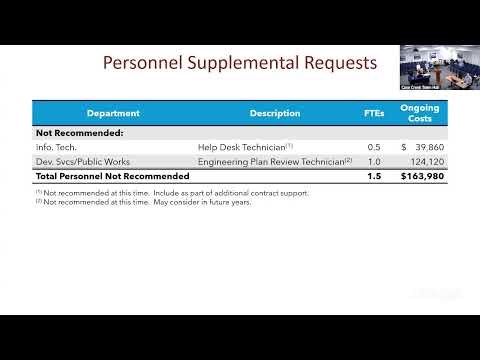
Staff opened the work session by outlining the goals and legal framework for the town budget, telling council that “no expenditure can be made for a purpose not authorized in the adopted budget,” and walking members through the budget book, supplemental requests and the five‑year capital improvement plan.
The preliminary FY27 proposal uses FY26 adopted amounts as the baseline and shows total resources available of about $85 million with estimated expenditures around $80 million, leaving an estimated ending fund balance of roughly $17.5 million. Staff said the proposed budget carries forward an estimated $38 million beginning balance into FY27 and includes approximately $30 million of other financing sources in FY26 (primarily debt proceeds).
The CIP is the largest single piece of the spending plan, at about $44 million. Staff said about $12 million of that amount is a placeholder for new water resources within the Cave Creek Water program and another $12 million is a placeholder tied to a proposed 4,000‑acre open‑space acquisition; the town also included a $6.2 million placeholder for a town‑hall remodel expansion.
On utility finances, staff reported that Cave Creek water revenues are projected to decline about 10 percent, Desert Hills water 8 percent and wastewater 1 percent. Because of debt service needs and planned projects, staff said the Cave Creek Water fund would require roughly $12 million of new debt financing and a $2.9 million general‑fund transfer to meet CIP and reserve requirements. “In order to accomplish what we have here in the fund … it requires $12,000,000 of debt financing,” the presenter said.
Staff presented two rate‑impact scenarios: a cumulative rate increase around 30 percent to cover planned projects, or about 48 percent to eliminate the general‑fund subsidy entirely. Council members pressed staff on debt timing, noting that several bonds roll off in mid‑2027 and could improve cash flow; staff recommended evaluating early payoff of specific WIFA loans if interest‑rate conditions make that advantageous.
On reserves and one‑time items, staff said the budget includes both an ongoing contingency and one‑time supplementals (including a $3 million grant contingency placeholder) and warned that utility subsidies and one‑time transfers would reduce the general‑fund balance in the near term. Staff also proposed splitting a $1 million streets‑catch‑up request 50/50 across FY27 and FY28 and recommended a consulting audit to identify CIP process savings and reduce scope‑change costs.
Council concluded the session by asking for more detailed departmental reviews the following day. A motion to adjourn the work session carried by voice vote with members saying “aye.”