Get Full Government Meeting Transcripts, Videos, & Alerts Forever!
Get email alerts on the Single Use Plastics topic
No spam. Unsubscribe anytime.
Irvine staff report wide business support for targeted Styrofoam ban, urge phased approach
Summary
City staff told the Irvine City Council a targeted ban on expanded polystyrene (Styrofoam) and plastic straw restrictions drew the strongest business support in a survey of 233 local food‑service operations; staff recommended phased implementation with procurement guidance and business assistance to reduce costs and operational impacts.
City staff presented results of a targeted outreach and survey that asked 233 Irvine brick‑and‑mortar food businesses about readiness to switch away from single‑use plastics.
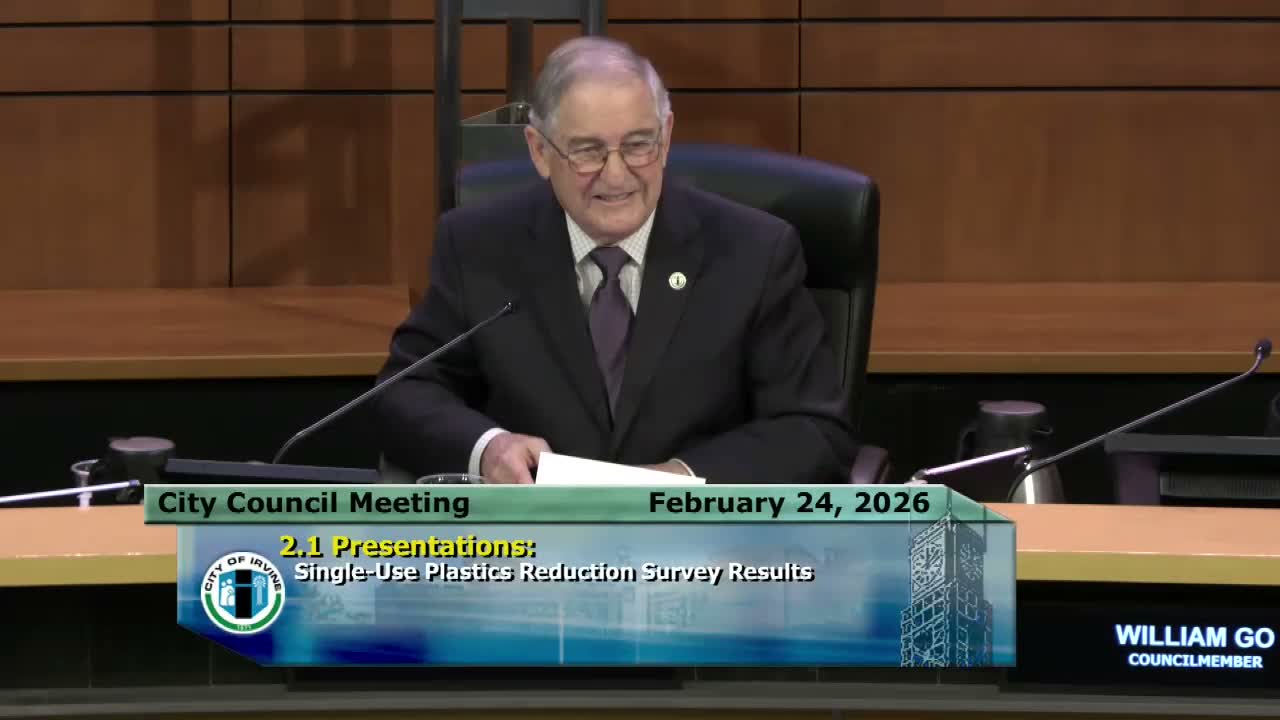
Ryan Tenney, the city's sustainability policy strategist, told the council the survey — done December 2024 through April 2025 by Environment Innovations Inc. — produced a 31% response rate among local food businesses and was offered in nine languages. Tenney said the strongest readiness signal was for a ban on expanded polystyrene (commonly called Styrofoam), where a majority of respondents supported a ban and current reported use was low. He said the survey found 56% support for a Styrofoam ban, 42% support for plastic straw restrictions (with some business concerns about performance and cost), and conditional interest in broader single‑use plastics restrictions that would require phased implementation and assistance.
Councilmember Trecedor, who requested the report, said the city spent public funds on the consultant and wanted residents and businesses to see the results. Trecedor asked the council to use the survey to inform future policy choices, not to act immediately. Tenney and colleagues Jocelyn Fritz and Sandrine Cassidy emphasized that successful adoption of any new requirement would depend on clear standards, transition timelines, procurement guidance, and financial or technical assistance to businesses.
Councilmembers asked staff about the cost differential between traditional disposables and compostable or reusable alternatives; Tenney said costs vary by product and quantity and that in some cases reusable systems can be cost‑competitive over the long term but often carry higher upfront costs for dishwashing infrastructure. Vice Mayor Mai asked how enforcement would work; staff said there is no enforcement policy in place and that other jurisdictions sometimes use code or health inspections to enforce such local rules, but that would require further research and legal review.
The presentation recommended advancing targeted measures (for example, a focused Styrofoam prohibition and straw restrictions) rather than an immediate, comprehensive ordinance. Staff advised pairing any regulation with procurement guidance and city support to address cost and operational impacts so businesses can transition more smoothly.
The council received several related public comments during the presentation and broader public comment periods — including both opposition to mandates and appeals to reduce plastic waste — and did not take immediate regulatory action on the presentation itself. Staff said they will continue outreach and return with options if the council wishes to proceed.