Get Full Government Meeting Transcripts, Videos, & Alerts Forever!
Get email alerts on the Mental Health Response topic
No spam. Unsubscribe anytime.
Residents press council for accountability and faster Tri City coordination after Tri City mobile‑crisis briefing
Summary
Tri City Mental Health presented details of its mobile crisis response to the Claremont City Council; in public comment, family members and residents demanded answers about why those services were not used in the November encounter that left Diego Rios dead and urged quicker formal coordination, dispatcher training and disciplinary transparency for involved officers.
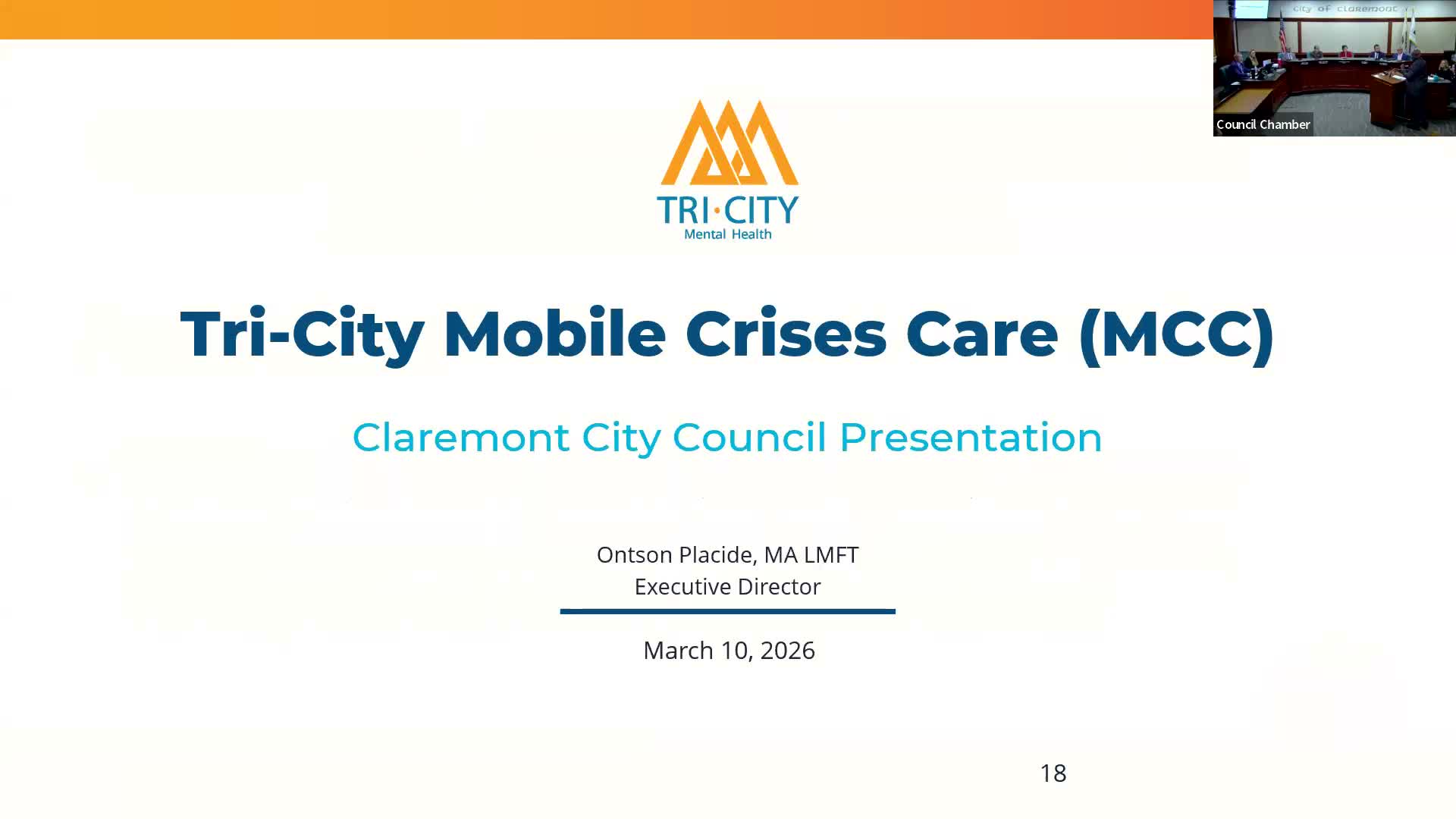
Claremont — Anson Placide, executive director of Tri City Mental Health, told the City Council on March 10 that Tri City’s mobile crisis care team has operated 24/7 since July 1, 2024, serving Pomona, La Verne and Claremont and responding to roughly 394 referrals in the current eight‑month reporting period. "We operate 24/7," Placide said, describing a core staff of seven that is supplemented by rotational clinical staff and a triage process that prioritizes safety before on‑site assessment.
The presentation, which described triage, assessment and care‑coordination practices, drew repeated public comment asking why Tri City was not contacted during the Nov. 28 encounter in which Claremont resident Diego Rios died. "If Claremont maintains crisis response partnerships for behavioral‑health emergencies, why were those services not requested when officers encountered someone clearly in distress?" Victor Rios, Diego’s brother, asked during public comment.
Several speakers cited the Los Angeles County medical examiner’s ruling that listed prone physical restraint as a contributing factor in Rios’s death. "The medical examiner reviewed that footage and ruled Diego's death a homicide," Victor Rios said during his three‑minute comment. Residents and students said they had learned from Placide’s presentation that Tri City had been available and that Claremont Police Department officers called Tri City nine times between July 2024 and February 2026.
Speakers pressed the council for immediate institutional changes: expedited memoranda of understanding (MOUs) to formalize referrals, changes to 911 dispatch options so callers are offered a mental‑health response, and clarity about whether officers involved remain on duty or have been disciplined. "Can CPD send out the 866 emergency number to their police officers today while we wait on the MOU?" one commenter asked. Several called for disciplinary transparency for officers Benjamin Alba and Joshua Arona, named in public comments and in the family's liability claim.
City Manager Adam Perry reiterated that two independent investigations are ongoing — by the Los Angeles County Sheriff’s Department and the LA County District Attorney’s Office — and that the City Council and Police Commission do not have jurisdiction over those investigations. He also said the City has received claims for damages from the Rios family and had not been served with a wrongful‑death complaint as of the meeting.
Placide said Tri City is formalizing MOUs with the three cities it serves to strengthen coordination and communication with police and dispatch. He described safety‑stabilization protocols that require police or health‑care providers to clear scenes when necessary before clinicians begin assessments, and urged continuing collaboration: "We want to make sure that that's not — we are going to continue to respond regardless of whether our MOU exists or not," he said.
Vice Mayor Rees and other council members asked technical questions about staffing, the triage tool and when police should be present for safety stabilization. Placide described the triage tool and said team deployments require at least two members for on‑site evaluation.
Multiple public commenters asked the council to expedite the MOU and to add Tri City’s mobile crisis unit as an option in the 911 dispatch menu; several asked when the council will require training so dispatchers routinely offer a mental‑health response option. The city did not announce a firm date for such an agenda item at the March 10 meeting.
The council did not take a formal vote on policy changes at the March 10 meeting. The most recent procedural updates are the staff presentation, the public demand for faster formal coordination, and the city’s statement that two outside investigations remain active.