Get Full Government Meeting Transcripts, Videos, & Alerts Forever!
Get email alerts on the Behavioral Health topic
No spam. Unsubscribe anytime.
County supervisor outlines Fullerton police behavioral-health clinician program, cites CalAIM street-medicine expansion
Summary
Orange County Supervisor presented the history and goals of Fullerton Police Department—s embedded behavioral-health clinician program, describing three aims (community services, public safety, officer well-being), staffing as city employees, licensing constraints, and pending CalAIM-backed "street medicine" funding that could expand nighttime response by year—nd.
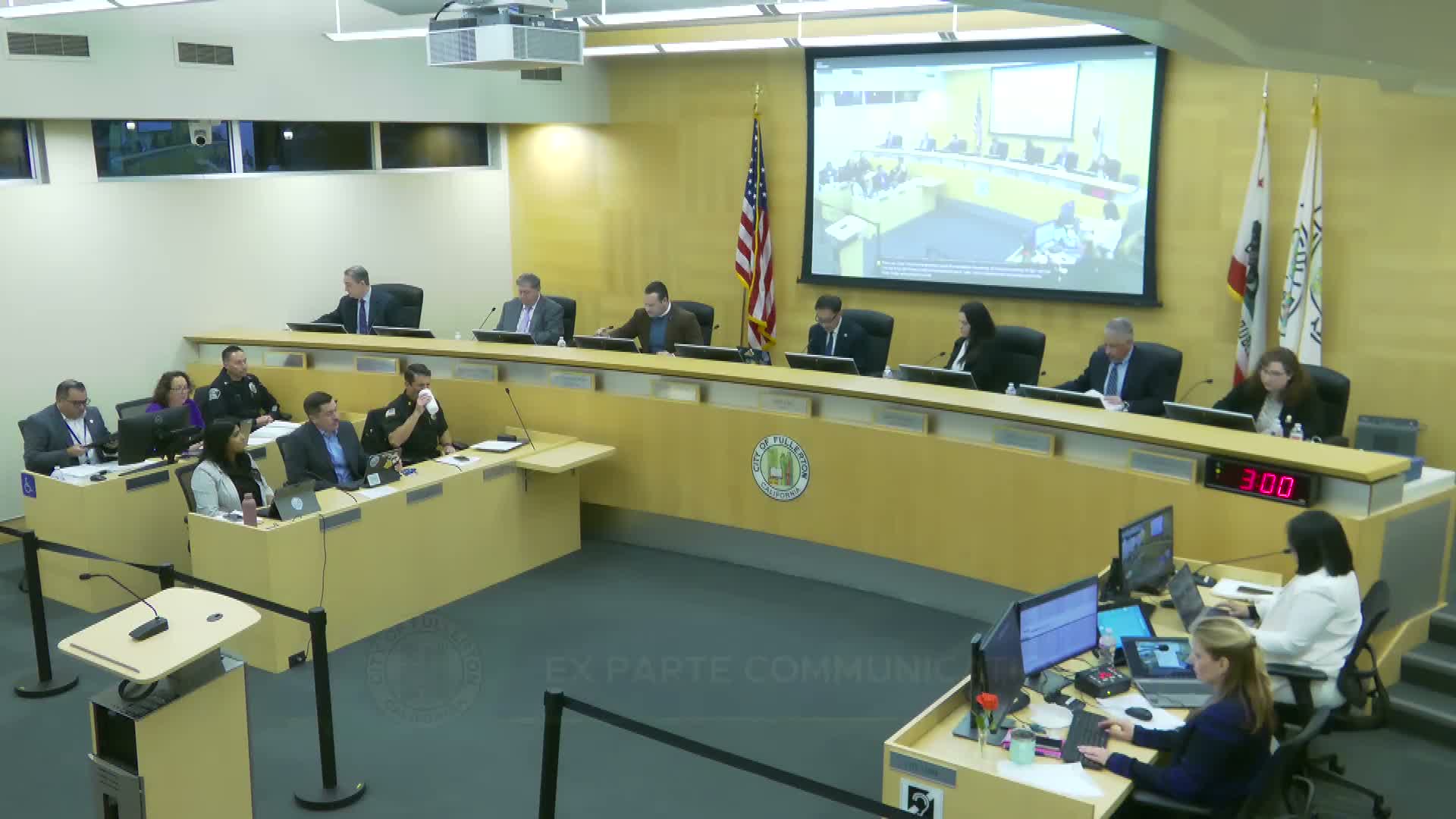
Supervisor Chaffee told the Fullerton City Council on Feb. 17 that the behavioral-health clinician program in the Fullerton Police Department began from a community-policing concept developed about a decade ago and has since become a model for embedding behavioral-health specialists directly within the department. He said the program has three primary goals: provide services that would not otherwise be available when police receive behavioral-health calls; improve public safety by keeping officers on patrol for core duties; and support officer well-being by giving staff specialists to handle complex social-service needs.
Chaffee said the clinicians are department employees (not contractors) working under special arrangements and licensing with the county to allow some crisis involuntary holds where necessary. He described program design decisions that reduced stigma (distinct uniforms and vehicles rather than squad cars), discussed the role of local university partnerships, and credited previous department leadership and local chiefs for supporting the initiative. He said initial program funding came from county resources and that the model has attracted statewide attention; he said the California State Association of Counties will be submitting the program for an award.
Chaffee acknowledged limits: behavioral specialists "don't actually provide the cure," he said, but they can refer people to services and coordinate care. He highlighted a remaining gap in nighttime response for people experiencing homelessness, noting that intake at shelters and hospital transport options are limited overnight. To address that, he said the county is pursuing a regional "street medicine" program funded by CalAIM that would front-load costs until the program becomes self-sustaining; Chaffee said he anticipates the program could be operating by the end of the year and that 12 North SPA cities are participating in the application.
Council members and staff followed with questions about expanding nighttime coverage and partnering with local institutions. Council members asked whether the county or the Supervisor—s office could help expand hours for homeless-liaison officers and whether Cal State Fullerton might provide master's-level interns to assist with program paperwork and learning opportunities. Chaffee said he expected the county-funded street-medicine effort to help mitigate the overnight gap and encouraged continued local support and clear public presentation of the program's role.
The mayor thanked Chaffee for the presentation; council members expressed appreciation and urged continued collaboration with the police department, local universities and county partners.
Ending: The presentation concluded with council and staff agreeing to continue exploring partnerships and to present future updates as county street-medicine planning advances.