Get Full Government Meeting Transcripts, Videos, & Alerts Forever!
Get email alerts on the Public Safety topic
No spam. Unsubscribe anytime.
Irvine police report declines in property and violent crime, outline technology and ICARE crisis response
Summary
Police Chief Michael Kent told council violent crime fell 5% and property crime dropped 16% in 2025 vs. 2024; he described expanded technology use (license-plate readers and drones), new enforcement units and ICARE alternative response handling nearly 3,500 calls in 2025.
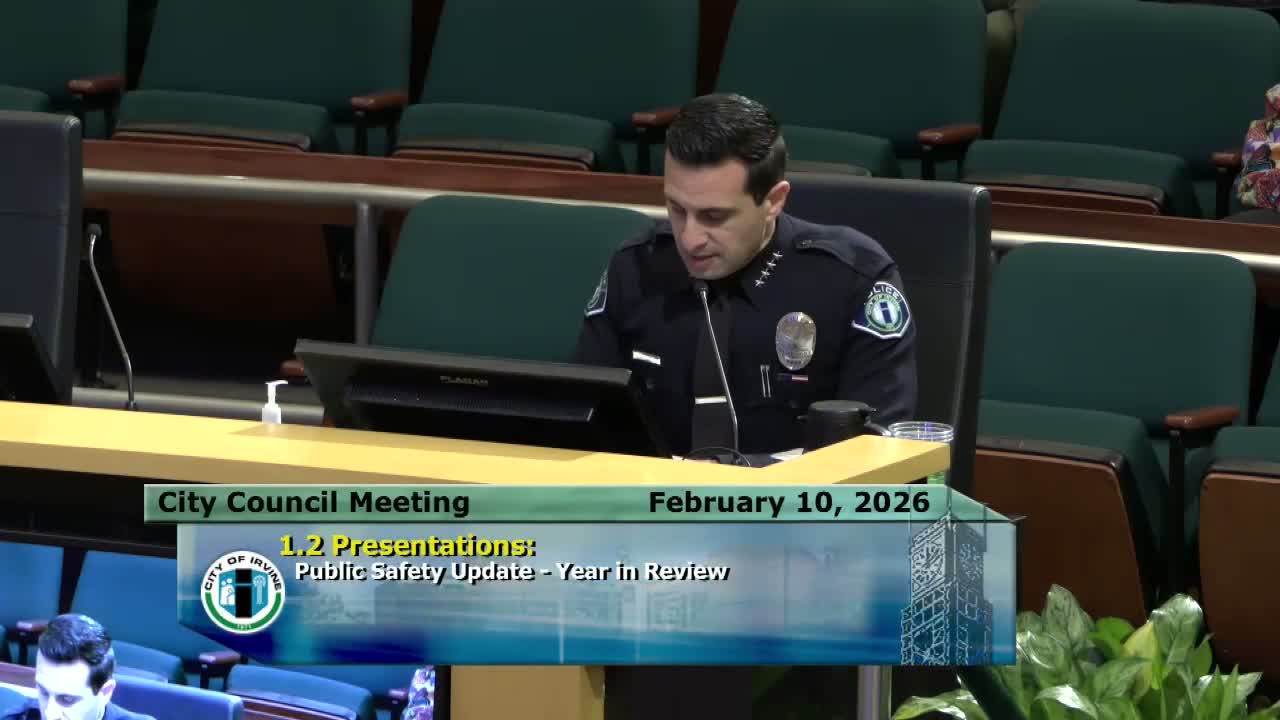
Chief Michael Kent delivered the Irvine Police Department’s year-end report, telling the council the department’s strategy of targeted enforcement, specialized units and crisis-response partnerships produced declines in several crime categories in 2025.
Kent reported a 5% decrease in violent crime and a 16% decline in property crime compared with 2024; he said reductions were notable in robberies, residential and commercial burglaries, and auto thefts, while acknowledging increases in aggravated assaults and shoplifting. Kent said many aggravated-assault incidents were domestic or acquaintance disputes.
Kent described the department’s structure and specialized units, including a Scribe Impact Unit focused on property crime and a Special Investigations Unit handling narcotics and multi-jurisdictional operations. He said SIU seizures included more than 24,000 pounds of narcotics, recovery of more than 20 firearms and approximately $300,000 in U.S. currency pending forfeiture.
The chief highlighted technology investments: a real-time crime center that integrates cameras and license-plate readers, and a drone-first responder program that provides rapid aerial intelligence. Kent said the department has ‘‘30-something’’ drones of varying sizes for operations ranging from attic searches to citywide responses and that operations comply with FAA rules and department policy.
Kent also described ICARE (Irvine Community Alternative Response and Engagement), a clinician-based alternative-response program handling nearly 3,500 calls in 2025 to provide mental-health-focused interventions without an officer in many cases. Councilmembers praised outreach programs and asked about drone policy, license-plate-reader data sharing and coordination with federal immigration enforcement; Kent said the department does not coordinate enforcement with ICE or CBP and asserted that by law officers cannot share immigration-specific data with those agencies.
The chief offered the department for follow-up questions and said staff will be available as council and community members raise operational questions.